


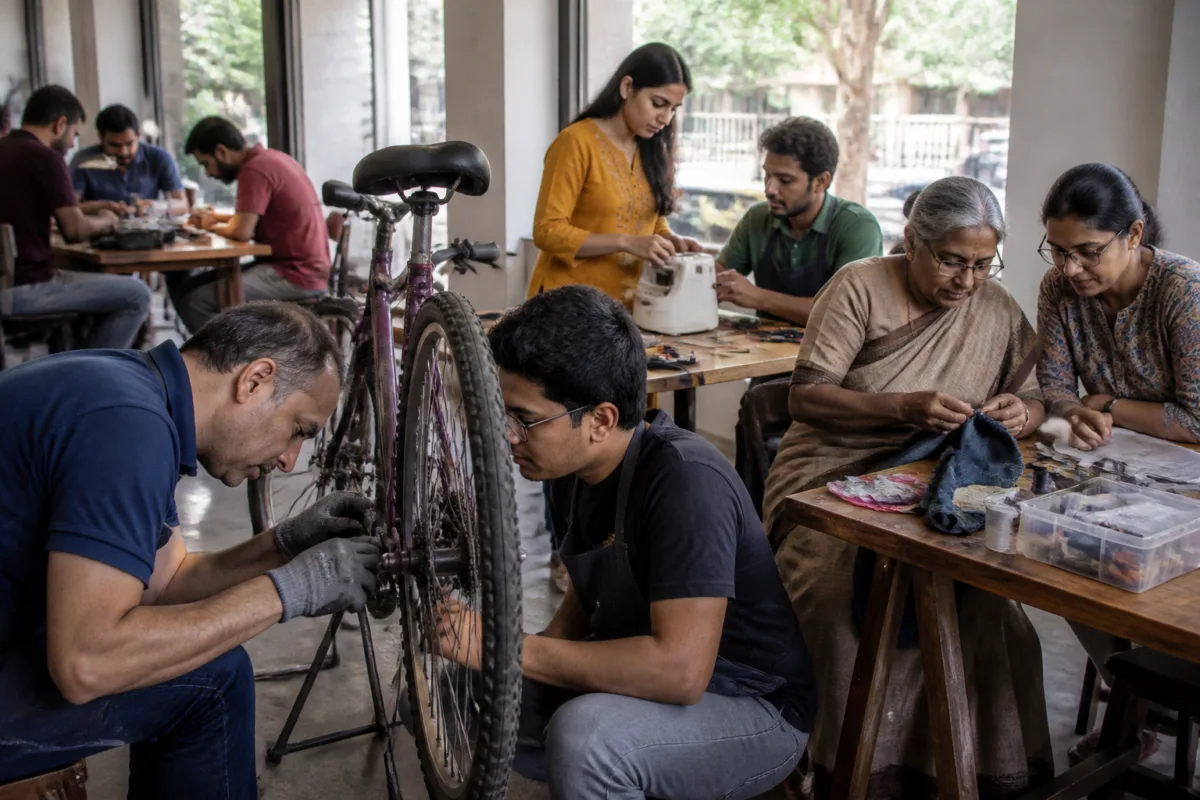
Repair cafés are small community spaces, but their ambition is larger than fixing a broken appliance or returning a bicycle to the road. Across India, these initiatives are testing whether cities can reduce waste and preserve practical skills by making repair more visible, accessible and participatory. Their work points to a neglected part of urban sustainability: what happens to products after households stop using them, and whether communities have the knowledge and services needed to keep them in circulation.
The Repair Café Collective India has emerged from this question. The initiative began as Repair Café Bengaluru in 2015 and has since developed into a wider network involving volunteers, professional repairers, educators, makers and local communities. Founder Purna Sarkar and co-founder Himadri Das of Repair Café Bengaluru, along with Babajan Sajjan, founder of Pune-based Erepair, are associated with efforts to expand access to repair knowledge and connect residents with the people who can maintain everyday objects.
The model is deliberately different from a conventional repair shop. Residents bring broken household items to shared workshops and work alongside volunteers or professional repairers to understand what has gone wrong and whether a solution is possible. Depending on the event, the objects may include electronics, clothing, bicycles and other commonly used products. The purpose is not simply to return an item in working condition. It is also to help participants understand how objects function and what maintenance may be possible before an item is discarded.
That distinction matters in cities where convenience, product turnover and limited time often make replacement appear easier than repair. The supplied report does not establish that every product can or should be repaired. Some items require specialised expertise, while others may be unsafe or uneconomical to fix. But the collective’s approach creates a decision-making step between failure and disposal. It asks households to assess an object’s remaining value instead of treating a breakdown as the end of its useful life.
Repair therefore sits at the intersection of household economics and municipal waste management. When a product remains in use for longer, the household may postpone a replacement purchase and the discarded item may be kept out of the waste stream for a period. The effect of one repaired appliance or bicycle is limited. The urban significance comes from repetition: many residents making similar decisions, supported by accessible skills and local services.
Repair Café Bengaluru’s reported activity offers an indication of that potential. Earlier reporting documented that around 40 pop-up events had helped keep more than 4,500 kilograms of material out of landfills by 2019. The initiative had organised more than 50 repair workshops by 2023, according to figures cited in the report. These numbers are specific to the initiative’s reported activities and should not be treated as a measure of India’s wider repair economy. They nevertheless show how community workshops can connect an individual act of maintenance with a measurable waste-reduction outcome.
The locations used for these activities are also important. Workshops have been held in schools, cafés, garages, parks and other shared spaces, relying substantially on volunteers. This suggests that repair infrastructure does not always require a new, dedicated building. Existing neighbourhood spaces can become temporary points where residents, skilled workers and learners meet. The model is therefore flexible, although its reach depends on volunteer participation, access to tools, the availability of experienced repairers and the ability to make events discoverable to residents.
The challenge is not that India lacks repair skills. The country has a long-established network of neighbourhood electricians, tailors, cobblers, bicycle mechanics, appliance technicians and other specialists. These workers already perform the practical maintenance that keeps homes, businesses and streets functioning. The problem identified by the collective is partly one of visibility and connection: residents may not know which repairer can handle a particular problem, while skilled professionals may remain disconnected from newer community and educational initiatives.
Repair mapping and community networks address this gap. The collective’s activities include repair walks, mapping initiatives, online troubleshooting groups, training programmes and workshops that bring professionals, volunteers and learners together. These activities treat repair as an urban service ecosystem rather than an isolated transaction. A repair map can make local capacity more visible; a workshop can transfer knowledge; and an online group can help a resident determine whether a problem requires professional attention.
This has implications for livelihoods as well as waste. Extending product life can support the people whose income depends on maintaining and restoring everyday goods. It can also preserve skills that are often undervalued because they are associated with informal or small-scale work. The report does not provide data on the income generated or jobs created through the collective’s activities, so the economic impact cannot be quantified from the available material. The connection is nevertheless clear at the level of function: a city that continues to use local repair services creates more space for maintenance-based livelihoods than one organised entirely around replacement.
The educational dimension adds another layer. Through TinkerKinder, the collective introduces children to repair, maintenance, tinkering and practical problem-solving. Participants are encouraged to use tools, explore how everyday objects work and approach faults as questions to investigate. This is significant because repair culture is not sustained only through waste policies or consumer messaging. It also depends on whether people develop confidence in handling objects and recognising when skilled help is needed.
Children’s programmes can make that knowledge more ordinary. A broken object becomes an opportunity to examine, test and learn rather than an item that is automatically considered useless. The initiative’s educational approach does not suggest that children should undertake unsafe repairs or replace professional technicians. Instead, it presents maintenance as a form of practical learning and helps establish the idea that products require care throughout their useful lives.
The network’s expansion beyond Bengaluru shows how the model can be adapted to different urban contexts. Repair-related activities have been associated with cities including Hyderabad, Mumbai and Chennai, while the collective’s public resources highlight communities and activities in Ahmedabad, Delhi and Pune. The range of cities matters because repair needs are shaped by local economies, housing patterns, transport choices and access to services. An electronics-focused workshop may be relevant in one neighbourhood, while bicycle repair, clothing mending or household maintenance may be more useful in another.
This decentralised structure also distinguishes repair cafés from a single central facility. Community initiatives can use existing spaces, work with local professionals and organise activities around the objects that residents actually bring. That flexibility may make the model easier to reproduce, but it can also make outcomes uneven. The supplied material does not establish a common national standard for workshop quality, safety, reporting or material recovery. Nor does it show how many residents are reached across the wider network. Those gaps matter if community repair is to be assessed as part of a city’s formal sustainability strategy.
Municipal waste systems typically become visible to residents at the point of collection, segregation or disposal. Repair operates earlier in that chain. It attempts to prevent an item from becoming waste in the first place. That places repair close to the principles of reuse, maintenance and resource conservation, even when the activity is organised by civil society rather than a municipal agency. The collective’s work therefore raises an institutional question: whether cities should recognise repair networks as contributors to waste reduction and local resilience, rather than treating them only as informal consumer services.
The report does not describe a government funding model, municipal partnership or formal policy framework supporting the collective. It also does not provide city-level waste data that would allow the impact of repair cafés to be compared with other waste-reduction measures. What it does establish is a community-led model built around workshops, mapping, training and collaboration. Its current strength lies in making repair knowledge visible and creating opportunities for residents to participate.
For policymakers, the key issue is not simply how many objects are repaired at an event. It is whether urban systems make repair a realistic choice. That depends on several conditions reflected in the collective’s work: residents must be able to locate skilled professionals; repairers must have opportunities to share knowledge; children and adults must be exposed to basic maintenance; and community spaces must be available for practical learning. Without these connections, the responsibility for repair remains with individual households, even when the benefits of reduced waste extend to the wider city.
The figures cited for Repair Café Bengaluru show both the promise and the limits of the model. Keeping more than 4,500 kilograms of material out of landfills through around 40 pop-up events is a tangible result. More than 50 workshops by 2023 indicate continuity beyond a single campaign. But these figures do not establish the total quantity of waste avoided across India, the durability of repaired products or the cost comparison between repair and replacement. Those questions require consistent measurement that is not supplied in the report.
What can be established is that repair cafés are addressing an urban problem at the point where consumption becomes disposal. They are combining environmental awareness with practical education and local livelihood connections. Their work also challenges the assumption that sustainability must always be delivered through large infrastructure projects or expensive technology. In this case, the relevant infrastructure can include tools, skills, shared spaces, trusted information and relationships between residents and repair professionals.
The larger urban question is whether cities can build a culture in which maintenance is treated as a normal part of everyday life. Repair cafés cannot resolve product design limitations, the absence of spare parts or every weakness in municipal waste systems. They cannot make every repair safe, affordable or technically possible. But they can make the option visible, preserve knowledge and create a bridge between households, local workers and waste-reduction goals.
The evidence supplied on Repair Café Collective India confirms a growing community-led effort that began in Bengaluru and now connects activities across several Indian cities. It also documents reported workshop activity, a landfill diversion figure and programmes aimed at children and professional repairers. What remains unclear is the network’s current scale, its long-term funding and the extent to which municipalities formally recognise its contribution. Those are the next questions for anyone assessing whether India’s repair movement can move from scattered community activity to a durable part of urban sustainability.

