


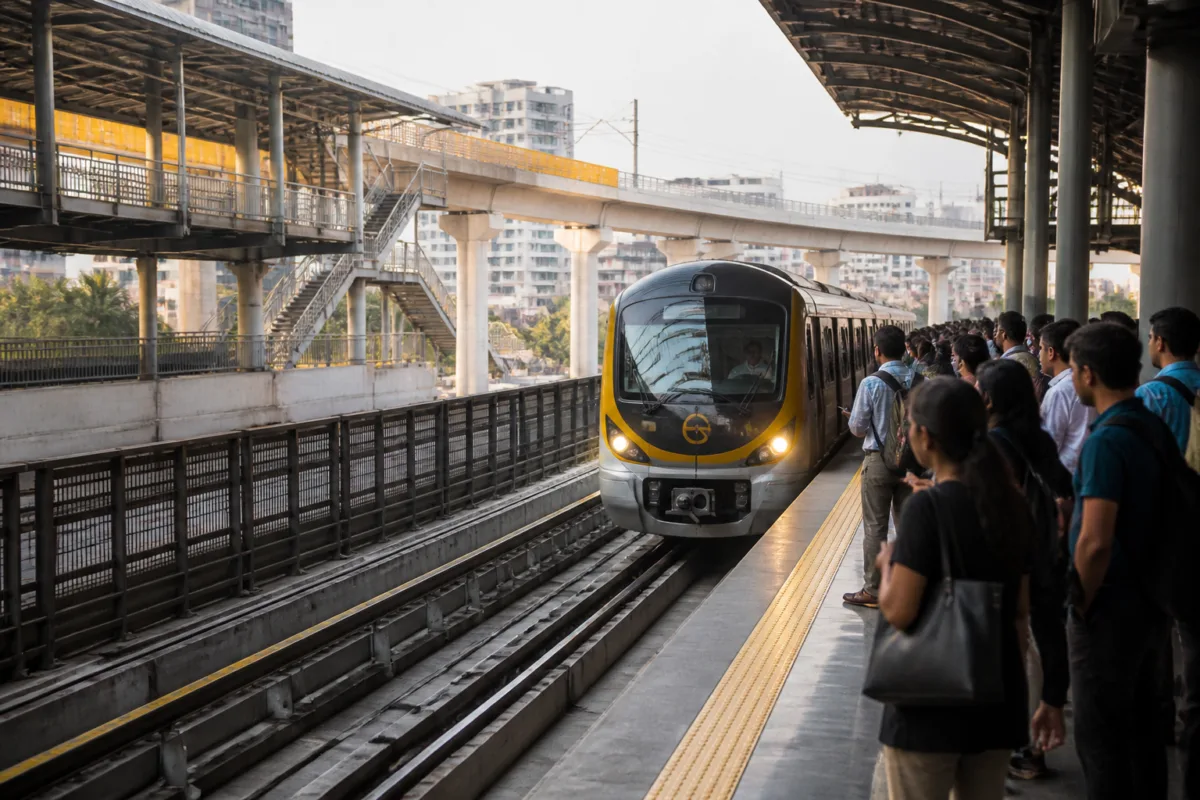
Bengaluru Metro’s daily ridership has remained below the passenger volumes projected in its detailed project reports, according to findings cited from the Comptroller and Auditor General (CAG) in a report by Vijay Karnataka. The gap is not only a question of how many trains run each day. It also shows how incomplete corridors, limited train capacity and weak last-mile access can reduce the value of a rapidly expanding urban rail network.
The Namma Metro system currently carries an average of about 10.50 lakh passengers a day, according to the report. The government and Bangalore Metro Rail Corporation Limited (BMRCL) had expected ridership to rise to 12.5 lakh after the opening of the Yellow Line, which connects RV Road with Bommasandra. However, the highest daily count reported after the corridor opened was 11.45 lakh on September 9.
That difference is significant because metro projects are planned around expected passenger demand, not merely around the physical completion of tracks and stations. When actual usage remains below the projections in a detailed project report, the consequences extend to fare revenue, operating assumptions and the justification for future extensions. The CAG findings cited by the report indicate that this has not been a one-off shortfall: BMRCL’s actual passenger numbers have remained below the projections in its detailed project reports for five years.
The evidence points to a network that is attracting large crowds on specific days and during peak periods, but has not yet converted that demand into the sustained daily volumes anticipated in its planning documents. Trains were reported to be heavily crowded on festival holidays such as Ganesh Chaturthi and Navratri, while regular peak-hour congestion is also visible. But crowding at selected times does not automatically mean that the network is meeting its overall demand forecast.
That distinction matters for a city such as Bengaluru, where metro use depends heavily on the completeness of the network and the ease of reaching stations. A passenger may find the train efficient for the main part of a journey but still avoid it if getting to the station or travelling from the destination station is inconvenient, costly or unreliable. The report identifies last-mile connectivity as a central reason for the ridership gap across the metro system.
The Yellow Line illustrates the problem. Although its opening was expected to increase daily ridership to 12.5 lakh, the reported peak remained below that level. The source report attributes part of the shortfall to a shortage of trains on the corridor. This means that the infrastructure may be available, but the service frequency and carrying capacity required to turn that infrastructure into a high-volume public transport option may not yet be fully in place.
The challenge is compounded by the way Bengaluru’s next metro corridors are being brought into service. The Pink Line’s elevated section has completed testing by the Commissioner of Metro Rail Safety, but commercial operations had not received permission at the time of the report. Work on the Blue Line, which was expected to be completed last year according to the report, was still continuing. Both projects are being opened in stages.
A staged opening can make portions of a corridor available earlier, but it can also delay the network effects that planners expect from a connected system. The usefulness of a metro line is not determined only by the number of kilometres opened. It depends on whether the new section connects major residential areas, employment centres, interchange points and other modes of transport in a way that creates complete journeys. Until those links are operational, the passenger gains expected from the full project may not appear.
The CAG figures cited in the report provide a longer view of the issue. In 2021, peak-hour passenger traffic on the first phase of Bengaluru Metro was reported to have ranged from 6,429 to 8,852 passengers, against a metro planning benchmark of 15,000. The figures show a wide gap between the usage assumed in planning and the demand being recorded in operation. The report also links lower-than-expected ridership to an impact on metro revenue.
These numbers should not be read as evidence that Bengaluru lacks demand for public transport. The crowded trains during peak periods and the rise in overall daily ridership after network expansion indicate that people do use the system when it offers a practical journey. The more specific issue is whether the metro is accessible, frequent and connected enough throughout the day and across the city to become the default option for a larger share of trips.
This is where last-mile connectivity becomes an institutional issue rather than a minor passenger convenience. Metro construction is largely handled through a major infrastructure agency, but a complete journey also depends on feeder buses, roads, walking routes, intermediate public transport, station access and coordination between agencies. If those links are weak, the investment in the mainline system does not translate fully into passenger demand.
The source report cites transport expert Prakash Mandoth of the Bengaluru Metro Rail and Suburban Commuter Association, who said the government should address last-mile access, the delay to the airport metro and the failure to open completed corridors. He also suggested extending metro operating hours and providing feeder bus services to support late-night travel.
At present, metro services stop at 11.30 pm, according to the report. Mandoth suggested that Bengaluru consider a service pattern in which operations begin earlier and are withdrawn in stages after midnight, similar to arrangements in some other metro systems. Such a change would require operating and financial decisions that are not established in the supplied report, but the proposal identifies an important limitation: a system designed mainly around conventional peak hours may not serve all the journeys that a large and dispersed city generates.
Capacity planning is another part of the discussion. The report cites a recommendation that future metro lines should be designed for trains with eight or nine coaches, rather than six, along with platforms capable of accommodating them. The argument is that a longer train can increase capacity on a corridor where passenger demand is already strong. But coach length alone cannot resolve a ridership gap if services are infrequent, stations are difficult to reach or the corridor does not connect to the destinations passengers need.
Bengaluru’s metro planning therefore involves two separate but connected calculations. The first is infrastructure capacity: how many kilometres, stations, trains and coaches the system can provide. The second is usable accessibility: how easily residents can reach the network, transfer between lines and complete their journeys. The CAG findings cited in the report suggest that the first calculation has not yet translated into the passenger volumes assumed in the planning documents.
The timing of the next openings will be important because the city’s expected ridership growth is tied to the completion of Phase 2 projects. The report states that daily passenger numbers should cross 15 lakh once the Phase 2 projects are open. That target will depend not only on when the Pink and Blue Line sections receive approvals and begin commercial operations, but also on whether train availability, feeder services and station access are ready at the same time.
The gap between projected and actual ridership also raises a question about how future metro projects are evaluated. A detailed project report is necessarily based on assumptions about population, employment, travel behaviour, competing modes and network completion. Once a corridor opens, the difference between those assumptions and actual passenger use becomes operational evidence. The CAG findings make that comparison visible and show why ridership forecasts need to be assessed alongside service quality and connectivity.
What the available evidence confirms is that Namma Metro has substantial passenger demand but has not reached the levels projected in its planning documents. The reasons identified in the report are interconnected: incomplete network expansion, delayed openings, limited trains on the Yellow Line, insufficient last-mile connectivity and operating hours that may not match all travel needs. The next test will be whether the completion and commercial opening of pending corridors, together with improvements in feeder access and capacity, can close that gap.

