


Rajasthan’s drought declaration for 80 tehsils across 14 districts is more than an administrative classification for the 2026 kharif season. It is a measure of how rainfall shortfalls, crop stress, declining reservoirs and intensive groundwater use are converging into a wider water-security problem. The immediate challenge is rural, but the consequences extend to the state’s settlements, livestock economy, public water supply systems and migration patterns.
The state government’s department of disaster management, relief and civil defence issued the notification on October 24, declaring 69 tehsils severely drought-affected and 11 moderately affected. The declaration will remain in force for six months and was made after an assessment under the Centre’s Drought Management Manual, 2016.
The notification creates an administrative basis for relief, but it does not itself deliver water, fodder, employment or income support. Those outcomes depend on how quickly the state and district administrations convert the classification into operational measures. The distinction is important because drought is not only a rainfall event. It is also a test of institutional capacity: whether authorities can identify affected areas, move resources, protect livestock and maintain basic services before distress deepens.
The geography of the declaration shows that the stress is not limited to one isolated pocket. Barmer and Jalore have the highest number of drought-hit tehsils, with nine each. Jodhpur and Dungarpur have seven each, while Jaisalmer and Phalodi have five each. Banswara and Balotra have three each. Churu, Beawar, Nagaur, Pali and Sirohi have one affected tehsil each. In Barmer, the listed areas include Gadra Road, Chauhtan, Barmer, Baytoo, Sedwa, Ramsar, Shiv, Dhanau and Barmer Rural.
This distribution matters because Rajasthan’s drought exposure is shaped by very different local conditions. Western districts face severe aridity and long distances between settlements, while other districts depend on agriculture and livestock under varying levels of rainfall reliability. A state-wide declaration therefore has to be implemented through district-level responses rather than a single uniform relief model.
The first pressure point is water storage. Reservoirs held around 8,014 million cubic metres of water on October 16, equivalent to 61.5% of total capacity. During the corresponding period a year earlier, reserves were around 11,794 million cubic metres, or 90.5% of capacity. The year-on-year reduction was about 3,780 million cubic metres. These figures indicate a substantially smaller buffer before the state enters a period of greater demand and continued uncertainty over water availability.
Reservoir levels do not capture the entire water system, but they provide an important indicator of the state’s ability to absorb a poor agricultural season. Lower reserves can increase dependence on groundwater, intensify competition between drinking-water needs and irrigation, and raise the cost of transporting water to settlements that cannot rely on nearby surface sources.
The groundwater figures make that pressure more structural. The Central Ground Water Board’s 2025 assessment classified 213 of Rajasthan’s 302 groundwater assessment units as overexploited. That represents 70.5% of the state’s assessment units. Another 23 were classified as critical. In practical terms, a drought year is therefore arriving in a system where much of the underground reserve is already under excessive pressure.
This creates a feedback loop. When rainfall is deficient and reservoirs decline, farmers and households depend more heavily on groundwater. Where extraction already exceeds sustainable levels, that additional dependence can worsen the underlying stress. The result is not simply less water in one season, but a reduction in the reliability of the resource on which agriculture, livestock and settlement depend.
The crop economy is the most immediate casualty. The government’s declaration cited deficient rainfall and adverse crop conditions. The report also records concerns over crop losses, shortages of water and fodder, and declining farm incomes. For households that combine crop cultivation with livestock rearing, the impact is cumulative: weaker harvests reduce income while fodder shortages increase the cost of keeping animals.
That is why fodder depots and livestock camps are central to the response rather than supplementary measures. In Barmer, district collector Chinmayi Gopal approved 10 fodder depots in the first phase through village service cooperative societies. The depots are intended to supply fodder to eligible livestock owners at subsidised rates on a no-profit, no-loss basis. Ground-truthing in Nokhra and Batadu tehsils had been completed, and proposals were submitted to the state government.
The Barmer response also indicates how drought relief moves through multiple administrative layers. The state issues the broader declaration, district officials assess local conditions and prepare proposals, and village-level cooperative institutions may participate in distribution. This chain can help tailor relief to local needs, but it also creates several points at which delays can occur: assessment, approval, funding, procurement and last-mile delivery.
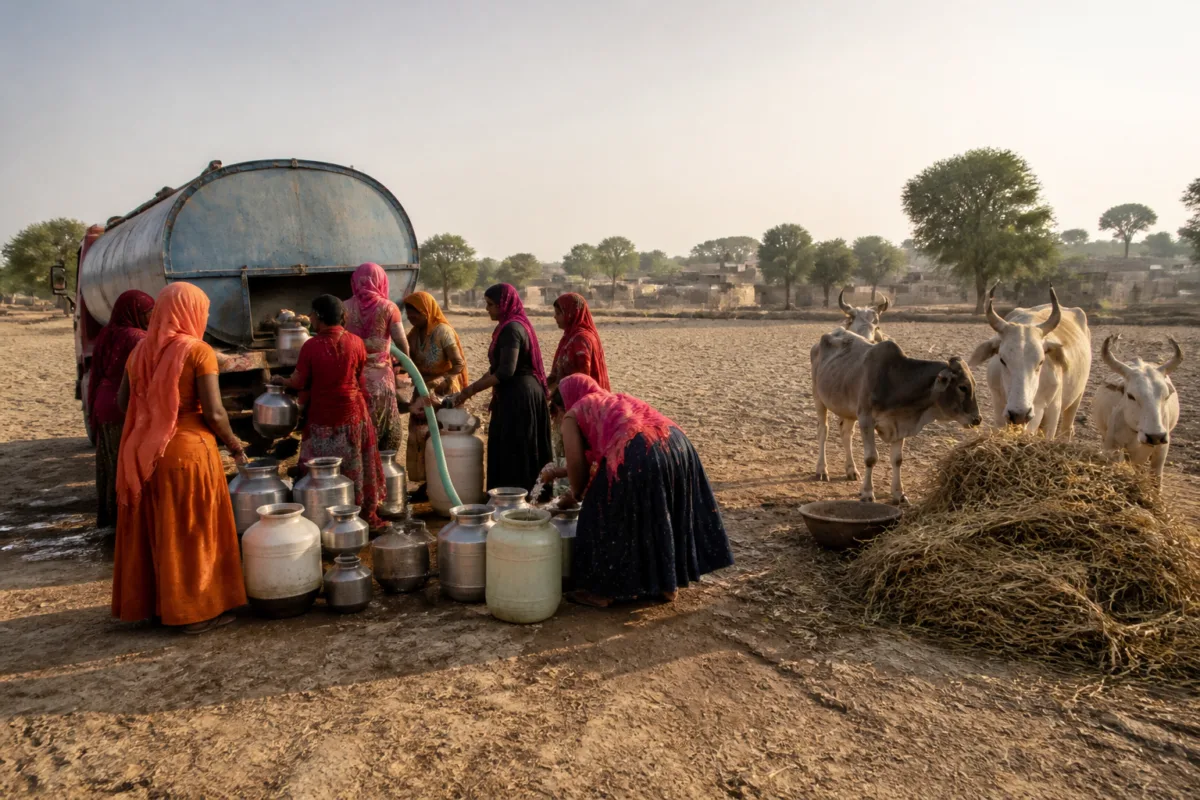
The district administration has also received approvals for fodder depots, livestock camps and transportation of drinking water in affected areas. These interventions address different dimensions of drought. Fodder protects livestock assets, camps provide a temporary support mechanism for animals and water transportation addresses the immediate needs of settlements that cannot access adequate local supplies. The effectiveness of the declaration will ultimately be judged by whether these measures reach households and livestock owners in time.
The six-month validity of the notification provides a formal window for relief, but the situation may not remain static. Government sources cited in the report described the current list as the first phase of the exercise and said more tehsils could be added if conditions worsen. Further assessments will determine whether the drought-hit area expands. This makes monitoring a continuing administrative responsibility rather than a one-time announcement.
The political context adds another layer to the timing. Former chief minister Ashok Gehlot had criticised the Bhajan Lal Sharma government over the delay in declaring drought-hit areas and had demanded early relief, including fodder depots, cattle camps and tanker-based drinking-water supply. Those political exchanges are part of the background, but the operational issue remains independent of them: affected households need assistance based on measurable conditions, regardless of when the notification is issued.
The declaration also raises questions about how drought is measured and governed. The use of the Drought Management Manual, 2016 provides a formal assessment framework. Yet the figures in the report show that the state’s vulnerability cannot be understood through rainfall or crop damage alone. Reservoir storage, groundwater classifications, livestock dependence, drinking-water access and the possibility of migration all shape the severity of the crisis.
Migration is particularly important because it connects rural drought to urban systems. The report notes that prolonged distress could force migration as crop losses mount and farm incomes fall. If that occurs, towns and cities may receive households seeking work, services and temporary accommodation. The pressure may appear first in informal labour markets and low-cost housing, while source villages face the loss of working-age residents and continued responsibility for livestock and vulnerable family members.
This does not mean that migration will necessarily occur at a particular scale. The supplied evidence establishes the risk, not its eventual magnitude. What it does show is that drought relief cannot be treated solely as an agricultural department concern. Drinking water, fodder, employment support, transport and local administration are connected parts of the response. Failures in one area can increase pressure on the others.
The reservoir and groundwater data also show why short-term tanker supply, while necessary in some locations, cannot resolve the larger problem by itself. Tankers can address immediate shortages, but the state’s wider water position is defined by the gap between available reserves and demand, as well as by the condition of groundwater units. The figures supplied in the report point to a system where emergency measures are being applied within a deeper and continuing resource constraint.
For cities and larger settlements, the lesson is equally direct. Urban water security is often discussed through municipal supply networks, treatment capacity and distribution losses, but those systems depend on the wider hydrological conditions of the state. A decline in reservoirs and groundwater availability can affect rural settlements first, yet eventually influence the cost, reliability and politics of water distribution across the urban-rural network.
Rajasthan’s latest drought declaration therefore confirms three layers of vulnerability. The first is seasonal, with deficient rainfall and adverse crop conditions affecting the 2026 kharif season. The second is infrastructural and administrative, involving reservoirs, drinking-water transport, fodder supply and district-level implementation. The third is structural, reflected in the high proportion of groundwater assessment units classified as overexploited or critical.
What remains to be established is whether the approved relief measures are delivered at the required scale and speed, whether additional tehsils are added after further assessment, and how effectively the state protects drinking-water access, livestock and household incomes during the six-month declaration period. Those developments will determine whether the notification becomes a functioning relief mechanism or remains primarily an administrative record of distress.

