


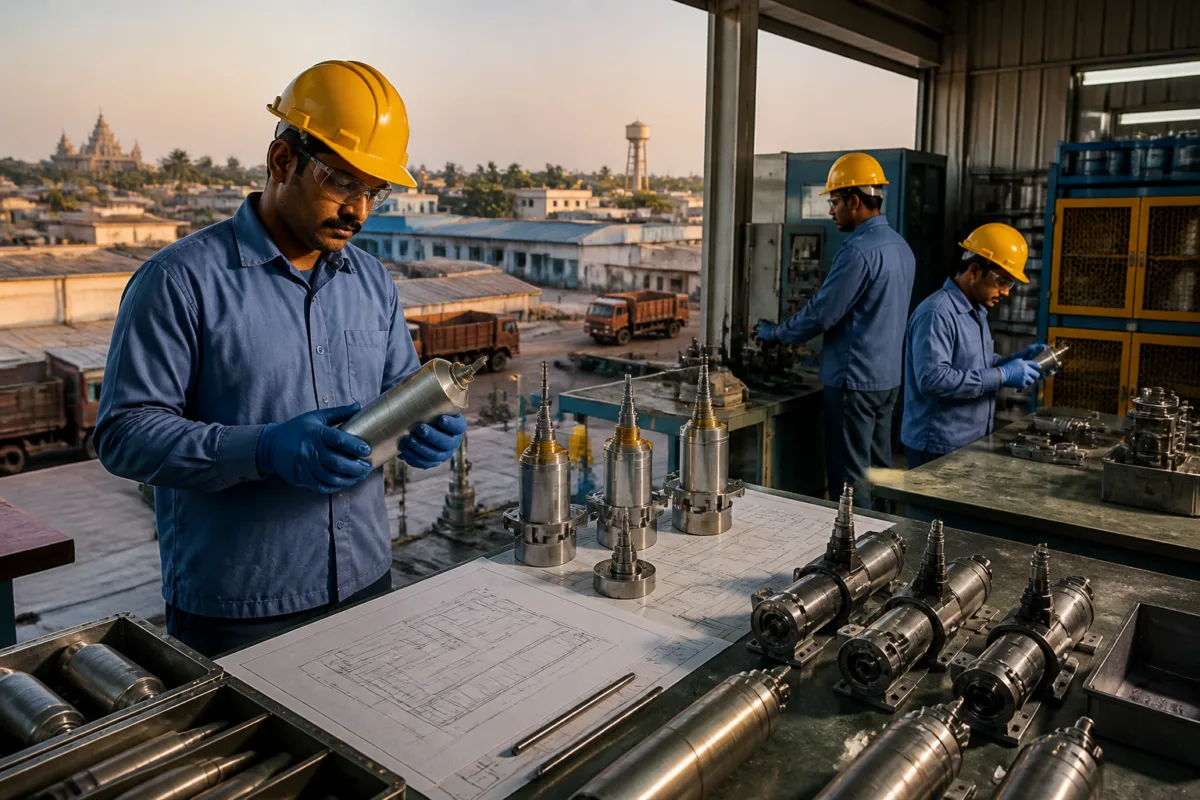
Sivakasi’s proposed move from fireworks into defence and space manufacturing is more than an industrial diversification plan. It is an attempt to convert a specialised local production ecosystem into a tightly regulated strategic supply chain, with the Tamil Nadu government exploring a decade-long pathway covering everything from emergency flares to rocket initiators and electronic fuzes.
The plan, reported by the Times of India, comes as Sivakasi’s firecracker manufacturers prepare for a strong Diwali season after what the report describes as positive legal developments. Yet the more consequential question for the town is whether its existing expertise in pyrotechnics can be adapted to products that operate under very different military, aerospace, chemical and safety standards.
The distinction matters because the proposed transition is not simply a matter of using existing factories to make new products. Fireworks manufacturing has given Sivakasi a concentration of skills in ignition, flares, smoke and related pyrotechnic processes. Defence and space production, however, requires qualification across multiple agencies, precision manufacturing, electronic systems, specialised materials and extended testing timelines. The report itself cautions that experience in fireworks does not automatically translate into military explosives.
That makes the proposed three-stage programme important. According to people aware of the development cited by the report, the first three years would focus on relatively accessible categories. These include flare and fog signals, marine distress flares, safety signalling devices, anti-bird airfield devices, training and simulation pyrotechnics, smoke generators, attention-creating devices and initial ignition components.
The second stage is expected to move towards more complex products, including infrared decoy flares, smoke grenades and candles, rocket igniters and delay elements. The third stage, planned over the longer term, could include complex electronic fuzes, propellant precursors for solid rocket motors, chaff and decoy consumables. Electronic fuzes are timed devices used in modern artillery and bombs, while rocket initiators are electrically fired igniters used in rockets and missiles.
This sequencing reveals the central logic of the proposal: Sivakasi would not be expected to leap directly from commercial fireworks to the most sensitive defence systems. It would begin with products that use related pyrotechnic knowledge but have lower technological and qualification barriers, then build towards more demanding components. Ganesan Panjurajan, president of the Tamil Nadu Fireworks and Amorces Manufacturers’ Association and a director at Vinayaga Sonny Fireworks group, said the industry had identified eight product categories for the initial stages. He also said discussions were continuing around more complex electronic fuzes.
The proposed Sivakasi Pyrotechnic Common Facility Centre is intended to provide the institutional and physical base for this transition. The Tamil Nadu government plans the facility on 35 acres, with the stated purpose of helping existing firecracker units improve safety and move towards defence and space supply. A common facility model could allow smaller manufacturers to access capabilities that individual firms may struggle to finance, although the report does not establish the centre’s final design, funding structure, ownership or delivery timeline.
The facility’s importance lies in the nature of Sivakasi’s industrial geography. The town’s manufacturing strength is distributed across a cluster of local units rather than concentrated in a single large defence contractor. A shared platform could support testing, training, safety improvements and technology development across that cluster. However, the report does not say that such capabilities are already operational, and the transition will depend on the government’s feasibility work and on partnerships with organisations that control defence and aerospace qualification pathways.
The institutional network being assembled is therefore as important as the product list. Discussions are taking place with IIT Madras, scientists from the Defence Research and Development Organisation and officials of the Directorate General of Quality Assurance, which operates under the Department of Defence Production. The South Indian Defence Suppliers and Startups Association has helped connect Sivakasi’s industry with DRDO scientists, IIT professors and Ministry of Defence officials. It is also preparing a feasibility report for the state government.
State industries minister S Keerthana said the Ministry of Defence’s indigenisation mandate had opened supply-chain opportunities for domestic micro, small and medium enterprises. She identified possible space-related products such as igniters, initiators, separation devices, flight-termination ordnance, signalling systems, range-safety pyrotechnics and energetic activation components. These are linked to launch, spaceport and range operations rather than only to weapons production.
That connection gives the proposal a regional infrastructure dimension. The Kulasekarapattinam spaceport in Tuticorin, described by the minister as roughly 100km south of the Sivakasi cluster, is expected to be a key catalyst. The report does not establish a procurement contract or confirmed supply arrangement between the spaceport and Sivakasi manufacturers. It does, however, show how the emergence of a nearby space facility is being incorporated into the state’s industrial planning for the cluster.
The opportunity is also being framed in export terms. Certain products, including signal and distress cartridges, could have markets in Southeast Asia and Africa, according to the report. Local units may also enter civilian subcontracting and component manufacturing for defence public-sector undertakings in areas where complex explosive licences are not required. This widens the potential transition beyond a narrow military market and could allow firms to begin with less regulated components while developing industrial capabilities.
But the regulatory barrier remains substantial. Palanikumar V, director of the South Indian Defence Suppliers and Startups Association, said entry-level defence pyrotechnics would require technology transfer from the DRDO’s High Energy Materials Research Laboratory. More complex strategic components would depend on direct partnerships with Bharat Electronics, L&T Defence and DRDO’s Defence Research and Development Laboratory, according to the state industries minister’s account in the report.
Palanikumar also described the shift as a long-term, high-barrier effort involving multi-agency licensing, heavy capital requirements and multi-year qualification timelines. His warning is central to understanding the proposal. In strategic manufacturing, the ability to produce a component is only one part of market entry. A supplier must also demonstrate repeatability, safety, traceability and performance under the standards set by the relevant defence or aerospace customer.
The industrial challenge is consequently one of capability conversion. Sivakasi’s existing strengths in flares, fuses, igniters and smoke may provide a starting base, but the proposed higher-end products require precision machining, electronics and materials science. The report identifies these requirements but does not provide estimates of investment, the number of participating firms, expected employment or the value of potential orders. Those details will be necessary to judge whether the plan can move beyond a strategic concept.
The safety dimension is equally significant. The state government’s proposed common facility is explicitly connected to improving safety in existing units. Any expansion into defence and space products would add new compliance requirements rather than remove existing ones. The report does not provide a consolidated safety framework for the proposed facility or explain how responsibilities would be divided among state authorities, defence agencies, quality-assurance bodies and individual manufacturers. Those institutional arrangements will determine how the cluster manages the risks of scaling up.
The proposal also reflects a broader change in the relationship between regional manufacturing clusters and national strategic programmes. The state government is attempting to position a traditional industrial centre within the defence indigenisation agenda and the emerging space economy. In this model, local firms do not need to become complete defence-system manufacturers. They can participate as specialised suppliers of subsystems, consumables and components, provided they can meet the technical and regulatory requirements of larger public and private integrators.
Air Marshal (Retd) M Matheswaran, president of the Peninsula Foundation and former deputy chief of integrated defence staff, said manufacturers should begin with simpler products before scaling up to complex systems. He also said the shift towards missiles, drones and long-range weapons would increase demand for pyrotechnics in the defence supply chain. His comments support the staged approach, but the report does not provide demand projections or confirmed procurement commitments.
For Sivakasi, the larger urban and economic question is whether a mature cluster can renew itself without abandoning the skills and firms that made it competitive. The proposed transition could create a path from seasonal, consumer-facing production towards year-round industrial supply, but that outcome is not yet established. The evidence currently supports a more limited conclusion: the government, industry bodies and technical institutions are designing a pathway, while the commercial and regulatory conditions for success remain to be demonstrated.
The next milestones are the feasibility report being prepared by the South Indian Defence Suppliers and Startups Association, the proposed development of the 35-acre common facility centre, and the progress of discussions with DRDO, IIT Madras, DGQA, defence companies and space-sector stakeholders. These will show whether Sivakasi’s defence and space ambition becomes a qualified supply-chain programme or remains an exploratory diversification plan.

