


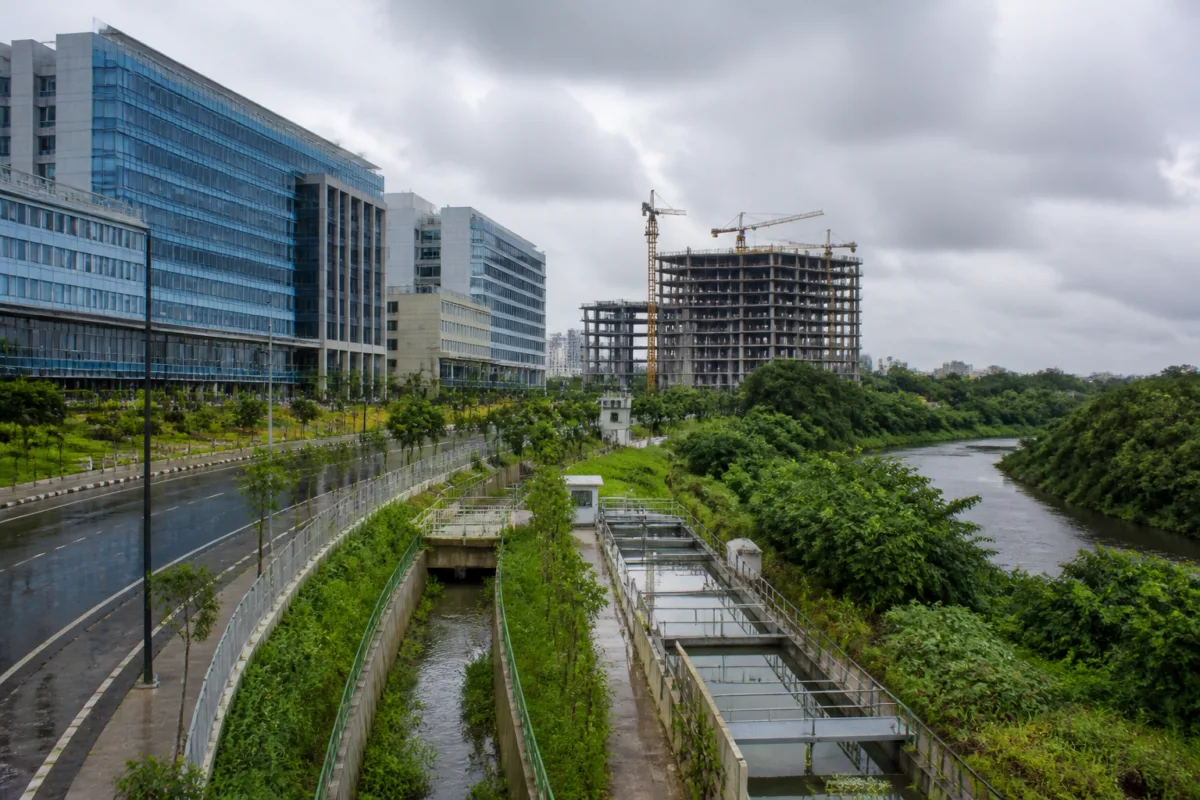
Technopark Phase III’s environmental clearance does more than unlock another expansion of Thiruvananthapuram’s technology district. It places the city’s next major office-building cycle inside a regulatory test: whether new commercial infrastructure can grow beside a river and a natural drainage system without transferring flood, water and waste risks to surrounding areas.
The State Level Environment Impact Assessment Authority, or SEIAA, has cleared the modified master plan for the Phase III campus at Attipra village in Thiruvananthapuram taluk. The proposal covers a planned built-up area of 8.19 lakh square metres and an estimated project cost of Rs 1,030 crore. The clearance is valid for 10 years and allows the development of additional IT buildings, subject to a detailed set of environmental conditions.
The reported scale is significant. The Phase III expansion is associated with a 94-acre campus, while the clearance covers 32.49 hectares. The report also states that the existing Phase III campus is spread across 90.02 acres and already includes the Ganga and Yamuna buildings and the Niagara complex. These figures refer to different descriptions of the project and its modified plan, but together indicate that the clearance concerns a substantial, already established technology district rather than an isolated building site.
The central issue is the relationship between built-up intensity and natural drainage. The project is close to the Thettiyar River, and the approval identifies flood mitigation and rainwater management as key conditions. Technopark must retain a three-to-four-metre buffer between the river and the project boundary wall and restore riparian vegetation across 0.5 hectares. It must also cooperate with any government proposal to widen the river, including work involving a downstream culvert reported to be only one metre wide.
That condition shows why environmental clearance is also an urban infrastructure decision. A large office campus increases the amount of roof, pavement and other impervious surface through which rainwater must be managed. The authority’s conditions do not treat the river as a peripheral feature of the project. They connect the campus boundary, downstream drainage capacity and future public works into one approval framework.
### Rainwater storage becomes a capacity question
The clearance requires a rainwater harvesting plan covering 5.41 acres, with storage capacity of 26,446 cubic metres. The plan is one of the most measurable safeguards attached to the project. Its effectiveness, however, will depend on how the storage system performs during intense rainfall, how quickly it can be emptied or reused, and how it connects with the surrounding drainage network. The supplied report does not provide details of the system’s operating design or performance criteria.
The project must also ensure that only filtered surface runoff is discharged into nearby natural drains or public sewer systems. Sewage must be treated before disposal, and treated water is to be reused or recycled to the maximum extent possible. These requirements place water circulation, rather than one-time disposal, at the centre of the campus’s operating model.
For the city, this is important because the environmental burden of office expansion is not limited to the construction phase. A technology campus generates recurring demand for water, sewage treatment, waste management, electricity and transport access. The approval covers both construction and operational monitoring, recognising that compliance must continue after buildings are occupied.
### The clearance links growth with green infrastructure
The authority has required afforestation across one hectare in common areas and another hectare within individual lessees’ plots. A green belt using suitable indigenous tree species must be maintained at a minimum rate of one tree for every 80 square metres. The project must also meet at least 20% of its energy requirements through solar power and provide common electric vehicle charging facilities.
These conditions establish a broad environmental checklist for the campus: river protection, flood mitigation, water storage, vegetation, renewable energy, mobility infrastructure, waste disposal and wastewater reuse. They also distribute responsibility between Technopark and individual lessees. The requirement for planting within lessees’ plots means that the environmental plan is not confined to common land managed by the campus authority.
The report does not state how much solar capacity has already been installed, how the 20% target will be calculated, or whether the target applies to annual energy consumption or installed capacity. Those details will matter when compliance is assessed. The clearance does, however, provide a defined threshold against which future reporting can be measured.
### Institutional oversight is built into the approval
The expansion proposal was considered by the State Expert Appraisal Committee before SEIAA approved it at its 164th meeting on April 25. The approval requires environmental monitoring during both construction and operation. SEIAA will conduct annual inspections, while half-yearly compliance reports containing environmental monitoring data must be uploaded to the designated portal and the project’s website.
This reporting structure is significant because large urban projects often move through different phases of construction, leasing and occupation. A condition recorded at the approval stage can lose practical force if monitoring is irregular or if responsibility becomes fragmented among the project authority, contractors and occupiers. Annual inspections and half-yearly public reporting are intended to create a continuing compliance trail.
The supplied report does not include the clearance document itself, the compliance-reporting format, inspection findings or details of penalties for non-compliance. It therefore establishes the obligations but not their implementation record. That distinction is important: an environmental clearance authorises development subject to conditions; it does not by itself demonstrate that every safeguard has already been delivered.
### Employment growth will increase pressure on the district
The expansion is being positioned as a platform for further IT investment. A senior Technopark official said receiving environmental clearance would bring more investments to Phase III and described the development as a potential gamechanger for the Internet of Things ecosystem. The report also states that new investments proposed or coming up in Phase II are expected to generate employment for more than 5,000 professionals.
Those employment and investment effects are part of the project’s urban significance. More office space can strengthen Thiruvananthapuram’s technology economy, but it also increases the need for reliable public infrastructure around the campus. The clearance directly addresses drainage, water, energy and waste, while the supplied material does not detail the project’s implications for roads, public transport, housing or other civic services.
That gap does not reduce the importance of the environmental conditions. It shows instead that environmental clearance is one part of a wider urban expansion process. The campus can meet its stated ecological obligations while the surrounding city still faces separate questions about access, congestion, worker housing and public-service capacity. Those issues are not resolved by the SEIAA approval and are not established in the supplied report.
Technopark Phase III therefore represents a test of whether institutional growth can be matched by environmental accountability. The clearance gives the project a path to expand, but it also creates specific obligations around the Thettiyar River, rainwater storage, vegetation, solar power, wastewater, solid waste and public reporting. The next measure of the project will be whether those conditions remain visible in construction and operations as the 10-year approval period progresses.

