


Bengaluru’s garbage collection crisis has intensified after waste-collection contractors indicated that many autos could stop reporting from October 26, while the Urban Development Department imposed the Essential Services Maintenance Act (ESMA) on waste management across the Greater Bengaluru region for one year from October 24.
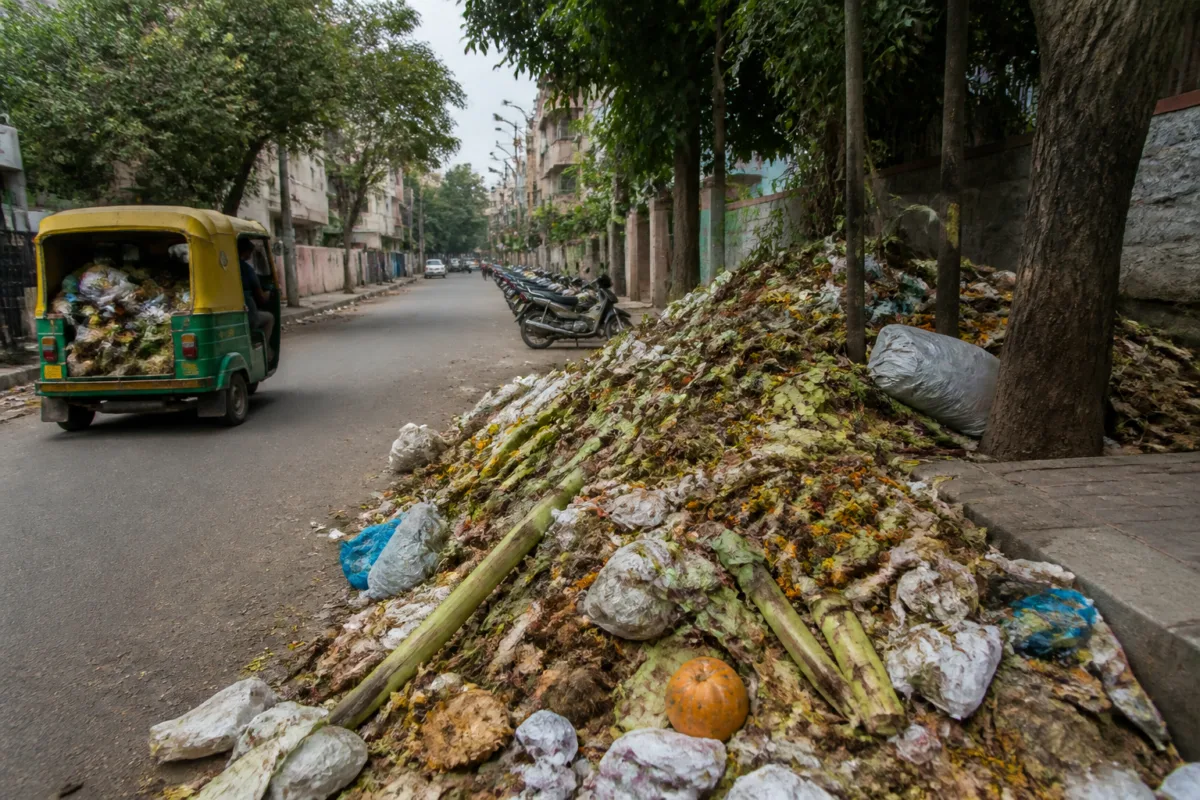
Waste from Ayudha Puja and Vijayadashami, including banana stems, pumpkins and flowers, remained uncleared on several roads and footpaths, according to a report by Prajavani. Garbage had also not been cleared in parts of KR Market and Avenue Road before and after Vijayadashami. Residential areas in Nayandahalli, Rajarajeshwarinagar, Pattangere and Kenchenahalli were among the locations where waste collection was reported to have been missed.
Supervisors involved in collection reportedly attributed the disruption to problems with autos. The report said a conflict between contractors and officials of the Bengaluru Solid Waste Management Limited (BSWML) had been continuing for several months and had now escalated. Contractors have decided to suspend disposal operations, raising the possibility of wider disruption to door-to-door collection and transportation.
The contractors’ association said its protest was not against the government but against what it described as the neglect of certain officials. Contractors said they had met the Bengaluru development minister and submitted representations seeking action, but had not received a resolution. They also said repeated approaches to the chief secretary, the additional chief secretary of the Urban Development Department and the BSWML managing director, who is also the chief commissioner of the Greater Bengaluru Authority, had not produced results.
A central dispute concerns the revision of workers’ wages. Contractors said the Labour Department revised wages from May 22, but that the revised rates had not been implemented. They said labour organisations, the Labour Department, the Employees’ Provident Fund authorities and the Employees’ State Insurance authorities had issued repeated notices. According to the contractors, failure to revise wages had increased their liability for ESI and EPF contributions, along with penalties and interest.
Contractors also said the diesel rate used for payments had not been revised since 2017-18. The rate fixed then was ₹66 per litre, while the current price cited by them was ₹98.80, creating a difference of ₹32.80 per litre. They said discussions with the Greater Bengaluru Authority chief commissioner had not resulted in a revision. Contractors further alleged that monthly bills required 25 to 30 days of follow-up before payment.
Prajavani reported that BSWML managing director and Greater Bengaluru Authority chief commissioner Maheshwar Rao did not respond when contacted for comment. The report did not include a response from the Urban Development Department to the contractors’ allegations.
The ESMA order treats waste management as an essential service under the Karnataka Essential Services Maintenance Act, 2013. It prohibits, for the next year, strikes by municipal workers, auto assistants, compactor loaders and drivers engaged directly or through suppliers and contractors in waste management across the Greater Bengaluru Authority, BSWML and the five Bengaluru city corporations: Central, North, South, East and West.
The order cites the Solid Waste Management Rules, 2016, which require civic bodies to carry out waste management, collection, segregation, transportation, processing and disposal within their jurisdictions. The immediate operational question is whether the ESMA order and administrative measures will prevent further accumulation while the disputes over wages, fuel reimbursements and contractor payments remain unresolved.

