


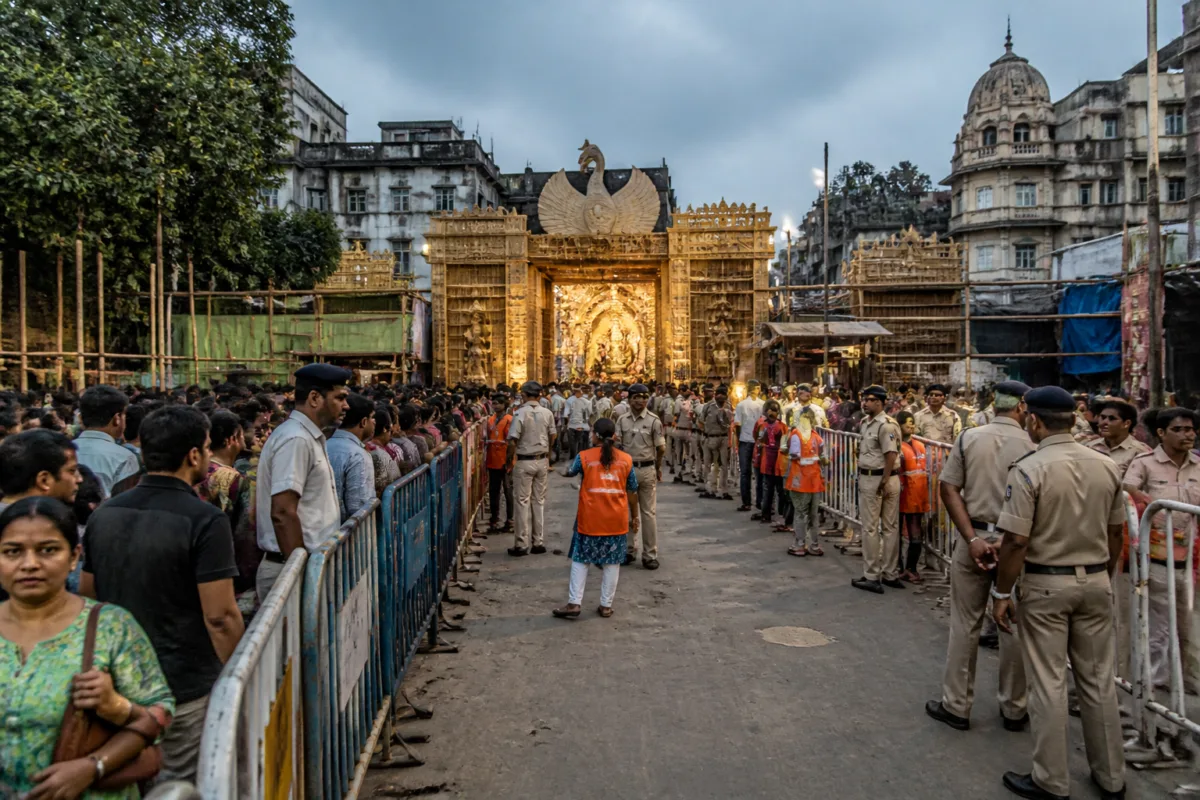
The Kolkata stampede inquiry is moving from the immediate tragedy at the Chorbagan Durga Puja pandal towards a more specific examination of how the venue was managed. Kolkata Police is compiling the names of personnel deployed at the pandal on the evening of October 17, when a stampede claimed 19 lives, and officers assigned to the entry and exit gates may be summoned for questioning.
The reported development matters because crowd disasters are rarely explained by the presence of a large gathering alone. They are also shaped by how people enter and leave a site, how movement is monitored, how responsibilities are distributed among officials, and how quickly personnel respond when normal circulation breaks down. In the Chorbagan case, the police inquiry is expected to focus on precisely these operational questions.
According to the report by Telegraph India, Kolkata Police headquarters is compiling a list of officers and personnel who were on duty at the venue. Particular attention is being given to those deployed at the entry and exit gates. The purpose, as described by police sources, is to establish individual responsibilities and assess how personnel responded as the situation unfolded.
The distinction between identifying personnel and establishing responsibility is important. A duty roster can show who was assigned to a location, but it does not by itself establish what each person saw, what instructions they received, whether those instructions were followed, or how conditions changed during the incident. Those questions are expected to be addressed when the identified personnel are summoned to Lalbazar, Kolkata Police headquarters, for questioning.
The report does not state when the questioning will begin, how many personnel are on the list, or whether any officer has already been formally identified as responsible for a specific failure. It also does not establish the precise sequence of events inside or around the pandal. Those details remain part of the inquiry rather than established facts.
What is known is that the state government has constituted a six-member special investigation team headed by retired Calcutta High Court judge Justice Anindita Roy Saraswati. The SIT has been tasked with conducting an inquiry into the stampede and making appropriate recommendations. The police exercise and the SIT process therefore represent two connected but distinct institutional tracks: one focused on the conduct and response of personnel deployed at the site, and the other authorised to examine the incident more broadly and recommend changes.
That division of responsibility will shape the credibility of the investigation. Kolkata Police is examining the actions of its own personnel, while the state-appointed SIT is expected to provide a wider review. The supplied report does not specify the SIT’s full terms of reference, the other members of the panel, or whether the team has submitted an interim report. It also does not say whether the panel will examine the physical layout of the pandal, the number of visitors present, emergency access, medical response or arrangements made by organisers.
The focus on entry and exit gates nevertheless identifies a central urban safety issue. Temporary public venues are designed to receive and discharge large numbers of people over a limited period. Their safety depends not only on the size of the crowd but also on whether movement is kept legible and separated, whether congestion can be detected early, and whether emergency personnel can reach a critical point without obstruction. A failure at one point in this system can affect every other point because people approaching an obstruction continue to add pressure to an already restricted space.
The report does not provide measurements of the Chorbagan site, its gate capacity, the number of access points or the volume of visitors. It would therefore be premature to conclude that the design or capacity of the venue caused the stampede. The current evidence supports a narrower conclusion: crowd-control arrangements, entry and exit management and the response of deployed personnel are among the issues being examined.
This is also why the police list is more than an administrative exercise. In a large public gathering, deployment plans convert a general safety responsibility into specific assignments. Personnel at an entry gate, an exit gate or another control point may have different roles, lines of communication and responsibilities. Establishing who was present allows investigators to reconstruct the operational chain without relying only on broad institutional explanations.
That reconstruction will need to account for the difference between planned arrangements and conditions on the ground. A roster can record deployment before an event begins, but it cannot by itself show whether a gate remained usable, whether instructions changed, whether crowd movement was diverted or whether personnel had sufficient visibility. These are precisely the matters that questioning and documentary review would need to clarify. The source report confirms that the inquiry is expected to assess the response as the situation turned critical, but it does not provide those findings.
The SIT’s role is significant because the official process is expected to move beyond identifying individual actions. Its mandate includes making recommendations, which suggests that the inquiry may also examine the systems that allowed the incident to occur. However, the supplied material does not say what recommendations are being considered or whether the government has already changed safety procedures for similar gatherings. No claim about a broader policy failure can therefore be treated as established at this stage.
The institutional architecture now in place also creates a test of accountability. A police inquiry can establish the actions of personnel and the chain of response at the site. A panel headed by a retired High Court judge can provide an independent-facing forum for reviewing the incident and recommending measures. For the process to answer the public questions raised by 19 deaths, the two tracks will need to produce a clear account of what happened, who was responsible for each operational decision and which safeguards were absent, inadequate or not implemented.
The timing of the police action is relevant. The stampede occurred on October 17, while the report was published on October 25. This is no longer an immediate incident bulletin; the central public question has shifted from what happened to how the authorities will establish responsibility and prevent the inquiry from ending at the level of general observations. The summoning of personnel, if it takes place, is an investigative step rather than a finding of culpability.
Several important facts remain unresolved in the material currently available. The report does not identify the conditions that led to the stampede, state how many people were at the venue, describe the crowd’s movement, or record the accounts of survivors, organisers or witnesses. It does not report any conclusion by the SIT or Kolkata Police. It also does not say whether the entry and exit arrangements complied with an approved plan or whether emergency services faced access problems.
Those gaps do not reduce the significance of the inquiry. They define what the investigation must establish before responsibility can be assigned. The essential questions are operational: how the venue was organised, how people were channelled through it, what information reached personnel, what action was taken when conditions deteriorated, and whether the response matched the risks of a major public gathering.
For Kolkata, the larger urban question is how temporary event spaces are governed when they become city-scale destinations. A festival pandal may be temporary in construction, but the public-safety obligations around it are not temporary. They involve police deployment, organiser responsibilities, access control and coordination between institutions. The Chorbagan investigation will show whether the authorities treat the deaths as an isolated operational failure or use the evidence to identify weaknesses in the way crowded public venues are planned and managed.
At present, the evidence confirms only the next stage of the process: Kolkata Police is compiling the duty list, personnel may be summoned to Lalbazar, and a six-member SIT headed by Justice Anindita Roy Saraswati is conducting an inquiry and is expected to make recommendations. The facts established through those proceedings, rather than the initial allocation of blame, will determine what the incident reveals about crowd safety in Kolkata.

