


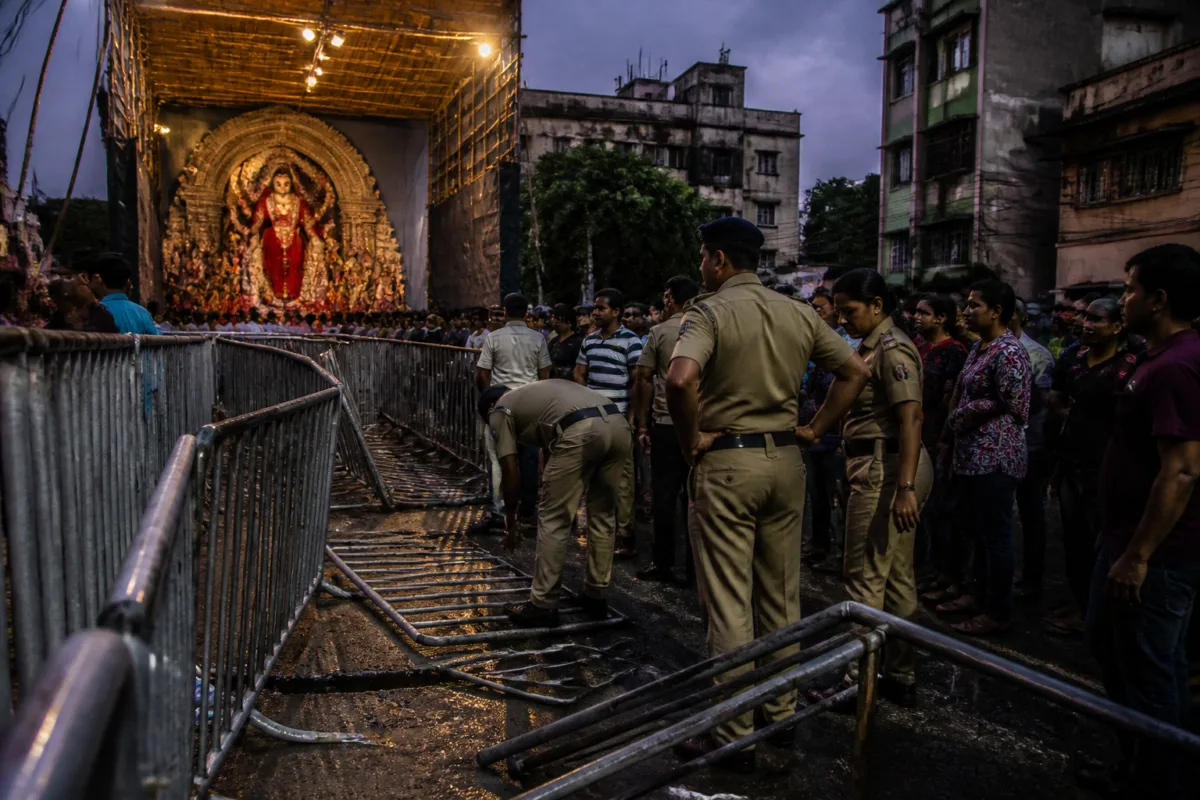
The Kolkata stampede inquiry has moved from the immediate tragedy at the Chorbagan Durga Puja pandal to a more specific examination of how the venue was managed when the crowd turned critical. Kolkata Police is compiling the names of officers and personnel deployed at the pandal on the evening of October 17, when 19 people died, while a six-member special investigation team headed by a retired Calcutta High Court judge has been tasked with examining the incident and making recommendations.
The shift towards identifying individual deployment and responsibility is significant because crowd disasters are rarely determined by the size of a gathering alone. They are shaped by how people enter and leave, whether movement is channelled or obstructed, how quickly a dangerous concentration is recognised and whether personnel have a clear chain of command when normal arrangements begin to fail. The information available in the report does not establish what caused the stampede or whether any individual or institution was at fault. It does, however, show that the inquiry is concentrating on the operational systems that govern a high-footfall public venue.
According to sources cited by The Telegraph, Kolkata Police headquarters is preparing a list of officers and personnel who were on duty at the Chorbagan pandal, with particular attention to those posted at the entry and exit gates. The personnel identified are likely to be summoned to Lalbazar, the police headquarters, for questioning as part of the ongoing inquiry. Their accounts are expected to help investigators reconstruct what happened at the venue and assess how the deployment responded as the situation unfolded.
That reconstruction matters because entry and exit points are the parts of a temporary public venue where crowd pressure can quickly become difficult to control. A gate is not merely a passage. It is where queues form, where incoming and outgoing flows can intersect, where security checks may slow movement and where a sudden change in demand can create pressure behind people who have limited room to move. The report specifically identifies these locations as an area of inquiry, but it does not provide details of the pandal’s layout, the number of visitors present, the police deployment strength or the arrangements made by the organisers. Those facts will be necessary to determine how the venue functioned that evening.
The inquiry is also expected to examine crowd-control arrangements and the response of personnel after the situation became critical. This makes the episode an institutional question rather than only a question of individual conduct. A public gathering depends on several actors working at the same time: police personnel, venue organisers, volunteers and the agencies responsible for emergency response. The supplied report does not specify the respective roles of these actors at Chorbagan. The police questioning and the SIT investigation will therefore be important in establishing how responsibilities were distributed before and during the incident.
The Bengal government’s decision to constitute a six-member SIT adds a second layer to the process. The team is headed by retired Calcutta High Court judge Justice Anindita Roy Saraswati and has been asked to conduct an inquiry into the stampede and make appropriate recommendations. The terms described in the report suggest that the SIT is not limited to establishing a sequence of events. Its mandate also includes identifying lessons and proposing measures that could address weaknesses revealed by the incident.
The parallel police and SIT processes serve different institutional purposes, even though they are examining the same tragedy. The police inquiry is focusing on the personnel deployed at the site and on how they responded. The SIT, led by a retired judge, has a wider remit to investigate the stampede and recommend changes. The report does not state whether the two processes will share evidence, whether their findings will be published in full or what deadlines have been set for their work. Those details will determine how transparent and actionable the eventual response becomes.
The immediate public-safety issue is clear: the Chorbagan pandal was a temporary venue that attracted enough people for crowd movement and gate management to become central to the investigation. Durga Puja pandals are part of Kolkata’s seasonal public realm, drawing visitors into neighbourhood streets and enclosed or semi-enclosed spaces. But the available report does not establish the scale of the gathering at Chorbagan, whether the venue had exceeded a planned capacity or whether there had been warnings before the stampede. Those questions should not be answered through assumption. They require evidence from deployment records, site plans, witness accounts and the findings of the inquiry.
The decision to compile a duty roster is therefore an important first administrative step. A roster can show who was assigned to each location, what level of supervision existed and whether the deployment matched the points of greatest risk. It can also help compare the planned arrangement with what actually happened. That comparison is necessary in any investigation of a crowded public venue: a plan may exist on paper, but the operational reality can change as visitor volumes, queues and movement patterns change.
The focus on entry and exit gates also points to the importance of managing movement as a continuous process rather than treating crowd control as a static security task. Personnel at a gate may have to regulate inflow, maintain separation between opposing streams and respond to distress signals from within the crowd. If a situation changes rapidly, the effectiveness of the response depends on communication, authority and the ability to redirect people. The supplied material does not say whether such measures were in place at Chorbagan. It only establishes that the police inquiry will examine the arrangements and the conduct of the personnel deployed there.
For the city, the case raises a broader governance challenge. Public celebrations often take place in spaces that were not designed as permanent event venues. Streets, neighbourhood approaches, gates and temporary structures have to perform functions that normally depend on formal planning: access management, emergency movement, supervision and rapid communication. The report does not provide enough information to assess whether those systems were formally documented at Chorbagan. The SIT’s recommendations may indicate whether the state intends to address such events through stronger planning standards, clearer institutional responsibilities or revised operating procedures.
The number of deaths gives the inquiry a significance beyond the individual venue. Nineteen people lost their lives in a single incident, and the questions being examined now concern both accountability and prevention. A credible inquiry will need to distinguish between what was planned, what was implemented and what happened under pressure. It will also need to establish which conclusions are supported by records and testimony, rather than allowing the scale of the tragedy to substitute for evidence.
At present, the central facts established by the supplied report are limited but consequential. The stampede occurred at the Chorbagan Durga Puja pandal on October 17 and claimed 19 lives. Kolkata Police is identifying personnel posted at the venue, especially at entry and exit gates, and may summon them to Lalbazar. The Bengal government has constituted a six-member SIT headed by Justice Anindita Roy Saraswati to investigate the incident and make recommendations. The cause of the stampede, the adequacy of the arrangements and the responsibility of the different actors remain matters for the inquiry.
The next important developments will be the questioning of the identified personnel and the findings and recommendations of the SIT. Until those processes establish the sequence of events, the most responsible conclusion is that Kolkata’s crowd-management system is under formal examination after a fatal failure at a major public gathering. What the city learns from that examination will depend on whether the investigations reconstruct the event in sufficient operational detail and convert their findings into clearly assigned responsibilities and enforceable safety measures.

