


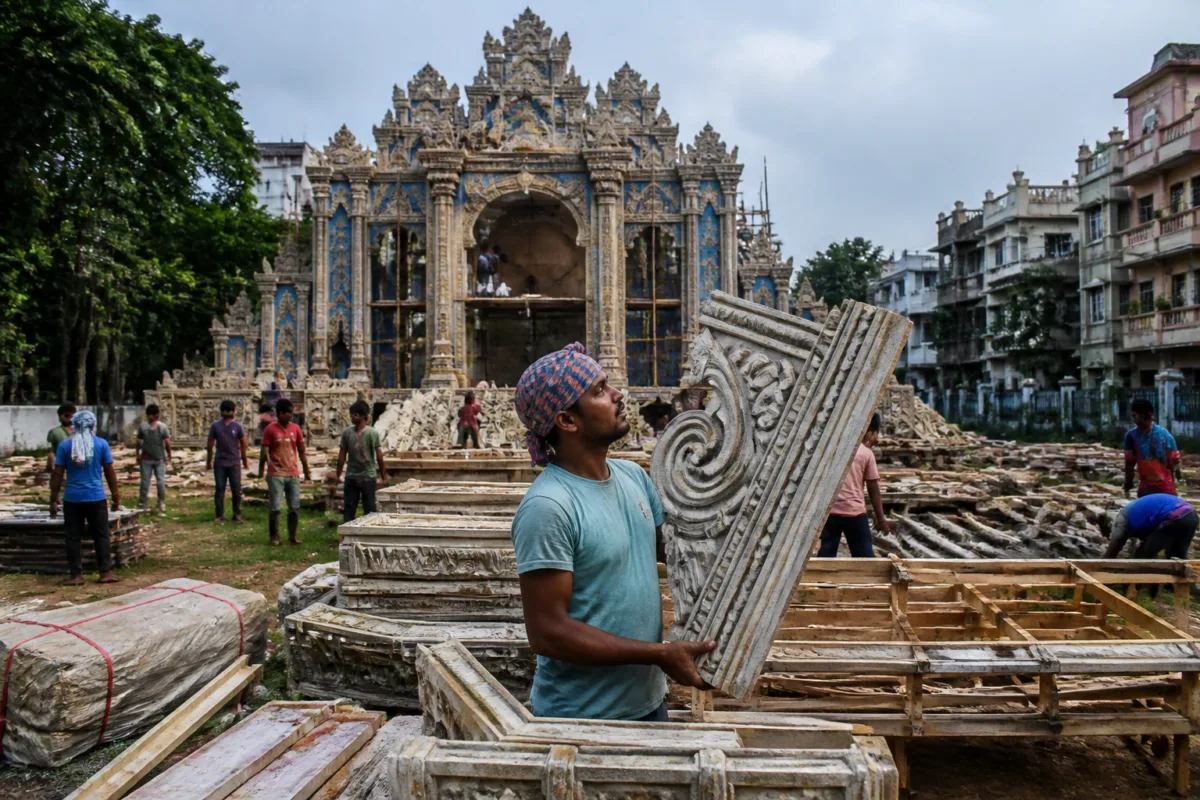
Kolkata’s Durga Puja pandal reuse is turning temporary festival architecture into a travelling cultural asset. Six theme-based installations that attracted visitors during Durga Puja are scheduled to be dismantled and reassembled for Jagaddhatri Puja in Chandernagore, Kali Puja in East Midnapore and another Jagaddhatri celebration in Mankundu. The move shows how structures designed for a short festival window can remain useful beyond the event for which they were created.
The installations include four works conceptualised by theme artist Gouranga Kuila and two designed by Biman Saha. Their second use is not limited to transferring decorative material from one venue to another. Each pandal carries a distinct visual narrative, from mythological conflict and historical memory to gender identity, folklore and imagined journeys through time. In their new locations, the structures will continue to function as public cultural spaces while reaching audiences who may not have visited the original Kolkata venues.
That distinction matters because a festival pandal is more than a temporary shelter. It is a constructed environment assembled to guide movement, frame an experience and communicate an idea. During Durga Puja, these installations become destinations within the city, drawing visitors to neighbourhood clubs, school grounds and public spaces. Once the festival ends, however, the same structures must either be dismantled, stored, discarded or adapted for another use. The reported reuse programme places the dismantling process within a wider cycle rather than treating the end of Durga Puja as the end of the installation’s life.
Kuila’s work for Tridhara Sammilani, titled ‘Surasur’, explored mythological battles involving Rama and Ravana, Krishna and Kansa, and Durga and the asuras. Giant mythological dragons guarded the entrance, with Durga positioned above them as a symbol of the triumph of good over evil. The installation is scheduled to be reused at a Kali Puja in East Midnapore. Its transfer demonstrates how a structure created for one religious festival can be adapted to another without losing its visual power or its ability to organise a public gathering.
Another Kuila installation, ‘Ram Er Ayodhya/Ram Ki Ayodhya’, was displayed at Central Park in Salt Lake and is set to be transported to a club in Chandernagore for Jagaddhatri Puja. The source does not provide details of the dismantling method, the distance involved, the materials being retained or the cost of transportation. Those omissions are important. Reuse is not automatically resource-efficient in every case; its environmental value depends on how much of the structure survives dismantling, how far it travels and how much new material is needed for reassembly. The available information confirms the second use, but not the scale of its savings.
Kuila’s installation ‘O Men and Women’, created for Haridevpur’s 41 Pally Club, addressed discrimination against transgender people. It presented the ridicule, neglect and social exclusion faced by the community and called for greater acceptance of diverse gender identities. The structure will be reused at another Jagaddhatri Puja in Chandernagore. Its movement gives the installation a second public setting, but its social theme also raises a separate question: whether the meaning of a public artwork travels with its physical form, or whether it depends on the context in which visitors first encountered it.
The fourth Kuila work, ‘Samay’, was installed at the Ichhapur Anandamath Boys’ School ground in Baranagar. It combined traditional festive elements with futuristic, science-fiction-inspired aesthetics. Mechanical gears, large structures and distinctive lighting created the impression of a journey through time. The installation is also scheduled for reuse at a Jagaddhatri Puja in Chandernagore. The reported transfer illustrates the adaptability built into many temporary festival structures, which are often designed as assemblies of separate components rather than as permanent buildings.
Biman Saha’s two installations are also part of the reuse route. ‘Aitijhyer Lokkotha (Heritage of Folklore)’, displayed at Mudiali Club near Tollygunge railway station, drew on Bengali folklore and traditional Durga Puja rituals associated with old Kolkata households in Jorasanko and Kumartuli. It will be taken to Chandernagore for Jagaddhatri Puja. The work’s movement from a neighbourhood near a major railway station to another festive setting shows how cultural infrastructure can connect different parts of the wider urban region, even when the structure itself is temporary.
Saha’s second installation, ‘Guptayan’, was displayed at Jodhpur Park Sarbojonin. Designed to evoke the Gupta empire and its associations with architecture and sculpture, it took visitors through a time-machine-like setting. The structure will be reused at another Jagaddhatri Puja in Mankundu. Together, the six installations create a circuit linking Kolkata, Salt Lake, Baranagar, Chandernagore, Mankundu and East Midnapore. The source identifies the destinations and themes, but does not establish whether the transfers are being coordinated through a common administrative programme or arranged separately by the organisers.
The urban significance of the development lies in the way it expands the useful life of event infrastructure. Cities regularly invest labour, materials, lighting, transport and temporary services into large public celebrations. In the case described here, artistic installations that might otherwise have had a single primary use are being treated as reusable assets. That approach can potentially reduce the need to build entirely new structures for subsequent festivals, although the report does not provide a material inventory or a comparison with the resources required for new construction.
The distinction between reuse and recycling is also relevant. Recycling generally involves processing material so that it can enter another production cycle. Reuse retains an object, component or structure for another purpose with some degree of its original form intact. The six pandals are being described as dismantled and reused, suggesting a process of direct or adapted reuse rather than merely recovering raw materials. Whether every component will be retained is not stated. The report also does not say whether the idols, lighting systems, electrical installations, decorative surfaces or structural frames will travel with the pandals.
That missing information points to the institutional questions behind temporary architecture. A successful reuse chain requires early planning between the original organisers, artists, contractors, transport providers and the receiving puja committees. It also requires decisions about ownership, storage, safety, weather protection and modification. A structure designed for one site may need a different foundation, entrance arrangement, crowd circulation plan or electrical layout at another. None of these operational details is provided in the supplied report, so the exact mechanics of the transfers remain unclear.
Safety is particularly important when a temporary structure is moved and reassembled. The source confirms that the installations are set to be dismantled for reuse, but it does not identify the authority responsible for inspecting their structural condition at the new sites. Nor does it provide information about fire safety, electrical certification, crowd capacity or emergency access. These are not reasons to discount the reuse effort; they are the practical conditions that determine whether temporary cultural infrastructure can be safely extended beyond its first venue.
The festival calendar creates the opportunity for such a system. Durga Puja is followed by Jagaddhatri Puja and Kali Puja, allowing an installation to move from one major public celebration to another within the same broader cultural season. The source specifically links the Kolkata pandals to Jagaddhatri Puja in Chandernagore and Mankundu and Kali Puja in East Midnapore. This sequence gives organisers a potential window in which dismantling, transport and reassembly can take place, although the report does not state the precise schedule or turnaround time.
The cultural value of reuse is as significant as the material question. Each installation has been designed around a narrative: mythological battles in ‘Surasur’, the idea of Ayodhya in ‘Ram Er Ayodhya/Ram Ki Ayodhya’, inclusion in ‘O Men and Women’, time and technology in ‘Samay’, folklore in ‘Aitijhyer Lokkotha’ and historical imagination in ‘Guptayan’. Moving these works allows their themes to be encountered by a new audience. It also means that the creative labour invested in temporary architecture is not confined to a single neighbourhood or festival period.
At the same time, a second life does not make a pandal permanent. The installations remain temporary structures with a limited operational cycle. Their continued use depends on how they are built, how carefully they are dismantled and whether their components can withstand transport and reassembly. The report does not say how many times any of the six pandals can be reused, whether they will be modified to fit their new venues or what will happen after the forthcoming Jagaddhatri and Kali Puja celebrations.
For Kolkata and its neighbouring urban regions, the episode offers a small but visible example of a broader built-environment challenge: how to manage structures created for short-term public use. Event infrastructure is often planned around opening day, while its afterlife receives less attention. The six installations show an alternative sequence in which design, dismantling and relocation are connected. To assess the full value of that sequence, future reporting would need evidence on materials, transport distances, labour, costs, waste avoided and safety approvals.
What is established is that six prominent Durga Puja installations by Gouranga Kuila and Biman Saha are being prepared for reuse at later festivals in Chandernagore, East Midnapore and Mankundu. The transfers will extend the public life of the works and expose their artistic narratives to new audiences. What remains unestablished is the exact environmental, financial and administrative benefit of the process. Those details will determine whether this remains a set of individual festival arrangements or becomes a repeatable model for circular temporary construction in the region.

