


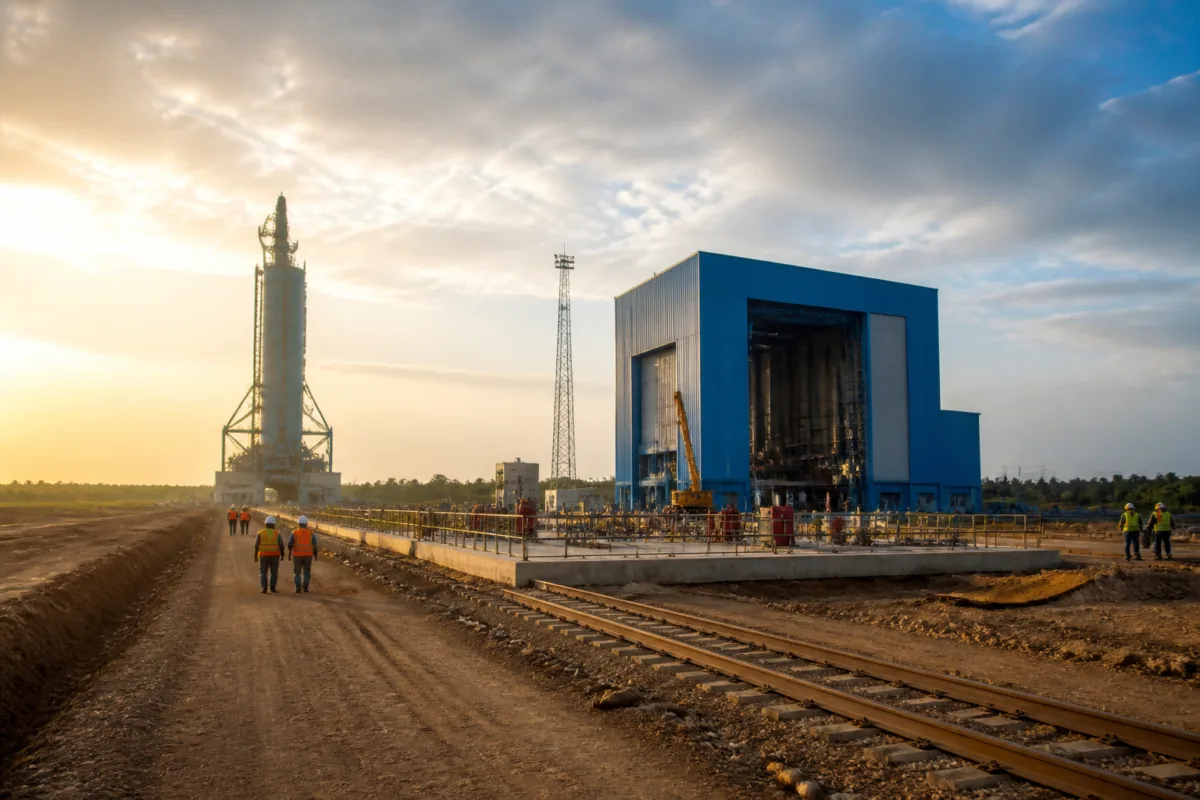
India’s plan to have four operational launch pads by 2029 is more than a capacity expansion for the national space programme. It points to a transition from a largely state-operated launch architecture towards a broader ecosystem in which private companies are expected to participate in operations, satellite launches and the supporting infrastructure built around spaceports.
ISRO chairman V Narayanan said India would have four operational launch pads by 2029, including a third launch pad at Sriharikota and the small satellite launch vehicle launch complex being built at Kulasekarapattinam. He was speaking in Chennai on the sidelines of a graduation ceremony at Sri Ramachandra Institute of Higher Education and Research, according to the Times of India.
The statement places launch infrastructure at the centre of India’s next phase of space activity. The proposed capacity is linked not only to government missions but also to what Narayanan described as a growing requirement to launch thousands of satellites. His argument for involving Indian start-ups and private companies is therefore tied to a practical constraint: the country will need more organisations capable of operating launch systems and supporting a higher frequency of missions.
That makes the Kulasekarapattinam project significant as a physical infrastructure undertaking. The SSLV launch complex is being developed on 2,000 acres and is planned to include stage-preparation and vehicle-integration buildings, a launch pad, rail-track systems, range systems, checkout systems, telemetry and telecommand systems, safety and firefighting facilities, and civic amenities. These components show that a spaceport is not simply a pad from which a rocket takes off. It is a coordinated industrial and safety system requiring specialised buildings, testing infrastructure, communications, emergency response and basic services.
The first rocket launch from the complex is expected next year, Narayanan said. The stated timeline means that the project’s immediate challenge is not only completing construction but also integrating the different systems required for safe operations. A launch complex has to bring together vehicle preparation, transport within the site, command and control, range monitoring, safety procedures and emergency services. The range of facilities listed for Kulasekarapattinam indicates the scale of that integration task, although the supplied information does not provide a detailed construction schedule or commissioning milestones.
The proposed expansion also changes the institutional question around space infrastructure. Narayanan defended the decision to bring private companies into some operations at Kulasekarapattinam, saying ISRO would handhold them. He linked the arrangement to economic growth and the creation of engineering jobs. This suggests a model in which the public agency continues to provide technical support and oversight while private firms take on a larger operational role.
The distinction matters because the infrastructure required for frequent satellite launches cannot be understood only as a government construction programme. It also requires companies with the technical capacity to prepare vehicles, manage launch-related systems and participate in a supply chain. Narayanan’s comments identify start-ups and private companies as part of that future capacity, but the source does not specify which companies will operate at the site, what contractual structure will govern their participation or how responsibilities will be divided between ISRO and private operators.
The proposed four-pad network must also be read alongside India’s wider space programme. Narayanan said ISRO plans to conduct the first uncrewed test for the Gaganyaan human spaceflight programme within the next two months. Three uncrewed tests are planned before the crewed mission. The tests are intended to examine the crew escape system, environmental control and safety systems, including pressure, temperature, relative humidity, oxygen and carbon dioxide levels inside the module, as well as systems designed to reduce the rocket’s speed.
The Gaganyaan programme illustrates why launch infrastructure cannot be separated from testing and safety infrastructure. Human spaceflight requires a chain of systems that extends beyond the launch vehicle itself. Narayanan said ISRO had conducted about 8,000 ground-based experiments for the mission and that the four astronaut-designates were undergoing training. He also said the crewed mission would be undertaken only after the successful completion of all three uncrewed tests.
That sequencing provides an important institutional signal. The programme is being presented as a staged process in which uncrewed testing precedes the human mission. The source does not provide the dates or outcomes of the planned tests, so the immediate milestone remains the first uncrewed flight and the evidence it will generate about the performance of the escape, environmental-control and deceleration systems.
India’s planned lunar missions add another layer to the infrastructure requirement. Narayanan said Chandrayaan-4, scheduled for 2028, would seek to bring samples back from the Moon. The module is expected to weigh 9,600 kg, compared with 3,900 kg for Chandrayaan-3. The stated plan is to use two rockets and dock them in space before landing on the Moon. That is a substantially more complex mission architecture than a single-launch approach because it depends on coordination between separate launches and an orbital docking operation.
Narayanan also described Chandrayaan-5, a collaborative mission with the Japan Aerospace Exploration Agency, which is expected to send a 350-kg rover to the Moon. The rover would conduct experiments for 100 days, compared with the 14-day duration of experiments during Chandrayaan-3. These figures indicate a shift towards missions with heavier hardware and longer operating periods, although the supplied report does not provide the full design, funding or launch arrangements for either mission.
Taken together, the launch-pad expansion, Gaganyaan testing and future lunar missions show how several strands of India’s space programme are converging around infrastructure capacity. More launch pads can support greater mission frequency, while new mission profiles require more complex integration, testing and safety systems. The construction of Kulasekarapattinam therefore forms part of a wider effort to create physical capacity for a more demanding programme.
The regional development dimension is present in the scale and contents of the Kulasekarapattinam complex. A 2,000-acre site with industrial buildings, rail systems, range infrastructure, safety facilities and civic amenities will require coordinated land use and service planning. The available information does not establish the project’s complete impact on nearby communities, transport links, utilities or local employment. It does, however, make clear that the project is being conceived as a full launch complex rather than an isolated launch platform.
Narayanan’s reference to jobs for engineers also points to the skills infrastructure that must accompany physical construction. The expected participation of start-ups and private companies creates demand for specialised technical roles, but the source does not quantify the number of jobs or identify the training institutions that will supply them. The statement that ISRO will handhold private operators indicates an intended knowledge-transfer function, with the public agency supporting the development of capabilities outside its own organisational structure.
The policy landscape is consequently defined by a balance between public stewardship and private participation. ISRO remains the technical and institutional anchor in the account provided by Narayanan, while start-ups and private companies are being invited into selected operations. The exact regulatory framework, commercial model and accountability mechanisms are not detailed in the supplied material. Those elements will be important in determining how the planned capacity translates into regular launches.
The numbers announced by Narayanan show the direction of travel: four operational launch pads by 2029; a 2,000-acre SSLV complex at Kulasekarapattinam; a first launch from that site expected next year; three uncrewed tests before Gaganyaan; approximately 8,000 ground-based experiments already conducted for the human spaceflight programme; Chandrayaan-4’s planned 9,600-kg module; and Chandrayaan-5’s proposed 350-kg rover operating for 100 days.
These figures should not be treated as evidence that the full system is already in place. They are milestones and plans described by the ISRO chairman. The supplied report does not include an independent progress assessment of the Kulasekarapattinam construction, a formal notification on the four-pad configuration, detailed budgets, or an updated schedule for the Gaganyaan tests. The central fact established by the report is that ISRO is publicly pursuing a larger launch infrastructure network and a greater role for private operators.
The bigger urban and infrastructure question is how such specialised facilities are integrated into the regions that host them. Spaceports require land, access systems, safety zones, utilities, communications and civic amenities, while their employment benefits depend on the availability of skills and supporting firms. In Kulasekarapattinam, the project’s eventual significance will therefore be measured not only by rocket launches but also by how its industrial and institutional ecosystem is organised.
For now, the evidence confirms an ambitious expansion of India’s launch capacity, backed by a stated plan to involve private companies and supported by a pipeline of human-spaceflight and lunar missions. The developments to monitor are the first SSLV launch from Kulasekarapattinam, progress towards the four-pad target, the three uncrewed Gaganyaan tests and the formal arrangements governing private-sector operations.

