


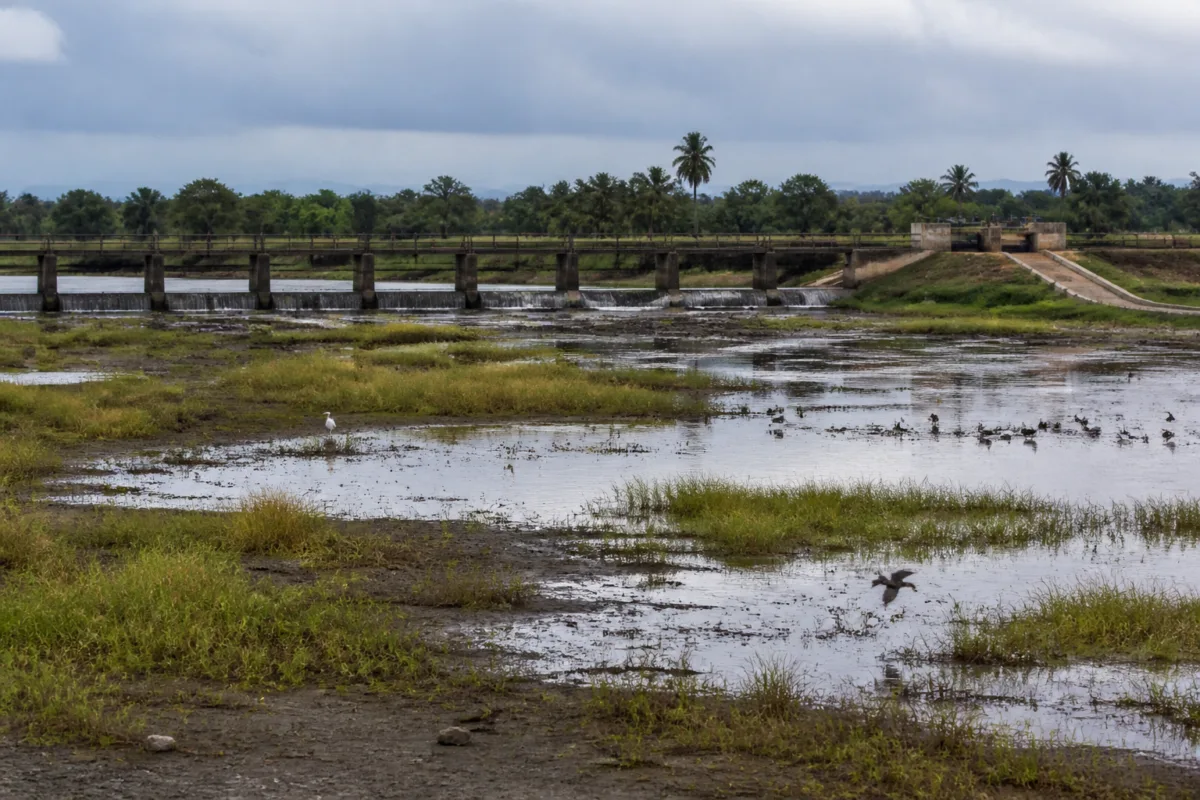
The Nandur Madhmeshwar wetland is entering a critical water-management discussion just as Nashik faces drought conditions, exposing the difficult choices that arise when drinking water, irrigation and ecological protection depend on the same canal and reservoir systems. The canal advisory committee, chaired by district guardian minister Girish Mahajan, is expected to consider how much water should be maintained in the wetland’s century-old pick-up weir.
The immediate concern is the falling water level at Maharashtra’s first Ramsar site. The forest department has asked the water resources department (WRD) to maintain adequate water in the weir during the bird season, warning that further decline could affect a habitat used by more than 250 bird species. The request comes as Nashik has recorded a 30% rainfall deficit during the monsoon and 13 of the district’s 15 talukas, including Niphad, have been declared drought-hit.
This is not simply a dispute over water releases. It is a question of how a district allocates a shrinking and shared resource across systems that are administered for different purposes. The wetland depends on water moving through infrastructure originally built for canals and irrigation, while the same upstream reservoirs are expected to support drinking water supply and farm demand. The ecological character of Nandur Madhmeshwar is therefore closely tied to decisions made outside the wetland itself.
The site covers nearly 10,000 hectares, including a protected core area of 1,765 hectares. Its wetland ecosystem developed over roughly a century through silt deposits carried by the Godavari after the construction of the British-era Godavari Left Bank and Right Bank canal systems. That history makes Nandur Madhmeshwar an example of how engineered water networks can produce environmental value over time, even when their original purpose was water conveyance and irrigation.
The present pressure has emerged because water levels in the weir have been dropping as releases are made into canals for drinking water supply and irrigation rotations. A WRD official said that releases are linked to decisions taken by the canal advisory committee and acknowledged that water levels can fall significantly. The official said the committee would discuss and decide whether a certain level should be maintained.
That arrangement places the wetland’s ecological needs within a broader allocation process rather than treating them as an independently managed requirement. The forest department can seek stable water levels, but the operational decision rests with the committee responsible for balancing competing demands. The outcome will depend on the quantity of water available, the timing of releases and the priority assigned to different users during drought conditions.
The available upstream options are also constrained. Replenishing the wetland would require releases from either the Gangapur dam complex or the Darna dam complex. Neither option is straightforward. Water in the Gangapur complex is reserved primarily for drinking water for Nashik city and nearby villages. The Darna system serves villages across three districts under a long-standing irrigation arrangement.
This creates a three-way institutional conflict. Nashik’s urban and rural settlements require reliable drinking water. Farmers depend on irrigation rotations governed through established canal arrangements. The wetland requires enough water to sustain a habitat that supports resident and migratory birds. None of these demands can be considered in isolation when the same reservoir and canal systems serve them all.
The figures in the report show why the committee’s decision is taking place under pressure. A 30% rainfall deficit has reduced the margin available for discretionary releases, while drought declarations across 13 talukas indicate that the shortage is geographically broad. At the same time, the wetland extends across nearly 10,000 hectares and supports more than 250 bird species. These numbers do not provide a formula for allocation, but they show the scale of the competing public and ecological interests.
The wetland’s protected core area of 1,765 hectares adds another layer to the decision. Maintaining water in the broader wetland landscape and protecting its core are related but not necessarily identical management tasks. The report does not specify the minimum water level required for the habitat, the volume needed to replenish it, or the duration for which any release would have to continue. Those details will be important because a short-term increase may not provide the same ecological benefit as a stable level through the bird season.
The issue also highlights a limitation in the way water infrastructure is commonly understood. Canals, weirs and dams are generally operated as supply systems, with performance judged by whether water reaches cities, villages or farms. Nandur Madhmeshwar shows that these structures can also sustain habitats created or transformed by the flow of water. When releases change, the consequences are not limited to the intended recipients of the water; they can alter an entire wetland ecosystem.
The institutional responsibility is divided across departments. The forest department is seeking protection for the bird habitat. The WRD controls the relevant water infrastructure and releases. The canal advisory committee, chaired by the district guardian minister, is the forum where the allocation question will be considered. The wetland’s condition is therefore shaped by decisions made through an administrative process that must reconcile environmental concerns with drinking water and irrigation priorities.
The source material does not establish that a final allocation decision has been made or that a specific quantity of water will be released. It also does not identify a formally notified ecological water requirement for Nandur Madhmeshwar. What is established is that the forest department has made a request, WRD officials have recognised the possibility of significant water-level declines, and the committee is expected to discuss how a certain level might be maintained.
That distinction matters in drought management. A committee discussion can acknowledge ecological needs without guaranteeing an operational change. The practical test will be whether a measurable water-level requirement is incorporated into the release schedule and how that requirement is reconciled with the reservations of the Gangapur and Darna systems. The report does not say what monitoring mechanism will be used or which department will verify compliance.
Nandur Madhmeshwar’s situation is consequently a test of whether ecological protection can be integrated into routine water administration rather than addressed only after levels fall. The wetland was formed through a canal landscape and remains dependent on that landscape. Its future water condition cannot be separated from the governance of reservoirs, irrigation rotations and urban supply.
The committee’s forthcoming discussion will clarify the immediate response, but the larger issue is already visible. Nashik’s drought has narrowed the space for balancing demands, while the wetland’s ecological needs have become more urgent during the bird season. The evidence currently confirms a conflict over water availability and institutional priorities; it does not yet establish the final release decision. The next significant development will be the canal advisory committee’s decision on whether and how to maintain water levels at Nandur Madhmeshwar.

