


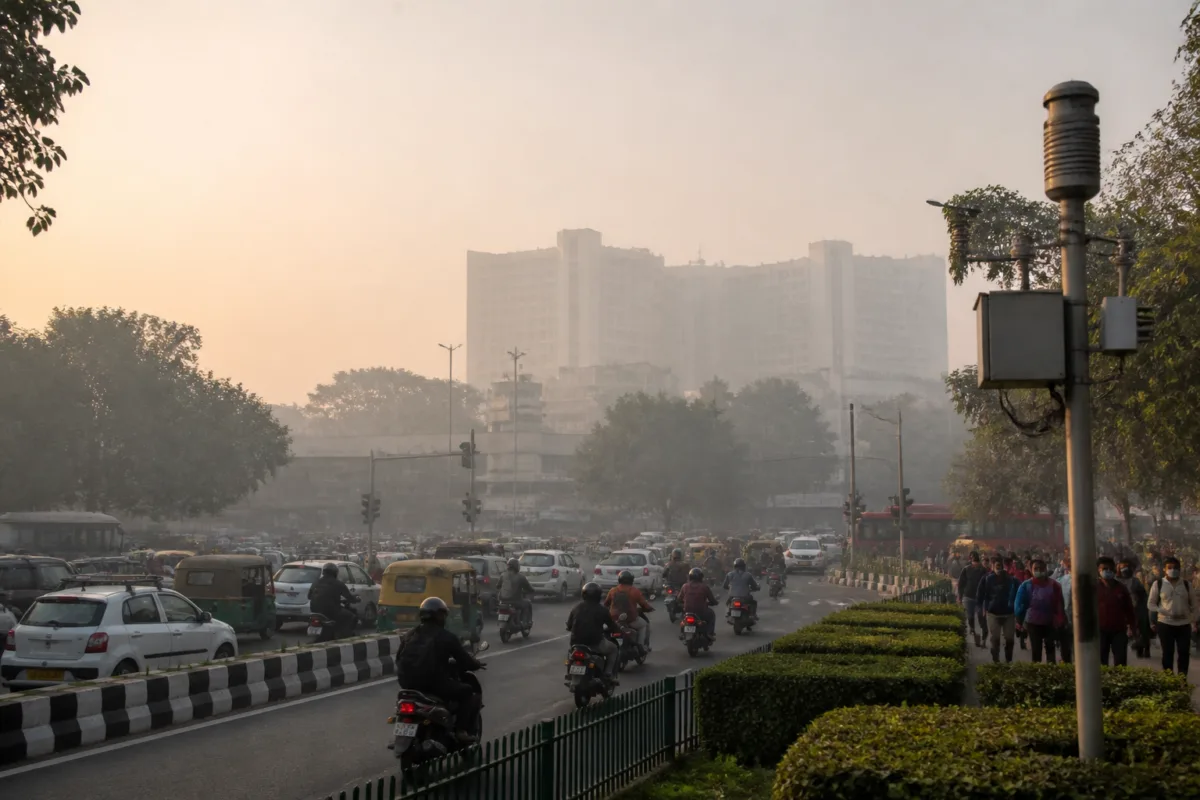
Delhi’s air quality improved from an AQI of 230 to 179 at the AIIMS monitoring location on Saturday, but the city is unlikely to receive significant pollution relief over the next nine days, according to the air-quality forecast cited in the report.
The AQI of 179 falls in the moderate category, marking a short-term improvement from Friday, when Delhi’s overall AQI was recorded at 230 in the poor category. The latest reading was reported around the All India Institute of Medical Sciences area and was attributed to Central Pollution Control Board (CPCB) data.
The improvement at one monitoring location has not translated into a city-wide easing of pollution. Data from the CPCB’s Sameer application showed that three of Delhi’s 56 monitoring stations recorded air quality in the very poor category. Pusa recorded the highest AQI among the stations at 324.
Thirty-six monitoring centres recorded air quality in the poor category, while 17 stations reported moderate air quality. The distribution indicates that pollution levels remain uneven across the capital, with some areas experiencing substantially worse conditions than the reading recorded near AIIMS.
The air-quality forecast system cited in the report has indicated that Delhi’s air may remain in the poor category until October 26. Conditions may continue at roughly similar levels during the following six days, meaning the city is not expected to see a major improvement in the immediate period.
The forecast has also pointed to low wind speeds as a continuing concern. Weak winds reduce the movement and dispersion of pollutants, allowing emissions and particulate matter to remain concentrated near the ground. The report said that the prevailing atmospheric conditions were not favourable enough to disperse pollutants effectively.
For Delhi residents, the latest readings highlight the difference between a temporary improvement at a monitoring station and sustained improvement in the city’s air. While the AIIMS reading moved below the poor category, the station-level data from across the capital showed that several areas continued to record poor or very poor conditions.
The forecast period will extend through the end of October, with air quality expected to remain a concern as long as low wind speeds continue to restrict dispersion. Further changes will depend on the readings recorded by Delhi’s monitoring network and subsequent updates from the air-quality forecasting system.

