


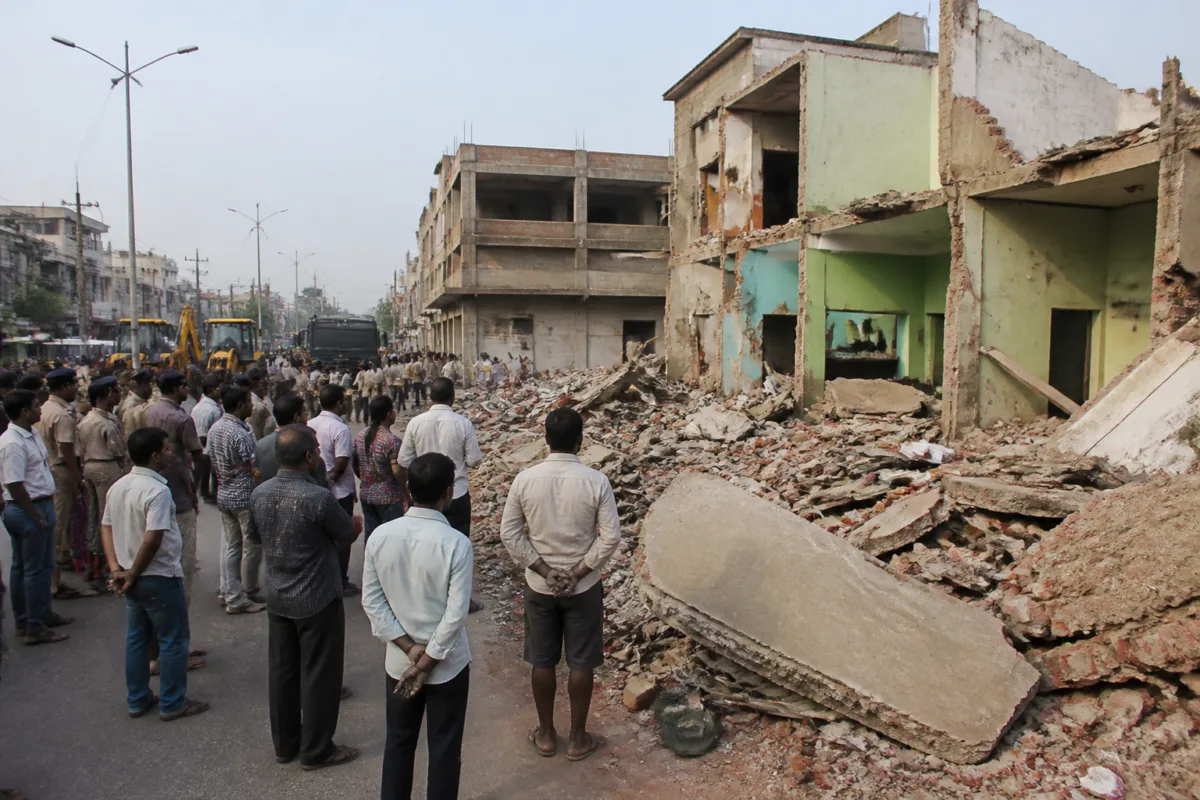
The Gujarat High Court’s sharp questioning of Surat Municipal Corporation officials in the Nasirnagar demolition case has shifted attention from the destruction of about 100 homes to a larger urban governance question: what happens to residents when a municipal authority acts without following legal procedure and then withdraws an assurance of alternative accommodation?
The court’s intervention, as reported by Divya Bhaskar, concerns homes demolished near Ved Darwaja in Surat on 29 and 30 May 2026. The action was carried out under heavy police deployment. The dispute later reached the High Court, where the court questioned the conduct of the municipal corporation, its officials and the state administration.
The immediate issue before the court is whether the displaced residents should receive alternative housing or another form of accommodation. The institutional issue is more serious. The court has questioned how the demolition took place, who authorised it, whether municipal officials followed the legally required process, and why the corporation changed its position after an assurance was given before the court.
That combination makes the Nasirnagar case different from a routine dispute over an unauthorised structure. It involves the use of municipal power against occupied homes, the administrative responsibility for displacement and the legal consequences of changing a position during ongoing proceedings. The case therefore offers a view into the gap that can emerge between demolition as an enforcement action and rehabilitation as a public obligation.
The court’s concern was recorded in unusually direct terms. During the hearing, Gujarat’s municipal commissioner, Rajkumar Beniwal, and the chairperson of the corporation’s standing committee were present and questioned about the corporation’s position. The court asked why the SMC was stepping back from an earlier assurance that alternative arrangements would be made for people whose homes had been demolished.
The court also asked who would take responsibility for alleged irregularities by municipal employees. It questioned where the displaced residents would live while responsibility was being determined and rejected the logic that the residents could simply be moved elsewhere without a proper housing arrangement. These observations place accommodation at the centre of the dispute rather than treating it as a secondary administrative detail.
According to the report, the SMC argued during the hearing that there was a long waiting period under the Pradhan Mantri Awas Yojana and that there was no existing scheme for allocating homes to people in this particular situation. The court rejected that as an answer to the immediate responsibility created by the demolition and the corporation’s earlier assurance.
The court’s written order reportedly recorded that the corporation had promised to make alternative arrangements and subsequently changed its position during the proceedings. It questioned whether such a reversal could amount to contempt of court, particularly because the assurance had been made by the Advocate General. The court has not, according to the supplied report, finally determined criminal contempt or fixed individual liability. Those remain questions for the continuing proceedings.
This distinction is important. The petition contains an allegation that the demolition was carried out at the request or direction of a private third party and that the action may have benefited that party. The court has described the case as unusual and has noted that the homes appeared to have been demolished without following legal procedure. However, the allegation about private-party influence remains an allegation in the petition, not an established finding recorded in the supplied material.
The court reportedly observed that the corporation’s conduct could amount to interference with the administration of justice and could diminish the dignity of the court, especially because the municipal position changed after an assurance had been given. Such observations do not by themselves establish criminal wrongdoing. They do, however, show that the dispute has moved beyond a conventional property or encroachment matter and into questions of institutional credibility.
The housing dimension is central. Demolition removes a physical structure, but displacement also removes access to a neighbourhood, local services, livelihoods and social networks. The supplied report does not provide details about the residents’ occupations, tenure documents, household composition or present living conditions. It therefore cannot establish the full social cost of the action. What is clear from the court’s questions is that the residents’ immediate shelter has become a live legal and administrative issue.
The case also highlights the difference between a housing scheme and a remedy for displacement. A waiting list under a general housing programme may be relevant to long-term allocation, but it does not automatically answer what a public authority must do after its own action leaves people without homes. The court’s questioning suggests that the corporation cannot resolve the issue simply by placing affected residents in an existing category or asking them to wait for a general-purpose scheme.
This is an important administrative distinction. A housing programme is normally designed around eligibility, supply and allocation rules. A displacement remedy arises from a specific event and may require a separate assessment of responsibility, interim shelter and permanent rehabilitation. The High Court’s reported remarks indicate that it did not consider the dispute to be merely about whether residents belonged in one category or another under an existing scheme.
The chronology described in the report also reveals how accountability can become fragmented. The demolition involved municipal officials and police deployment. The later proceedings brought the municipal commissioner, the standing committee chairperson and other authorities into focus. The court has asked who was responsible for the conduct of employees and why the municipal position changed. Without a clear administrative record, responsibility can move between field staff, senior officers, elected committees and other actors.
That is why the court has required the municipal commissioner and the standing committee chairperson to remain personally present at the next hearing. Their appearance is not a substitute for an inquiry, but it places the institutional chain of responsibility directly before the court. The next proceedings are expected to examine why the assurance of alternative accommodation was withdrawn and whether action against officials, including possible criminal contempt proceedings, should be considered.
The supplied report also refers to earlier coverage of the demolition, including questions over why the state government had not acted sooner and the formation of an inquiry committee 51 days after the demolition. The report does not provide the committee’s findings or terms of reference. It therefore remains unclear what conclusions, if any, have been reached outside the court proceedings.
That uncertainty is significant. A credible account of an urban demolition requires more than the number of structures removed. It requires the authorisation trail, notices issued, hearings offered, ownership or occupancy records considered, the stated legal basis, the role of police and the arrangements made for residents afterwards. The supplied material establishes that the High Court has raised serious concerns on these issues, but it does not contain the complete administrative record.
The Nasirnagar dispute consequently exposes three connected accountability gaps. The first is procedural: whether homes were demolished without the required legal process. The second is rehabilitative: whether residents were given a workable alternative after displacement. The third is institutional: whether a public authority can change its position after making an assurance before a court without facing consequences.
For Surat, the case is also a test of how urban enforcement is conducted in areas where land, housing and development interests may overlap. The court has not, on the supplied evidence, determined that a private party caused the demolition or benefited from it. But the fact that the allegation has been placed before the court makes transparency over the decision-making chain essential to the dispute.
The evidence currently confirms that approximately 100 homes were demolished in Nasirnagar on 29 and 30 May 2026; that the matter is before the Gujarat High Court; that the court has questioned the SMC’s reversal on alternative accommodation; and that the municipal commissioner and standing committee chairperson must appear at the next hearing. It does not yet establish the final legal status of the demolition, the residents’ entitlement to permanent homes, the findings of any inquiry committee or whether criminal contempt proceedings will follow.
The next hearing, scheduled for November according to the report, will therefore be important for determining whether the corporation provides a concrete accommodation plan, explains the change in its position and supplies the records needed to establish responsibility. Until then, Nasirnagar remains a case in which the legality of demolition and the duty to house displaced residents are inseparable questions of urban governance.

