


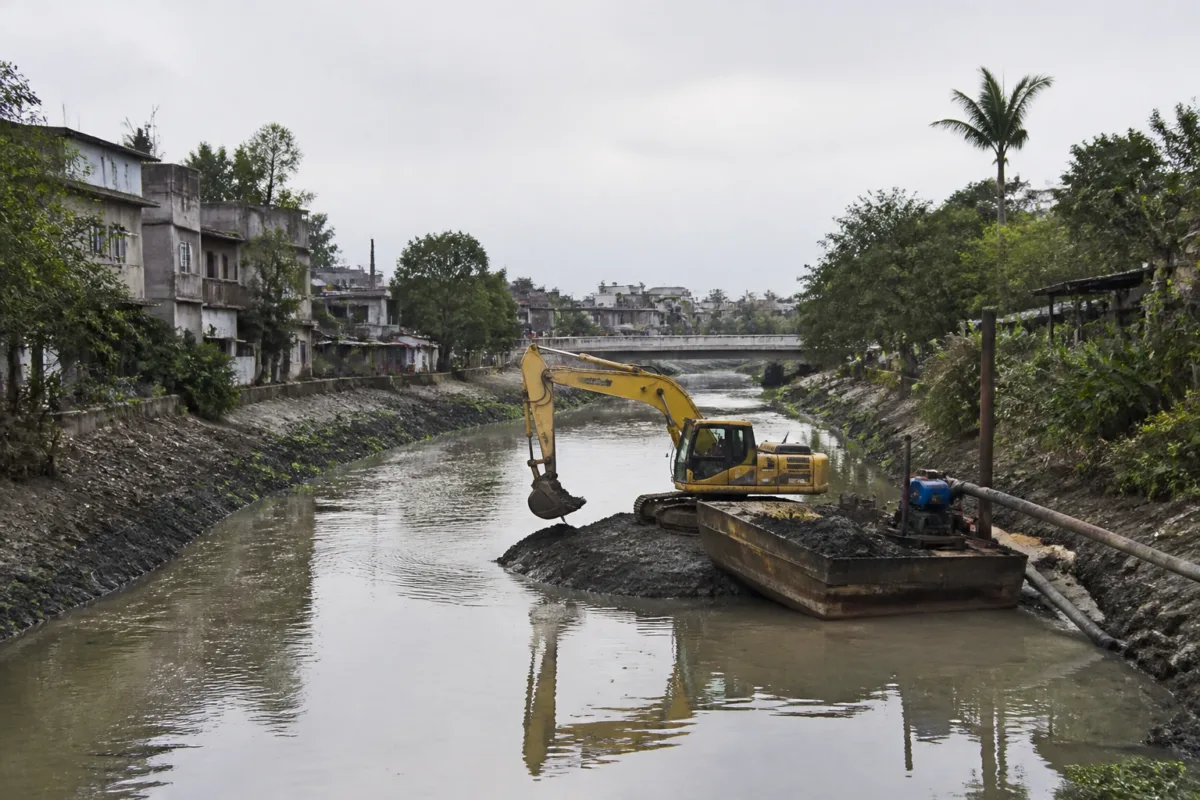
A new tender for dredging the Karala river in Jalpaiguri will cover a 15-kilometre stretch and remove an estimated 1,27,730 cubic metres of sand and silt, under a revised system that requires the selected agency to pay royalty to the state government for the extracted material.
The tender has been floated by the Bengal irrigation department after an earlier process was cancelled. The state finance department will determine the royalty rates, either per cubic foot or per cubic metre, before the agreement is signed with the successful agency.
Dredging is expected to begin by late November or December, although the schedule could be delayed, according to an irrigation department source quoted by The Telegraph. The work is planned to be completed within six months of commencement.
The project will cover the river stretch from near National Highway 27 and Jalpaiguri Government Engineering College to the Karala’s confluence with the Teesta. The route passes through Aravinda, Paharpur, Kharia and Mondalghat gram panchayat areas, as well as Jalpaiguri municipality. The department estimates that the volume to be removed is equivalent to about 45 lakh cubic feet.
The revised tender mechanism replaces an arrangement under which the agency would have handed over a portion of the extracted sand and silt to the irrigation department instead of making a direct royalty payment. That model raised administrative concerns related to the storage, transport and sale of the dredged material, prompting the department to cancel the tender before Durga Puja and invite fresh bids.
Krishnendu Bhowmik, chief engineer of the irrigation department’s northeast division, said the royalty-based arrangement would reduce administrative complications, improve the river’s carrying capacity and generate revenue for the state government. Irrigation department engineers will supervise the work and check whether dredging is carried out at the designated locations.
The Karala carries domestic wastewater and rainwater from several parts of Jalpaiguri town. The river has become considerably shallower over the past few decades and, during the dry season, water levels can fall below knee height in winter. During the monsoon, however, the river overflows and inundates low-lying areas including Samajpara, Paresh Mitra Colony, Pabitrapara, Hospitalpara, Dinbazar, Senpara and Babupara.
Bhowmik said the dredging is intended to improve drainage, reduce waterlogging and minimise the risk of flash floods caused by heavy rainfall in parts of Jalpaiguri. Environmental expert Raja Raut attributed the reduced depth and carrying capacity to sediment accumulation, which has left nearby areas vulnerable to flooding even when water levels rise only modestly.
The project follows earlier delays. A first tender floated during the previous Trinamool Congress government failed to attract bidders. A second tender was issued in January to avoid direct expenditure by the department, but was later withdrawn after concerns emerged over the handling of the extracted material. The next formal milestone is approval of the royalty rates by the finance department, after which the irrigation department will sign an agreement with the selected agency.

