


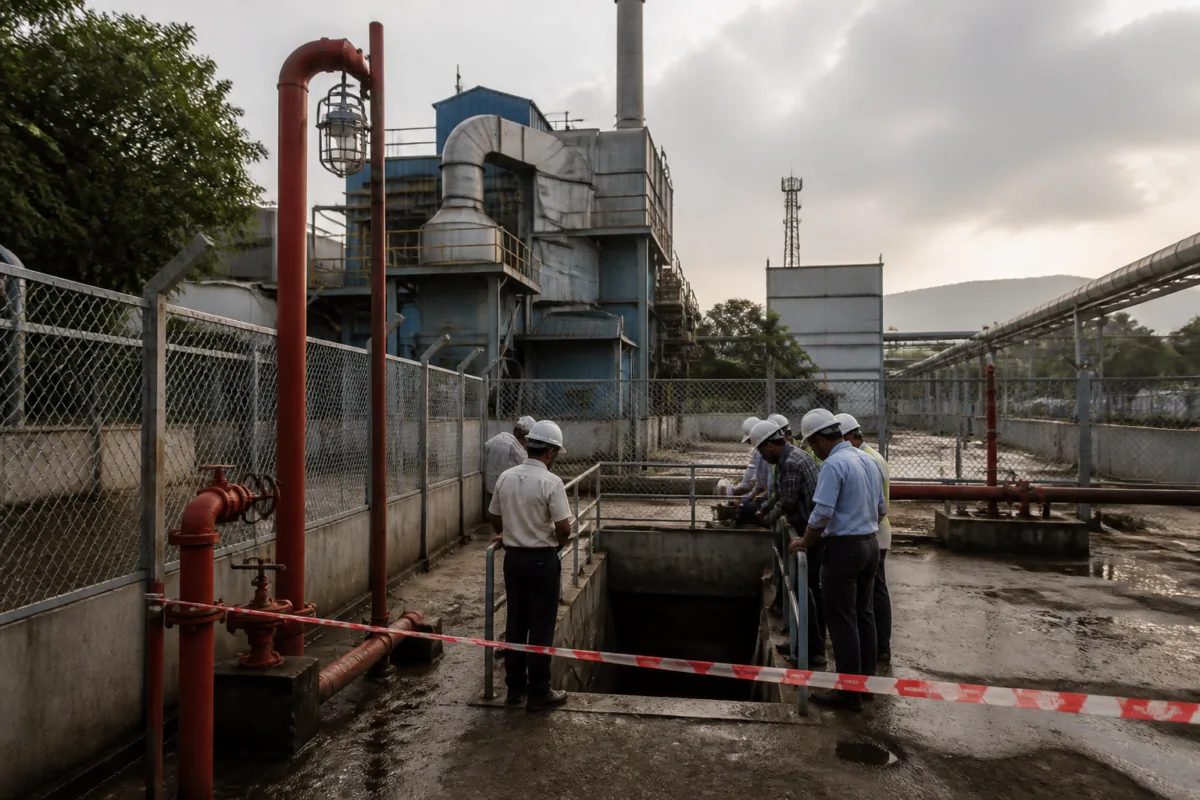
The Talegaon CO2 leak case has moved beyond an accident report into a test of how industrial safety responsibility is assigned inside a functioning plant. Two workers died and four were injured after carbon dioxide was released during the replacement of expired cylinders in the fire suppression system at Schaeffler India’s Talegaon MIDC plant. The company’s chief executive officer and managing director, Harsha Kadam, was later arrested, granted bail and named in a chargesheet filed by police.
The case, as reported by the Times of India and based on statements from Talegaon MIDC police, centres on an alleged mismatch between the plant’s approved layout and the way the CO2 cylinders were installed. Police said the cylinders had been kept in a basement pit without the necessary permission, and that the area did not have an exhaust fan or mechanical ventilation system. Officials from the Directorate of Industrial Safety and Health reportedly found that the pit did not conform to the company’s approved layout during an inspection.
Those details matter because they shift the focus from the immediate release of gas to the chain of approvals and safeguards that should govern hazardous installations. A fire suppression system is intended to protect a facility, but a system using CO2 can itself create a serious risk if the gas is released into an enclosed or poorly ventilated area. The allegations in this case suggest that the risk was not limited to the cylinder replacement operation. It may also have been embedded in the physical configuration of the plant, the permissions for that configuration and the absence of a mechanism to clear the gas.
The police account does not establish a final finding of guilt. It sets out the basis on which investigators have proceeded against eight people, including Kadam, the company’s safety officer and personnel from two contractors involved in the work. Kadam was described by police as the “occupier” of the premises. On that basis, the police alleged that he was responsible for the installation because modifications could not be made without his permission.
This distinction between operational responsibility and senior accountability is central to the case. Industrial facilities are generally operated through several layers: the owner or occupier, plant management, safety officers, maintenance teams and contractors. The presence of multiple parties can make a task more efficient, but it can also create gaps in responsibility if no one has clear authority to approve a modification, verify a safety measure or stop work when conditions are unsafe.
The reported involvement of two contractors adds another layer. The cylinders were being replaced when the leak occurred, and police initially registered an accidental death case before filing an FIR on July 4 naming six people. The investigation subsequently led to seven arrests before Kadam became the eighth accused to be arrested. The fact that a chargesheet has been filed indicates that police have completed the investigation stage described in the report, although the chargesheet’s detailed findings and the court’s assessment are not available in the supplied material.
The sequence also shows how industrial incidents can pass through different institutional stages. The deaths and injuries first resulted in an accidental death case. The police then registered an FIR, arrested accused persons and filed a chargesheet. Separately, officials from the Directorate of Industrial Safety and Health inspected the installation and assessed whether it conformed to the approved layout. These are distinct processes: criminal investigation examines alleged negligence and individual responsibility, while industrial safety oversight examines whether a workplace and its systems comply with prescribed requirements.
The reported inspection finding is therefore significant. Police said the basement pit did not conform to the company’s approved layout. That allegation raises a basic governance question: how are changes to a plant’s physical systems recorded, approved and checked after installation? A drawing or approval is not a safety control by itself. Its value depends on whether the facility built and operates the system in accordance with the approved design, and whether later alterations trigger a fresh review.
The alleged absence of an exhaust fan or mechanical ventilation system points to another control failure. In an enclosed pit, the consequences of a gas release depend not only on the quantity released but also on the space’s ability to disperse or remove the gas. The supplied report does not provide the dimensions of the pit, the quantity of CO2 involved, the precise exposure mechanism or the technical standard applied by inspectors. It does, however, identify ventilation as a specific issue raised by police. That makes the physical design of the installation an important part of the case rather than a background detail.
The incident also exposes the limits of treating maintenance work as routine. Replacing expired cylinders may appear to be a scheduled operational task, but it involves equipment connected to a safety-critical system and can expose workers to the contents of that system. The report does not say whether a formal work permit, gas monitoring, evacuation protocol or isolation procedure was used. Those details may be relevant to the eventual legal assessment, but they are not established in the supplied material. What is established is that the leak occurred during cylinder replacement and that investigators have alleged negligence linked to the installation.
The role of the company’s safety officer and contractor personnel indicates that safety management in an industrial plant is not confined to the chief executive’s office. Day-to-day controls may sit with technical teams, maintenance supervisors and contractors, while senior management may retain responsibility for the premises and major modifications. The case will therefore test how the court interprets the relationship between direct operational acts and the broader duty attributed to the occupier.
Kadam’s arrest and subsequent bail also illustrate the difference between police action and judicial determination. Police formally arrested him after he was discharged from Sassoon General Hospital, where he had been admitted after his blood pressure rose during a medical examination before a remand hearing. The court later granted him bail. Bail does not resolve the allegations; it determines the conditions under which an accused person remains available to the legal process. The chargesheet, meanwhile, presents the investigators’ case for consideration by the court.
For workers and surrounding industrial communities, the immediate concern is whether the physical and administrative conditions that allegedly contributed to the leak have been examined and corrected. The supplied report does not state whether the plant was shut, whether the CO2 installation was modified, whether other systems were inspected or whether workers and families received compensation. It also does not provide the names of the deceased or injured workers, their employment status or the outcome of their treatment. Those omissions limit what can currently be said about the broader human impact.
The institutional question is wider than one company. Industrial safety depends on a chain that includes approved layouts, equipment maintenance, contractor management, inspection, emergency response and legal accountability. A failure at any one point can become more dangerous when the next control assumes that the previous one worked. An installation that is not reflected in an approved plan, a pit without adequate ventilation or a maintenance task performed without sufficient safeguards can turn a preventive system into a source of harm.
At the same time, the case shows why accountability cannot be reduced to the identity of the most senior person arrested. The investigation names several categories of accused, including a safety officer and contractor personnel. The eventual legal findings will need to distinguish who authorised the installation, who carried out the work, who knew or should have known about the conditions and whether the alleged violations directly caused the deaths and injuries. The supplied report records the police allegations but not the defence version or the court’s detailed reasoning.
The Talegaon CO2 leak case therefore remains both a criminal proceeding and an industrial-governance signal. It confirms that police have filed a chargesheet after investigating an incident that killed two workers and injured four. It also records specific allegations about an unauthorised basement installation, inadequate mechanical ventilation and a departure from the approved layout. What remains to be established is how those conditions arose, who approved them, whether warnings existed and how the court evaluates the evidence.
The next significant developments will be the progress of the court case and any publicly recorded findings on the plant’s safety systems, the responsibilities of the accused and the corrective measures taken after the leak. Until then, the case’s clearest lesson is contained in the alleged gap between what an industrial facility was approved to contain and what was physically installed inside it.

