


The Brihanmumbai Municipal Corporation has announced a 28-point plan to curb Mumbai air pollution, including mandatory dust-control measures at construction and demolition sites, sensor-based monitoring and inspections by 76 ward-level squads.
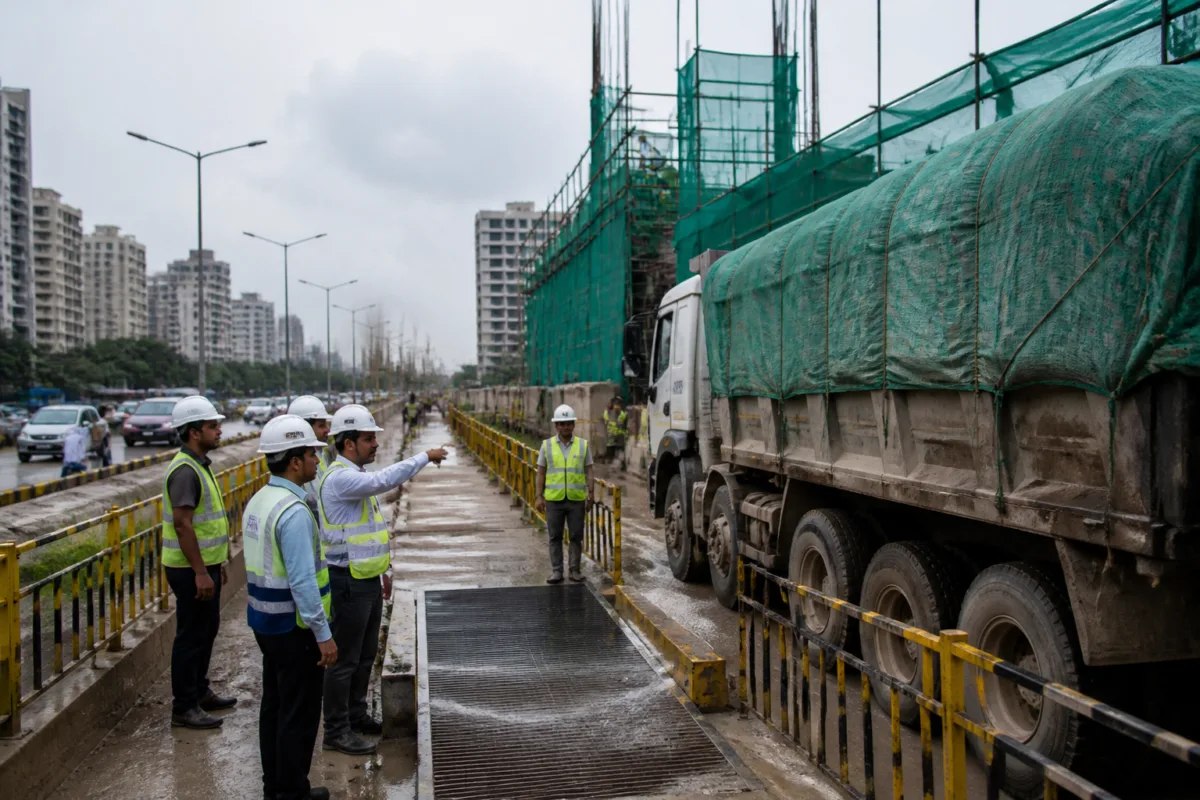
Under the guidelines, construction sites must be enclosed with green cloth, jute sheets or tarpaulin to limit the spread of dust. Structures being demolished must be covered from top to bottom, with continuous water spraying during demolition activities.
The rules prescribe metal-sheet barricades at least 3.5 feet high for projects taller than 70 metres and construction layouts spread over more than one acre. Sites covering less than one acre must have barricades at least 2.5 feet high. Water sprinklers or fogging systems are required during the loading and unloading of materials, while water must also be sprinkled on debris, soil and other materials that could generate airborne particulate matter.
Grinding, cutting, drilling, sawing and trimming must be carried out in enclosed areas with continuous water sprinkling or fogging to prevent dust from escaping. Construction sites must also install sensor-based air pollution monitors and take immediate action when readings exceed prescribed limits. Monitoring data must be made available to civic officials for inspection.
The BMC said 3,166 construction sites have installed sensor-based air quality monitors connected to a central dashboard. Sites must also install CCTV cameras along their perimeters to check whether vehicles leave after their tyres have been cleaned and whether vehicles are overloaded. Trucks transporting construction materials and debris must be covered on the top and all sides, must not be overloaded and must carry valid pollution-under-control certificates.
The civic body said 76 ward-level mitigation squads are conducting random and surprise inspections. Each squad is required to carry out at least two construction-site inspections daily and follow up on compliance at pollution hotspots. The squads comprise two ward engineers, one policeman, one marshal and a vehicle, and are headed by a senior ward officer.
Violations can result in show-cause notices, stop-work notices or sealing of premises. The BMC said enforcement action would be supported by site-specific inspection reports, photographs and videographs. Ward officials have also been directed to deploy special squads to prevent illegal dumping of construction and demolition waste, particularly at night.
Construction and demolition waste must be transported to designated unloading locations under the relevant waste-management plan. Vehicles must be washed and cleaned after unloading, while authorised disposal and movement are tracked through the Mumbai Debris Control and Tracking System. Developers and contractors are also required to clean adjoining roads according to the size of their construction sites and provide tyre-washing facilities at site exits.
The BMC said it carries out deep cleaning of roads to remove accumulated dust, supported by routine sweeping using 29 multipurpose vehicles. It is coordinating with the Traffic Police to check ready-mix concrete vehicles and take action against visibly polluting vehicles.
The plan also bans open burning within Mumbai, including at dumping grounds and other locations where waste may be burnt. Developers and contractors must arrange food for workers living at construction sites and provide electric heaters for security guards and labourers instead of allowing firewood and similar fuels to be burned.
According to the BMC, Mumbai recorded 231 days in the Good and Satisfactory Air Quality Index categories up to October 22, compared with 218 days in 2025, 216 in 2024 and 185 in 2023. The civic body also said PM10 concentration declined by approximately 48 per cent between 2017-18 and 2025-26, citing data from the Ministry of Environment, Forest and Climate Change’s PRANA portal.
The BMC said bakeries contribute approximately 35 per cent of Mumbai’s particulate matter emissions. Of the city’s 593 bakeries, 209 were using cleaner fuel, 175 had converted, 69 were undergoing conversion, 87 remained non-compliant and eight had closed. New bakery licences and permissions require the use of green fuel, with compliance to be verified before approval.
The civic body is also installing air pollution control devices at 10 crematoria. Its 2026 winter mitigation and enforcement plan covers pollution hotspots, open burning, construction-site compliance, road dust and vehicle checks. Ahead of Diwali, the BMC reiterated that firecrackers are not permitted on public streets, roads, lanes, footpaths, silence zones or other public places.

