


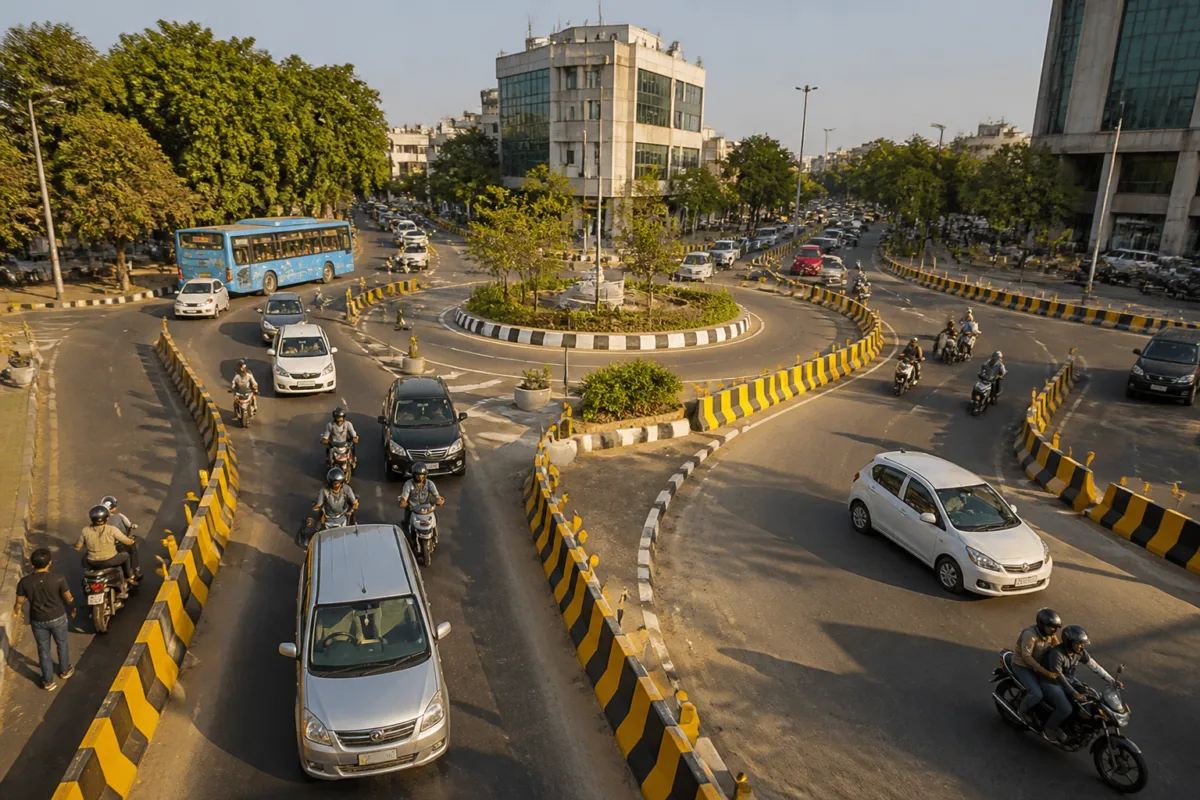
Ahmedabad’s traffic signal-free plan will target 104 major junctions over the next year, with the city traffic police and Ahmedabad Municipal Corporation preparing a joint master plan to address congestion and improve the movement of vehicles. The plan proposes capsule-shaped junctions, road design changes and the closure of selected direct cuts and crossings.
According to a report by Divya Bhaskar, the initiative is intended to create a continuous traffic flow across the city by reducing conflict points at major intersections. Under the capsule formula, a direct cut or straight crossing at a junction is closed permanently or temporarily using barricades or traffic islands.
The arrangement is designed to prevent vehicles approaching from four directions from entering the junction in direct conflict with one another. With traffic signals removed from the redesigned junctions, vehicles would be able to move through the intersection without stopping for a signal phase, potentially reducing waiting time for motorists.
The proposed changes are part of a wider master plan being prepared jointly by the traffic police and AMC. The report said that several circles in the city will be made smaller in the coming days, while road layouts will also be modified to support the new traffic arrangement.
Deputy Commissioner of Police (Traffic) Naresh Kanzariya said that additional road cuts would be closed and that the traffic flow would be made seamless. The statement indicates that the implementation will involve a combination of junction redesign, traffic islands or barricades and changes to the geometry of existing roads.
The plan’s stated objective is to make the entire city traffic signal-free within one year. However, the available announcement does not provide a junction-wise implementation schedule, details of the proposed road designs, or information on how pedestrian movement, public transport, emergency vehicles and access to adjoining properties will be handled at each location.
For residents and daily commuters, the immediate changes are expected to be visible at the junctions selected for redesign. Smaller circles, closed cuts and altered road approaches may change the routes used by motorists travelling between neighbourhoods. The effect on travel time will depend on how traffic is distributed after each direct crossing is closed and how effectively the redesigned junctions are managed.
The joint role of the traffic police and AMC places both traffic operations and civic road engineering at the centre of the initiative. The traffic police will oversee movement and enforcement, while the municipal corporation will be involved in changes to the road layout and physical infrastructure. The next phase is expected to include further junction modifications and the closure of additional cuts as the one-year target is pursued.

