


The Delhi High Court’s decision to quash an FIR against an SSC candidate who attended a protest at Ramlila Maidan has drawn an important line between being present at a demonstration and committing a specific criminal act. The ruling concerns not only one student and one police case, but also the way public authorities document, attribute and prosecute conduct during demonstrations in the city’s public spaces.
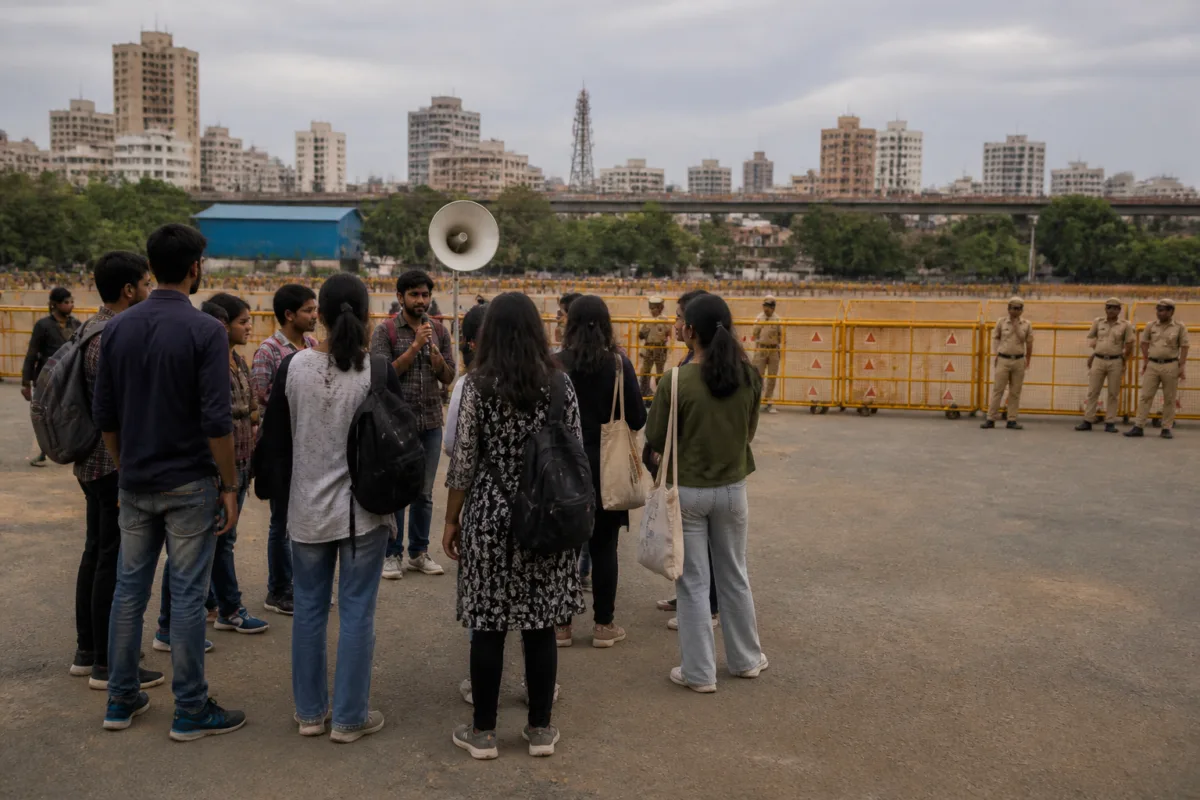
The case arose from a protest held at Ramlila Maidan in August 2025 over alleged irregularities in an SSC entrance examination. Delhi Police alleged that some protesters refused to leave after the scheduled time despite repeated announcements over a loudspeaker. The prosecution also alleged that some organisers encouraged participants to remain until their demands were met, that prohibitory directions issued under Section 163 of the Bharatiya Nagarik Suraksha Sanhita were violated, and that some protesters pushed police personnel.
The FIR was filed against an SSC candidate who was present at the demonstration. The Delhi Police case, as described in the court proceedings, treated the presence of protesters within the group alongside allegations concerning organisers and other participants. The High Court, however, found that neither the FIR nor the subsequent status report identified a specific criminal act by the petitioner.
Justice Sanjeev Narula’s bench held that mere participation in a protest does not, by itself, establish an intention to disobey a lawful direction issued by the police or to obstruct public servants in the discharge of their duties. The court also said that where there is no concrete basis to show that an individual shared a common intention with others to commit an offence, that person cannot be compelled to face criminal proceedings solely because they were present at the demonstration.
That distinction is central to the ruling. A protest is generally a collective activity, and police action at such events often begins with a broad description of what happened at the site. The court’s reasoning indicates that the later criminal case must still connect each accused person to the legal elements of the alleged offence. A general account of disorder, non-compliance or confrontation cannot automatically replace evidence of an individual’s conduct, knowledge or intention.
The ruling also addresses the requirements for prosecuting a person for disobeying an order issued by a public servant. The court said that the offence requires the relevant person to have knowledge of the order and to possess the necessary elements connected to its disobedience. The fact that a person was present at the same demonstration does not, on its own, establish that they knowingly violated the direction or intended to obstruct police work.
This is significant for the governance of large public spaces such as Ramlila Maidan. These venues are used for political meetings, public demonstrations, religious gatherings and other mass events. Managing them requires authorities to issue directions about time, movement, access and dispersal. It also requires a clear record of what orders were communicated, to whom they applied and how particular individuals allegedly breached them.
The High Court’s order places emphasis on that chain of accountability. The police may regulate an event and investigate alleged violations, but the existence of a regulation does not make every person in the regulated area criminally liable. The prosecution must still show how the individual accused became involved in the alleged offence. In this case, the court found that the material placed before it did not make that connection.
The distinction matters because protest-related cases can involve several different categories of conduct. One person may organise the event, another may address the gathering, another may remain after a dispersal order, while others may simply attend. These acts may have different legal consequences. Treating them as interchangeable risks converting presence into evidence of intention without establishing the facts required for criminal prosecution.
The ruling does not state that police directions at demonstrations are invalid, nor does it remove the responsibility of protesters to comply with lawful orders. The judgment, as reported, focuses on the evidentiary and legal basis required to proceed against a particular individual. Its concern is that the prosecution must identify the person’s own conduct and establish the necessary elements of the offence rather than rely only on association with a crowd.
That approach also affects how police reports and status reports are prepared. A broad description of an incident may explain why an investigation began, but it may not be sufficient to sustain proceedings against every person named in an FIR. The court specifically noted the absence of any particular criminal act attributed to the petitioner in both the FIR and the later status report.
For city administration, this creates a practical documentation challenge. Crowd management depends on timely communication, but criminal accountability depends on precision. Authorities must be able to demonstrate what order was issued, how it was conveyed, when it took effect, what conduct followed and which individuals were responsible for the alleged violation. Where those details are missing, the administrative handling of a demonstration can become difficult to translate into a legally sustainable case.
The case also shows how public-space regulation and civil liberties intersect in a dense capital city. Demonstration sites are not isolated from surrounding urban systems. Their use affects traffic, policing, public access and the operation of nearby areas. At the same time, the regulation of those spaces must distinguish between managing a gathering and criminalising participants without evidence of individual wrongdoing.
The court’s reasoning places common intention under particular scrutiny. Participation in a common event is not automatically the same as participation in a common criminal purpose. To proceed against a person on that basis, the prosecution must identify material showing that the individual was involved in the alleged offence or shared the relevant intention with others. Without such a foundation, presence becomes an insufficient basis for criminal action.
The decision therefore carries an institutional message for both sides. Police and local authorities retain the responsibility to enforce lawful orders and respond to obstruction or violence where evidence supports those allegations. Protesters, organisers and attendees remain subject to lawful directions governing the use of public spaces. But the legal process must separate those who allegedly committed a specific act from those whose connection to the incident is limited to being present.
The available report does not provide the full text of the High Court order, the exact wording of the FIR or details of any separate proceedings against organisers or other protesters. It does establish that the court found no specific criminal act attributed to the petitioner and concluded that the material did not demonstrate deliberate disobedience or a shared criminal intention. Those findings form the basis of the FIR being quashed against the SSC candidate.
The larger urban question is how cities can regulate collective activity without allowing administrative categories to become substitutes for individual evidence. Ramlila Maidan is designed to accommodate public gatherings, but the legal and policing systems governing such spaces must operate with equal clarity when events continue beyond permitted conditions or allegations of confrontation arise.
The Delhi High Court’s ruling does not settle every question about protest management. It does, however, confirm that the transition from crowd control to criminal prosecution requires a fact-specific account of each accused person’s conduct. The next point to monitor is how the ruling is applied in similar cases involving prohibitory orders, dispersal directions and alleged obstruction during public demonstrations.

