


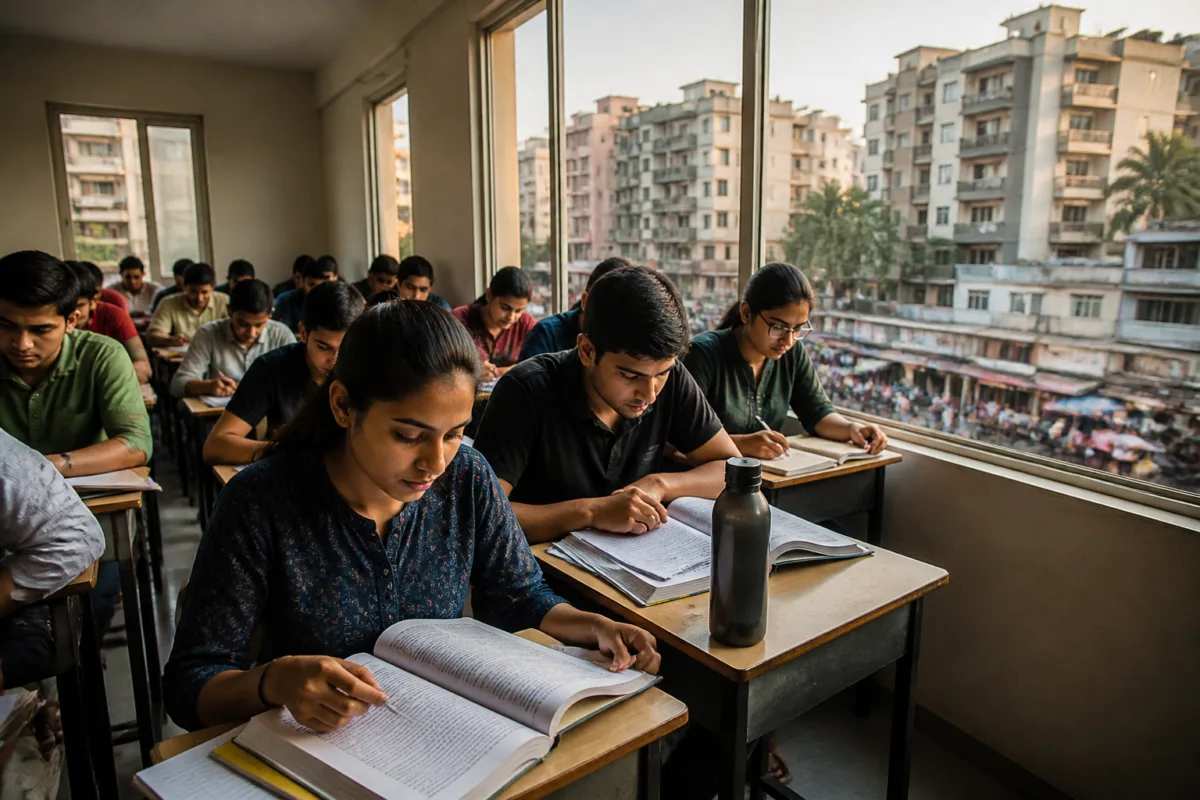
Pimpri-Chinchwad has become an important destination for young people from rural Maharashtra preparing for competitive examinations, but the city’s support ecosystem is becoming increasingly expensive for the very households that depend on government employment as a route to economic security. Food, rent, coaching, study rooms, books and examination fees now combine into a monthly and annual burden that many aspirants cannot meet without sustained parental support.
The issue is not simply that competitive-exam coaching has become costly. It is that preparation itself has become an urban consumption package. A candidate arriving from a farming, agricultural-labour or landless household needs a place to stay, regular meals, a quiet study space and access to teaching and learning material before appearing for an examination. Each of these requirements is tied to the city’s rental market, service economy and private education infrastructure.
Lokmat – Pune reported that around 50,000 young people are preparing for competitive examinations across Pimpri-Chinchwad. This includes 823 candidates studying in seven municipal competitive-examination centres and approximately 40,000 candidates using more than 20 private study centres and institutions. The figures indicate the scale of the city’s role as a preparation hub, even though the report does not provide a consolidated official count for all candidates.
The concentration of aspirants in areas including Chinchwad, Nigdi, Sangvi, Bhosari and Pimpri reflects a wider urban pattern. Students move towards locations where coaching institutions, study rooms and related services are available. The report says several well-known institutions that previously attracted students to Pune have also started operations in Pimpri-Chinchwad, creating what is described as a favourable study environment and drawing more candidates to the city.
But the same concentration that creates educational opportunity also raises the cost of participation. According to the report, two daily meals, tea and breakfast cost candidates approximately Rs 3,500 to Rs 5,000 a month. Accommodation costs between Rs 3,000 and Rs 7,000 a month. Even before coaching, study-room charges, books, examination applications and other educational material are included, food and rent alone amount to roughly Rs 6,500 to Rs 12,000 every month.
Private coaching adds a separate burden. Annual fees are reported to range from Rs 50,000 to Rs 75,000. For a student who spends the upper end of the reported monthly food and accommodation range, the basic living cost over a year can reach Rs 1.44 lakh, before coaching and study material. At the lower end, the same two expenses amount to Rs 78,000 annually. These calculations do not establish what every candidate spends, but they show why preparation can become financially difficult even without additional household or medical expenses.
## Competitive exam preparation costs and rural household stress
The urban affordability problem is closely connected to the economic conditions in the villages from which these candidates come. The report attributes the pressure on families to falling agricultural income, uncertain rainfall and a difficult financial situation. It also says that a drought situation has been declared in parts of Marathwada, Vidarbha, Khandesh and western Maharashtra after reduced rainfall and the failure of the kharif season.
For households dependent on agriculture or agricultural labour, sending a fixed amount every month to a child living in the city can be difficult when farm income is seasonal or uncertain. The student’s movement to Pimpri-Chinchwad therefore transfers part of the rural household’s financial stress into the urban economy. The city supplies the services needed for preparation, but the money supporting those services may come from families whose incomes are vulnerable to rainfall and crop performance.
This makes the preparation period different from a conventional short-term education expense. Candidates may spend several years preparing for examinations. During that period, they may have no independent income and may rely on parents for rent, food and coaching fees. The longer the preparation cycle, the greater the exposure to rising everyday costs and the greater the risk that a household will be forced to withdraw support before the candidate reaches an examination or selection stage.
The report cites an estimate that competitive examinations lead to the filling of approximately 450 to 470 government-service posts, while 7,000 to 8,000 candidates appear for the examinations concerned. These figures, attributed in the report to Jagannath Nerkar, founder-president of Soham Study Centre in Sant Tukaram Nagar, suggest a highly competitive system in which a large number of candidates may spend years preparing for a limited number of positions. The figures relate to the examinations described by the source and should not be read as a complete measure of all government recruitment in the state.
The resulting urban question is not only whether candidates can reach a coaching centre. It is whether they can remain in the city long enough to compete. A candidate may have access to a municipal study centre but still struggle with rent and food. Another may live in cheaper accommodation but lack a quiet place to study. A third may be able to pay for a study room but not private coaching. Access to one facility does not remove the cost of the wider preparation ecosystem.
## Municipal infrastructure helps, but does not solve the affordability gap
Pimpri-Chinchwad Municipal Corporation’s seven competitive-examination centres provide a public component within a largely private preparation market. The 823 candidates reported to be using these centres represent a form of municipal support for examination preparation. Such facilities can reduce at least one category of expense for those able to access them, particularly when private study-room charges are otherwise added to monthly living costs.
However, the presence of municipal centres does not by itself establish that the city has solved the affordability problem. The source does not provide details on capacity, eligibility, operating hours, fees, waiting lists, facilities or the geographical distribution of the seven centres. It also does not indicate whether the centres provide books, internet access, counselling or other services. Those missing details matter because the value of a public study centre depends on how consistently and affordably candidates can use it.
The contrast between 823 candidates in municipal centres and approximately 40,000 candidates in more than 20 private centres also shows the scale of the private market described in the report. The figures are not directly comparable because the source does not define the period, enrolment method or exact services included in each category. Even so, they indicate that municipal facilities form only one part of the city’s preparation infrastructure.
The city’s competitive-examination economy therefore operates across several layers: municipal study facilities, private coaching institutions, private study rooms, rental housing, food services, bookshops and transport connections. Candidates experience these sectors as one combined cost. Municipal intervention in only one layer may provide relief, but it cannot fully offset high accommodation or food expenses.
The institutional responsibility is similarly distributed. The municipal corporation controls or supports the public study centres. Private institutions set coaching and study-room charges. Landlords and accommodation providers determine rent. Families finance much of the preparation, while state recruitment authorities determine examination schedules, vacancies and selection processes. The report does not establish whether these institutions currently coordinate their support for candidates.
## The hidden cost of a government job pathway
Government employment is often pursued by young people from rural families because it is seen as a stable career path. The report describes candidates from farmer, agricultural-labour and landless households arriving in Pimpri-Chinchwad to prepare for officer-level government positions. Their migration is therefore linked to both rural economic uncertainty and the perceived security of public employment.
But the pathway to that employment requires an extended period in a city. The candidate must finance preparation before receiving any income from the occupation being pursued. This creates a reversal of the usual education model: the household bears the cost upfront, while the economic benefit remains uncertain and may arrive only after several attempts. When agricultural income falls or rainfall is inadequate, the preparation plan becomes vulnerable.
The report also highlights the risk of repeated unsuccessful attempts. Candidates may spend several years preparing, and failure to secure a position can create a separate employment problem. During that time, preparation may delay entry into other work, while the candidate accumulates living and educational expenses. The source does not provide data on how many candidates leave preparation, shift to employment or continue after unsuccessful attempts, so the scale of this outcome remains unestablished.
Nerkar has called for special government schemes that would provide training and employment opportunities according to candidates’ educational qualifications. This is a named stakeholder’s proposal, not an announced government policy. Its significance lies in identifying the gap between examination preparation and the broader employment needs of candidates who do not enter government service. A preparation ecosystem that serves tens of thousands of young people may also need pathways that prevent years of study from ending without usable skills or work opportunities.
The evidence supplied by the report confirms a cost problem, a large candidate presence and a limited public-service capacity relative to the reported private market. It does not establish the exact income profile of candidates, the change in rents or food prices over time, the number of municipal-centre users who receive fee support, or the proportion of aspirants who eventually secure jobs. Those are important gaps for any policy assessment.
What is clear is that competitive-examination preparation in Pimpri-Chinchwad is embedded in the city’s housing and service economy. The affordability of a study centre cannot be separated from the affordability of a room, a meal and the daily commute. For rural candidates, the city is both an opportunity platform and a recurring financial obligation. The next developments to monitor are whether municipal support expands, whether candidates receive assistance beyond study spaces, and whether public institutions create employment or training options for aspirants who do not secure limited government posts.

