


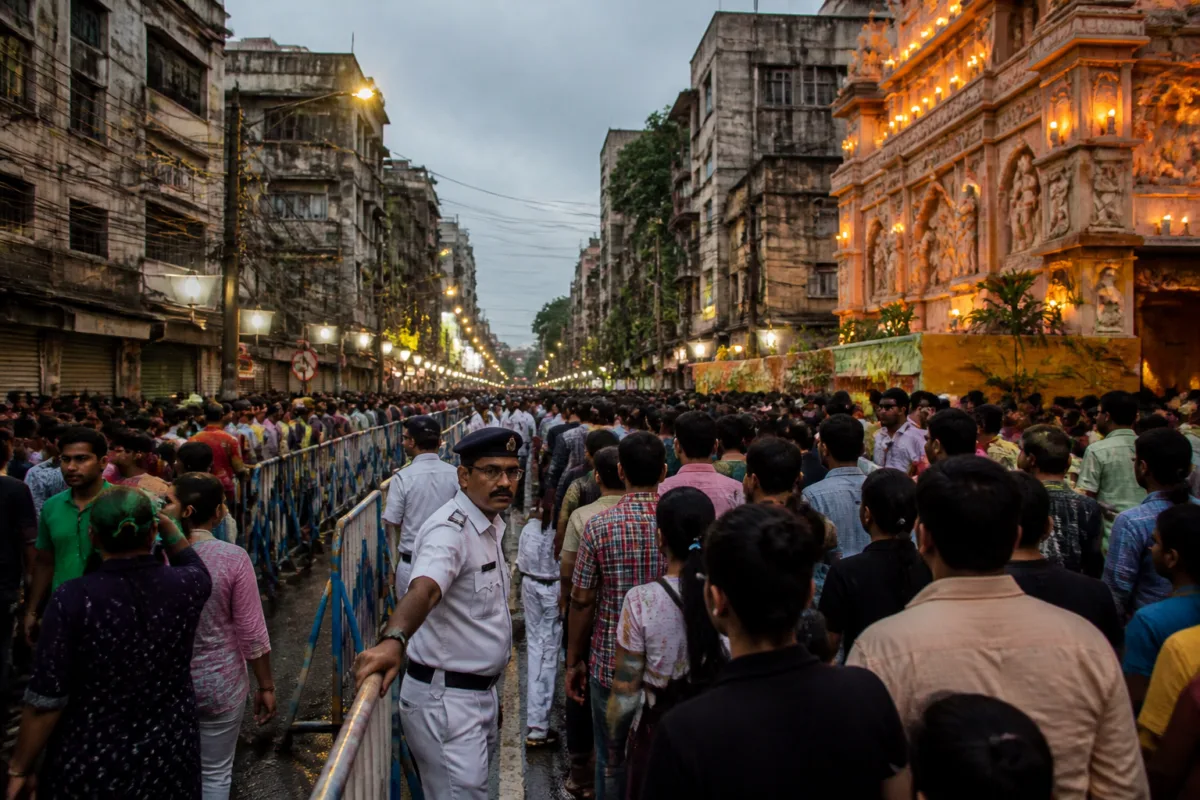
The Kolkata Durga Puja stampede that killed 19 people at the Chorebagan Sarbojanin pandal has exposed more than a failure at one festival venue. The incident has brought into question how a city that has managed enormous festive crowds for years is adapting to changes in police leadership, local organising committees, crowd routes and available personnel.
The Telegraph Online reported that the stampede on Saturday night was the first fatal stampede recorded in Kolkata during Durga Puja. The site was not unknown to crowd-management risks. A near-miss occurred at the same Chorebagan location four years ago, when one person died of cardiac arrest amid the crowd. Police officers who handled the earlier situation described a set of interventions that relied on controlling movement rather than simply increasing the number of personnel at the gate.
On that occasion, the crowd flow was altered so that visitors had to move several hundred yards towards the north before crossing Central Avenue and turning towards the pandal. When that detour did not sufficiently reduce the pressure, power supply to the pandal was switched off and waiting visitors were told that the disruption would last at least 30 minutes. The retired officer who described the operation said many people left, allowing the gates to reopen after the crowd had thinned.
Those measures illustrate the operational character of Kolkata’s festival crowd management. Safety depends not only on police presence but also on the ability to change routes, hold visitors back, create dispersal space and make decisions quickly when demand exceeds the capacity of a lane or entrance. In a city where many large pandals sit within dense neighbourhoods, the available road geometry can be as important as the number of officers deployed.
### A change in the people managing the crowds
The report identifies a transition at the top of the Kolkata Police as one of the central factors behind this year’s vulnerability. Commissioner Ajay Nand and most of the current divisional leadership had limited experience of managing Durga Puja crowds. Of the 10 divisional heads, only about three had handled the festival in the past, while many officers-in-charge of the city’s 91 police stations were also new to the task.
The issue was reportedly flagged at a meeting chaired by the police commissioner in July. Station officers were instructed to collect information about the pandals in their jurisdictions, including their themes and scale. A meeting with organisers was held at Nazrul Mancha in the last week of September, and police stations also held meetings with major organisers.
The sequence suggests that the administration recognised the knowledge gap before the festival. But gathering information and issuing instructions are not the same as transferring the practical experience required to manage a crowd that changes minute by minute. Earlier officers had developed familiarity with specific locations, bottlenecks and techniques such as drop gates and forced circulation. That institutional memory appears to have been less evenly distributed this year.
The state home department’s decision to recall nine IPS officers with previous experience of managing Durga Puja crowds in Kolkata, a day after the stampede, underlined the importance of that experience. A senior officer told The Telegraph Online that the officers had been recalled to assist with crowd management and prevent a repeat elsewhere in the city. The move was also seen by many as evidence of a gap exposed during the first year in 15 years in which Bengal’s biggest festival was being held under a new dispensation.
### Capacity is not only a question of deployment
The city’s police strength creates a second institutional constraint. More than 10,000 of the Kolkata Police’s 22,000 constable posts were vacant, according to the report. At the sub-inspector level, fewer than 500 of 1,200 sanctioned positions were filled, while around 15 assistant commissioner-level posts were also vacant.
A senior police officer told The Telegraph Online that constables formed the operational strength of the force and that shortages affected everyday law-and-order work, not only festival operations. The observation is significant because a major festival requires the police to perform several functions at the same time: regulate traffic, manage queues, keep emergency routes open, monitor access points, respond to incidents and maintain ordinary policing across the rest of the city.
This year, the Kolkata Police deployed 6,000 of its own personnel, along with an additional 6,000 each from the traffic and home guard divisions. The force also deployed 21,000 volunteers. The report said the overall deployment was similar to previous years, indicating that the problem cannot be reduced to a simple question of whether more people were assigned.
The more important question is how those personnel were distributed and commanded at points where crowd density rose rapidly. Kolkata Police had identified 247 major crowd-puller pujas. Police personnel were placed at 27 major pandals, while divisions were instructed to make arrangements for 10 to 15 smaller pandals each. The wider security plan included 30 mobile control vans, 20 Heavy Radio Flying Squads, 10 Special Radio Flying Squads, 42 watchtowers, seven mobile assistance police vans and three launches at the ghats.
These figures show a substantial logistical apparatus. They also show the scale of the challenge. The 247 major pandals reportedly attracted an average of 30,000 to 40,000 visitors an hour during the peak days from Saptami to Nabami. On one day last year, Chorebagan drew around 28,000 visitors in an hour, while Santosh Mitra Square, another major central Kolkata attraction, drew 48,000.
### The physical city sets the limits
Chorebagan’s location makes crowd management particularly demanding. Access to the 91-year-old Sarada Park puja is through narrow lanes including Parbati Ghosh Lane, Bhuban Banerjee Lane and Radha Madhab Lane. In earlier years, visitors entering from Central Avenue could disperse towards Bidhan Sarani. The report states that this option was unavailable this year.
That change matters because crowd safety is a network problem. A pandal may have a carefully managed entrance, but if visitors cannot disperse into alternative streets, the pressure accumulates outside the site. A route that is workable at moderate volumes can become unsafe when a popular installation attracts tens of thousands of people within an hour.
The police initially deployed one inspector and 25 personnel at Chorebagan. From October 13, after the crowd surge became apparent, the deployment was increased to two divisional commissioners, three assistant commissioners and around 100 personnel. The change indicates that the risk was not static and that the site’s operational requirements grew during the festival.
Retired police officers cited in the report described older practices in which senior officers were expected to remain on the streets at night and crowds were sometimes made to walk an additional two kilometres in a loop. Such arrangements could appear inconvenient to visitors, but they created distance between people and prevented an uncontrolled accumulation near a pandal. Drop gates served a similar purpose by limiting the number of people close to the entrance.
The evidence presented in the report points to a central administrative reality: crowd management is a live process, not a plan prepared once before the festival. It requires the authority to slow entry, redirect movement and temporarily close access even when the public expects uninterrupted viewing. That authority depends on experienced decision-makers, clear coordination and cooperation between organisers and the police.
### Organisers are part of the safety system
The report also describes changes among local Durga Puja organisers. Kolkata has nearly 3,000 pujas, many of which were previously patronised by leaders and ministers of undivided Trinamool Congress while the party was in power. Some committees have since changed hands, leaving new organisers responsible for large public gatherings.
One organiser from Jadavpur said that problems had emerged between organisers and local police stations and that the earlier rapport was missing. Another north Kolkata organiser said committees were given a state government circular containing general instructions, including keeping ambulance routes clear and ensuring adequate entry and exit points. Inspections were conducted by the Kolkata Police, the Kolkata Municipal Corporation and the fire services department.
The organiser also said that inspection teams should include officials from the public works department who were qualified to assess the weight-bearing capacity of structures. This raises a wider governance issue: a festival pandal is simultaneously a cultural venue, a temporary public building, a traffic attractor and an emergency-management site. Its safety cannot be assessed by one agency or through general instructions alone.
Questions have also been raised about the Chorebagan committee, which was replaced by a new group that included several members of the ruling BJP, including local MLA Vijay Ojha and a nephew of chief minister Suvendu Adhikari among the chief patrons. The report said that the artisans, private security agency and other personnel were changed after the old committee was removed. These details do not establish responsibility for the stampede, but they show how changes in local management can also alter the institutional relationships through which a pandal is planned and supervised.
### What the investigation must establish
The special investigation team examining the stampede is headed by retired Justice Anindita Roy Saraswati. She said three months was too short to submit the report but that the team would try to meet the deadline. Kolkata Police commissioner Ajay Nand did not respond to calls and messages from The Telegraph Online for the report.
The investigation will need to establish how the crowd entered and moved through the site, when pressure became dangerous, what emergency routes were available, how police and private security were positioned, and whether changes to the committee, site layout or crowd flow affected the operation. It will also need to examine the relationship between permissions, inspections and actual conditions on the ground.
The incident remains the only major blemish identified in the report on Kolkata Police’s handling of Durga Puja in 2026. That fact makes the institutional questions more specific, not less important. The city’s previous record demonstrates that large crowds can be managed, but it also shows that the methods are dependent on accumulated knowledge and on the willingness to impose controls that may be unpopular in the moment.
Kolkata’s Durga Puja safety challenge is therefore not simply about adding police, volunteers or equipment. It is about preserving operational memory during administrative transitions, matching crowd routes to the physical limits of neighbourhoods, and treating organisers as accountable partners in a citywide public-safety system. The special investigation team’s findings and the police response that follows will determine whether the Chorebagan stampede is addressed as an isolated failure or as evidence of a larger weakness in how the festival is governed.

