


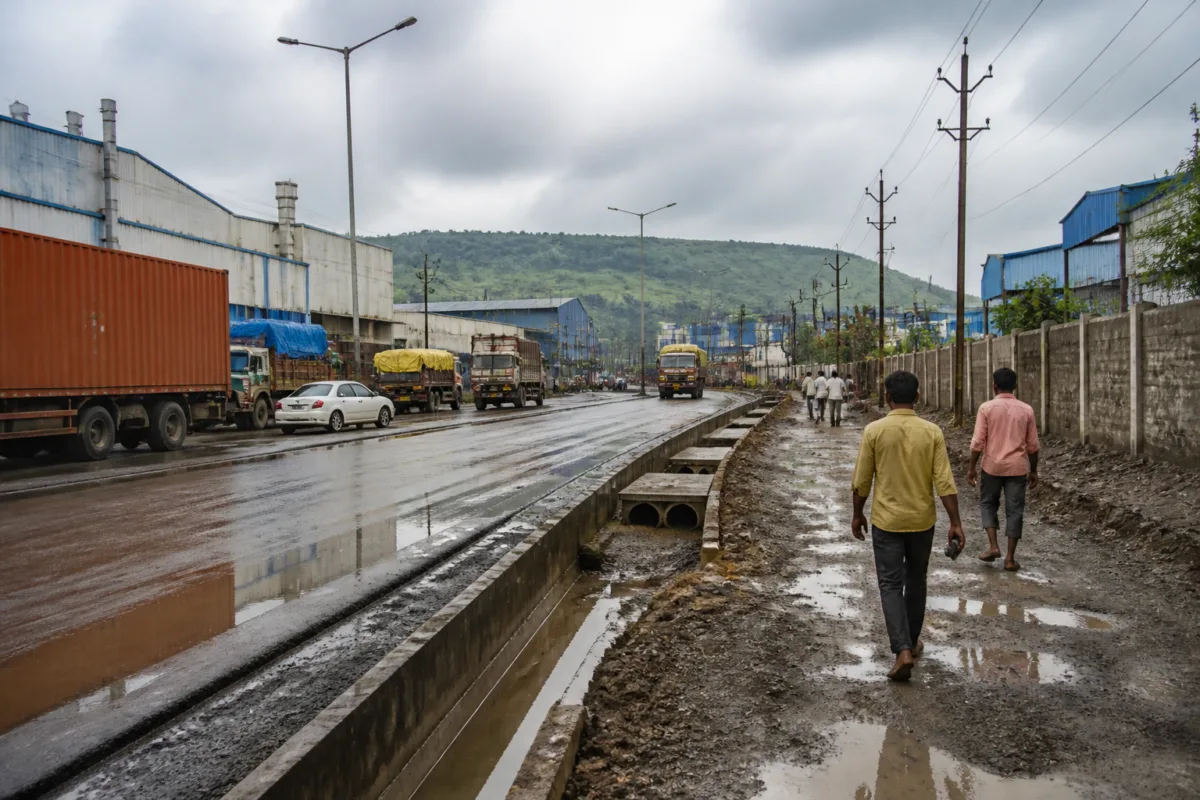
The Chakan infrastructure plan, estimated at approximately ₹1,400 crore, is an attempt to address a problem that has grown alongside Pune’s industrial expansion: the area has attracted factories and workers faster than it has built the roads, drainage, housing, public transport and civic services needed to support them. The programme covers about 78 km of roads, accommodation for nearly 15,000 workers, water and power augmentation, waste management and traffic controls.
The proposals were discussed at a meeting chaired by Pune District Collector Jitendra Dudi on October 21, according to the meeting minutes reported by Punekar News. Representatives of the Maharashtra Industrial Development Corporation (MIDC), Public Works Department, Pimpri-Chinchwad Municipal Corporation, Maharashtra State Electricity Distribution Company Limited, Maharashtra State Electricity Transmission Company Limited and other agencies attended the meeting, along with industrial associations and companies.
The range of agencies involved is significant. Chakan’s infrastructure problems do not sit within the responsibility of one municipal body or one industrial authority. Roads, drainage, land, electricity, water, public transport, traffic management and worker accommodation are controlled or influenced by different institutions. The proposed programme therefore reflects an effort to coordinate a fragmented governance structure rather than merely repair individual roads.
Its immediate pressure point is mobility. The meeting minutes refer to an estimated four to five lakh people travelling to and from the industrial area every day. Potholes, inadequate road shoulders, roadside encroachments, limited footpaths and truck parking were identified as contributors to congestion and safety risks. Industry representatives also raised concerns about increasing road accidents.
The proposed integrated road plan covers approximately 78 km and includes road improvements, stormwater drainage, streetlights, designated parking spaces, utility corridors and related infrastructure. The stated timeline for the road works and associated improvements is about 18 months. The Collector directed agencies to repair potholes, improve shoulders, remove encroachments and construct footpaths, with priority given to pedestrian safety.
This emphasis on footpaths is important because industrial mobility is often measured through vehicle movement, while the daily experience of workers is shaped by the last stretch between a bus stop, factory gate and residential area. The minutes identify inadequate footpaths as a major safety concern, but the supplied material does not specify the length, design standard or funding allocation for the proposed pedestrian infrastructure. Those details will determine whether the road programme changes how workers actually move through Chakan.
Drainage is the second major test. Authorities have been directed to survey the 78 km stretch and remove unauthorised encroachments obstructing natural streams, drains and watercourses. The minutes record that construction and encroachments along natural flow paths have contributed to flooding and waterlogging in the industrial area. A December 2026 deadline has been set for removing the identified encroachments.
The proposed action also illustrates the institutional complexity of flood management. PMRDA, PCMC, the Revenue Department, MIDC, gram panchayats and other authorities are expected to participate. Where government agencies have granted construction permissions, the concerned departments have been asked to examine the cases and take appropriate action to restore natural drainage in accordance with approved plans and applicable law.
That approach places the focus on restoring drainage corridors rather than treating each flood event as a standalone road or pumping problem. However, the minutes do not provide the number of encroachments, the specific watercourses involved or the process for resolving disputed permissions. The December deadline is therefore an administrative milestone, while the eventual flood-reduction outcome will depend on the survey, enforcement and physical restoration work that follows.
Worker housing is the plan’s most consequential proposal beyond transport. Accommodation for approximately 15,000 industrial workers is envisaged through dormitories and one- and two-bedroom residential units, along with schools, colleges, hospitals, playgrounds and other essential amenities. Industries have been asked to assess employee interest and communicate their requirements to the authorities.
The proposal recognises that congestion is partly a housing and employment-location problem. The minutes suggest that some workers could reduce daily commuting time by two to three hours if they lived closer to their workplaces, depending on their routes. That figure is presented as a potential reduction, not a measured outcome, and the material does not establish where the housing would be located, who would develop it, how rents would be set or which workers would qualify.
These unanswered questions are central to whether the housing proposal becomes an industrial workforce facility or a broader urban settlement. Dormitories may serve single workers, while one- and two-bedroom units could accommodate families. Schools, hospitals, public spaces and transport would be necessary if the development is intended to function as a complete neighbourhood rather than a residential annex to factories.
The plan also seeks to connect workforce housing with public transport planning. Industries have been given one week to submit employee commuting data, including origins, entry points, routes, travel timings, employee numbers and shift-wise movement. This information is intended to support planning for approximately 400 to 500 PMPML bus services between residential areas and industrial destinations, depending on requirements.
The wording is important: the minutes refer to planning bus services, not a confirmed procurement or deployment of 400 to 500 additional buses. The proposal will depend on the data supplied by industries, the final routes, operating requirements and coordination between the industrial area and Pune Mahanagar Parivahan Mahamandal Limited. It also links transport supply to shift patterns, a practical issue in industrial zones where conventional peak-hour planning may not reflect factory operations.
Industries have additionally been asked to consider staggered working hours and share shift-wise movement information. Truck operators, transport contractors and employees have been directed to use designated MIDC parking areas or parking within industrial premises. If MIDC parking is full, vehicles are expected to remain inside company premises rather than on public roads. The minutes estimate that effective implementation could reduce roadside parking by approximately 30 percent.
This is one of the plan’s clearest examples of infrastructure management extending beyond construction. New roads alone may not resolve congestion if freight vehicles continue to occupy carriageways or if employee travel remains concentrated at the same times. The proposed measures combine parking enforcement, employer cooperation, shift management and public transport planning. Their effectiveness will depend on compliance and on whether adequate off-street parking is actually available.
Water and electricity proposals show the scale of industrial demand. The Collector informed the meeting that a water supply allocation of 35 million litres per day had been approved for the Chakan Industrial Area. Maharashtra Jeevan Pradhikaran is expected to begin scheme-related work within four to five months. This timeline refers to the start of work, not the commencement of water delivery.
A plan to augment power infrastructure by approximately 100 MVA is also being pursued. MSEDCL, MSETCL and other agencies have been asked to strengthen supply in line with the approved implementation schedule. Together, the water and electricity proposals indicate that Chakan’s growth is creating utility requirements that cannot be addressed only within individual industrial premises.
Waste management is being planned through a proposed facility on approximately 36 acres made available by MIDC to PMRDA. PMRDA is preparing the plan, which is expected to be finalised in the coming months, followed by implementation. Once the facility is ready, surrounding villages and municipal councils will be responsible for transporting collected waste to the site for scientific processing and disposal.
This arrangement creates a clear chain of dependencies: land availability, plan finalisation, facility construction, collection systems and transport arrangements must all align. The minutes do not specify the facility’s processing capacity, technology, operating agency or implementation cost. Until those details are established, the proposal remains an important institutional step but not yet an operational waste solution.
The meeting also discussed the proposed Nashik Phata–Rajgurunagar elevated corridor, described as a major project expected to improve regional connectivity and industrial traffic movement. The minutes indicate a one- to two-year horizon subject to the project schedule. They do not establish a final completion date or explain how the corridor would interact with the local 78 km road plan.
Traffic enforcement is another proposed layer. An artificial intelligence-based monitoring system may be used to identify violations through vehicle registration details and other legally permissible evidence. The minutes specify that repeat offenders must be dealt with under applicable law and that any action involving driving licences must follow prescribed legal procedure. Approximately 100 personnel had also been made available to the Police Department for traffic management during construction.
The legal and procedural references are relevant because technology does not replace enforcement authority. A camera-based system can identify possible violations, but action must still follow the applicable process. The supplied material does not state whether the system has been procured, tested or approved for deployment, so it should be understood as a proposal rather than an operating system.
The delayed ESIC hospital was raised by industry representatives, with the Collector stating that the project was being treated as a priority after a meeting with the Chief Minister and Additional Chief Secretary. The minutes do not specify a firm completion date. The issue reinforces the gap between industrial employment and the availability of surrounding social infrastructure, particularly healthcare.
The Chakan programme’s larger significance lies in this combination of pressures. It is not only a road-upgrade plan, a housing proposal or a drainage-clearing exercise. It is an attempt to retrofit an urban system around an industrial concentration that has already generated large daily travel flows, freight movement, water demand, power demand and pressure on land and public services.
The programme also reveals the limits of project-by-project administration. A road can be widened while drainage remains blocked; a factory can expand while workers live far away; parking rules can be issued without enough designated spaces; and water allocation can be approved before delivery infrastructure is ready. The meeting brings these connected issues into one administrative framework, but the minutes do not yet establish a single integrated budget, delivery authority or public monitoring mechanism for the full programme.
The next milestones are therefore procedural as much as physical. Industries are expected to submit commuting data within one week. Authorities have set December 2026 as the deadline for removing drainage encroachments. Road and related infrastructure works are planned over approximately 18 months, while worker accommodation, utility improvements and other initiatives are envisaged over the next one to two years. MIDC’s Chief Engineer and Regional Officer are to coordinate between industries and government departments.
What the evidence confirms is that Chakan’s infrastructure deficit has become too interconnected for isolated repairs. What remains uncertain is whether the proposed timelines, agency coordination and industry participation will produce completed facilities at the scale discussed. The progress of the drainage survey, the 78 km road plan, worker housing design, bus-service planning, utility works and waste-facility proposal will determine whether the programme becomes a coordinated urban upgrade or another collection of delayed commitments.

