


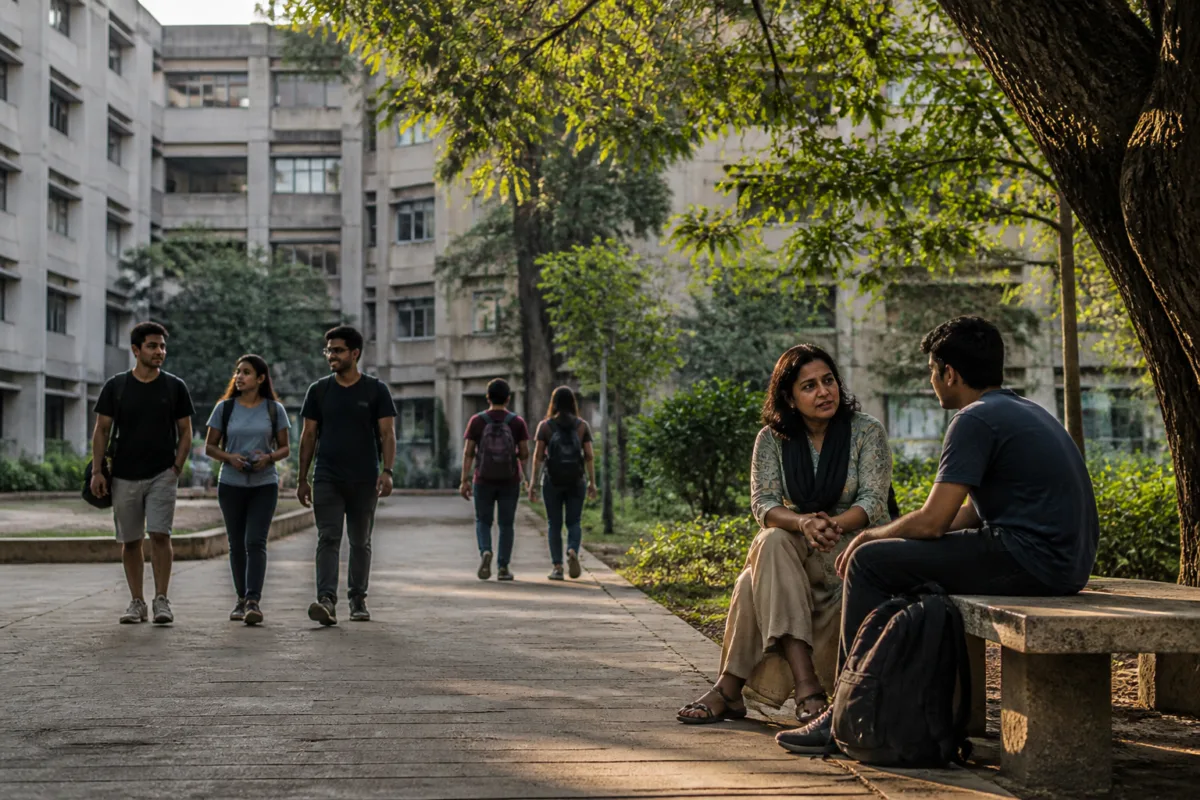
The mental health demands raised by IIT Bombay students after the death of a 20-year-old student last month point to a problem larger than the availability of counselling appointments. They raise questions about how a highly competitive residential campus identifies distress, distributes responsibility for student welfare and measures whether its support systems are accessible, trusted and adequately staffed.
Students submitted an 18-point draft of demands to the institute administration, with four demands directly addressing mental health services. They have sought at least one counsellor for every 250 students, a counsellor in every hostel, better in-person counselling, independent audits of the Student Wellness Centre, round-the-clock psychiatric support and a better-equipped hospital. They have also called for mental health sessions for faculty and staff every two months.
Taken together, the demands describe mental health as a campus-wide institutional responsibility rather than a service located in one counselling centre. That distinction matters in a residential institute where academic work, accommodation, peer networks, faculty relationships and career competition overlap in the same physical environment.
The accounts gathered from current students and alumni across different decades also complicate the idea that pressure at the Indian Institutes of Technology is entirely new. A former IIT Bombay student who studied there from 1975 to 1980 said the language of mental health was not widely used at the time. Academic pressure, he recalled, was present, but students had more time for music, sport, hobbies and friendships. Students who struggled often turned to professors rather than professional counsellors.
His account does not establish that earlier students faced fewer mental health difficulties. Clinical psychologist Dr Sreystha Beppari cautioned against assuming that such problems are more prevalent today simply because they are now more visible. Earlier students also faced deadlines, competition, isolation, homesickness and family expectations, but distress was often treated as a normal part of achievement.
The institutional difference is that students today are more likely to recognise psychological distress as a matter requiring formal support, while the pressures surrounding them have also become more continuous and visible. The report describes constant peer comparison through digital platforms, uncertainty about career stability and anxiety linked to technological change. Artificial intelligence has added concerns about employability, future opportunities and the value of existing expertise.
An alumnus from the 2007 batch described a period in which students competed with some of the country’s strongest academic performers while also building non-academic profiles for placements. Cumulative Performance Index scores remained important, but students increasingly understood that grades alone did not determine access to jobs. The result was not the disappearance of academic pressure, but the addition of more demands on students’ time and identity.
The same alumnus said friends and hostel wingmates were the main support systems. At the same time, social stigma discouraged students from approaching counsellors. This creates a structural tension for campus administrations: informal peer networks may provide the first line of support, but they cannot substitute for professional care when distress becomes severe or persistent.
Recent student experiences described in the report show how comparison operates at the campus level. One alumnus who graduated two years ago said the intensity of the IIT experience varied according to the hostel environment. Students faced stigma around backlogs and repeated courses, while placement packages and media attention given to high earners intensified comparisons. He recalled seeing students with internships paying Rs 1 lakh comparing themselves with peers receiving Rs 2 lakh stipends.
The pressure also extends beyond the campus. Family expectations can turn marks, internships and placements into measures of personal success. The alumnus described parents crying in front of their children after poor scores. Such accounts show why mental health cannot be treated only as an individual matter. The pressures are reproduced through families, peer groups, placement culture and the public celebration of exceptional outcomes.
The Student Wellness Centre is already used by many students, according to the recent alumnus. His assessment was that the help available was “just alright”. He also said students often approached the centre for personal or relationship concerns. This observation is important because it broadens the definition of campus mental health support beyond crisis intervention. Students may seek help for relationships, loneliness, academic setbacks, family conflict or uncertainty about their future before those problems become acute.
The students’ demand for one counsellor for every 250 students is therefore not simply a request for a larger number of appointments. It is a proposal about proximity and visibility. A counsellor located in each hostel would reduce the distance between support and everyday student life. It could also make help-seeking less dependent on a student navigating an unfamiliar central system while already under stress.
The demand for independent audits of the Student Wellness Centre points to a second issue: capacity is not the same as accountability. A centre may exist, yet students may find it difficult to approach, may not trust its confidentiality or may feel that conversations are not sufficiently student-friendly. A PhD graduate from an IIT who completed a degree in 2018 told Mid-Day that the campus therapist was not very approachable and that conversations at the support centre did not always feel student-friendly.
For postgraduate and research students, the source of pressure may also be located in the academic supervision structure. Dr Pranav Jeevan, who pursued a master’s degree at IIT Kanpur and research at IIT Madras and IIT Bombay, said a supervisor or guide can be a major source of stress. He recalled that some campuses could debar students if their CGPA fell below 6.5, adding another layer of pressure for those already dependent on supervisors and departmental systems.
This makes the mental health question partly a governance question. Students are not only service users; they are also participants in systems where faculty members, supervisors, hostel administrations, medical facilities and institute leadership hold different forms of authority. A counselling service cannot independently resolve stress created by academic rules, unclear grievance mechanisms or dependence on a single supervisor. The student demands, however, do not establish that every such institutional problem has been formally assessed at IIT Bombay.
The proposed reforms cover several levels of this system. Better in-person counselling and hostel-based counsellors address access. A psychiatrist available 24/7 addresses emergency response. A better-equipped hospital concerns the medical infrastructure available on campus. Independent audits address oversight, while regular mental health sessions for faculty and staff recognise that teachers and administrators also shape the environment in which students study and live.
The request for faculty and staff sessions every two months is especially significant because it places prevention and institutional culture alongside treatment. Students may hesitate to seek support if they believe that faculty members will interpret distress as weakness, poor commitment or academic inability. Training alone cannot resolve those concerns, but the demand indicates that students see staff awareness as part of the support system rather than as a separate workplace issue.
The report does not provide the current student population, the existing counsellor-to-student ratio, the number of psychiatrists available, response times, or the budget allocated to the Student Wellness Centre and hospital. It therefore cannot establish how large the gap is between present capacity and the students’ proposed standard. Nor does it record the administration’s response to each of the 18 demands. Those are important missing pieces for assessing implementation.
What the available accounts do establish is a widening definition of student welfare. Earlier generations often managed pressure through friends, professors and private coping strategies, while formal counselling was less visible. Current students are asking the institute to make support more local, continuous, professional and independently assessed. The shift reflects both greater awareness and a demand that the institution accept responsibility for the conditions it creates.
The central urban lesson is that a campus is a functioning settlement, not merely an academic facility. Its hostels, hospital, counselling rooms, classrooms, laboratories, supervisors and administrative offices form an interconnected environment. When support is concentrated in one centre or depends primarily on students finding informal help, the physical and institutional design of the campus can influence who receives assistance and when.
IIT Bombay students’ demands therefore place a measurable question before the administration: whether the institute’s mental health infrastructure matches the intensity and complexity of the pressures experienced by its students. The evidence supplied in the report confirms the demand for reform and documents concerns across generations, but it does not yet show which measures will be accepted, funded or implemented. The administration’s response, any independent assessment of the wellness centre and details of staffing and service capacity will determine whether the current debate produces structural change or remains a response to crisis.

