


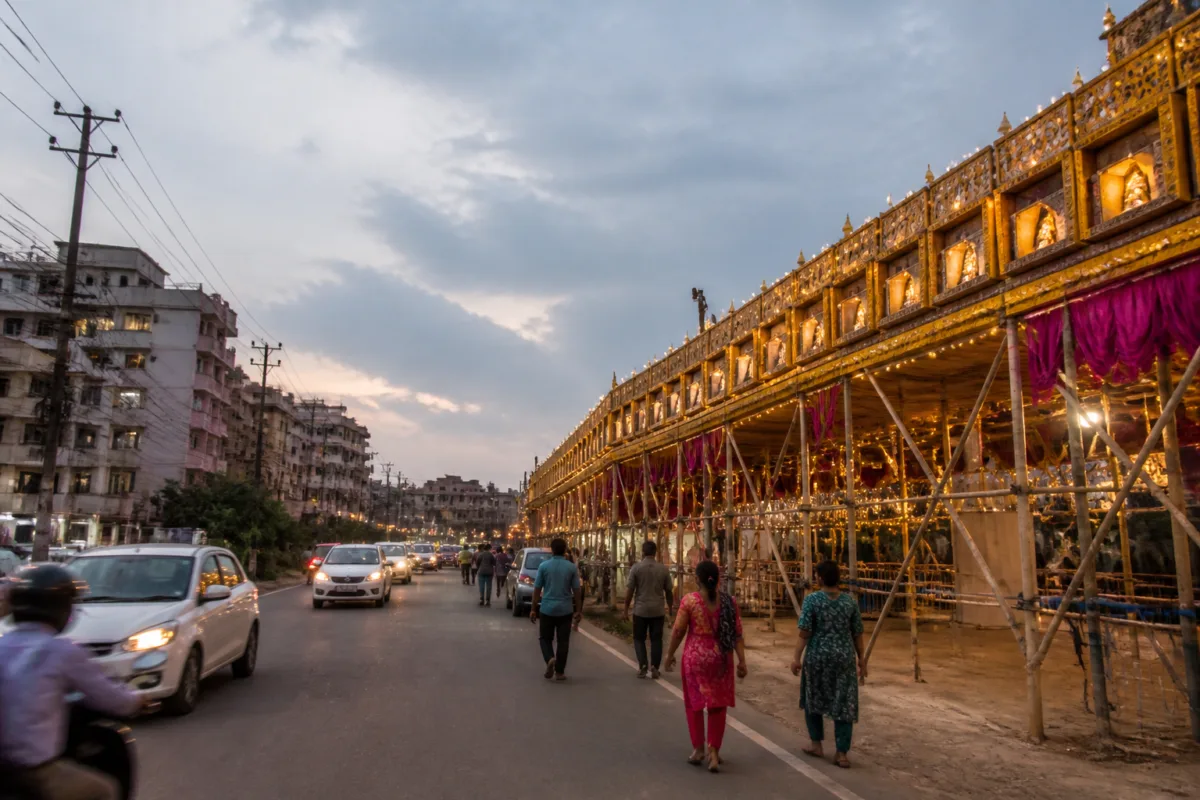
The Orissa High Court’s directions on festival pandals in Bhubaneswar have placed a basic urban question at the centre of religious-event permissions: how can public celebrations use shared streets without taking away residents’ access, traffic movement and emergency response routes? The court has not called for religious ceremonies to be stopped. Instead, it has required the state to ensure that public roads remain usable and that permissions carry enforceable safeguards.
The division bench of Chief Justice Harish Tandon and Justice Mruganka Sekhar Sahoo made the observations while disposing of a public interest litigation filed by 81-year-old Sarat Kumar Gajendra, a resident of Badagada in Bhubaneswar. The petitioner alleged that temporary structures erected for Ganesh Puja and Durga Puja, along with musical programmes, dance and orchestra performances, blocked a public road for about 10 days and made it difficult for him to reach his home.
The judgment was delivered on October 16 and uploaded on the court website on October 18. Its significance lies not only in the specific dispute but also in the way it frames public roads as common urban infrastructure. A road used for a festival does not cease to serve residents, vehicles or emergency services. The court’s directions therefore treat access as a continuing public obligation, even when a road is temporarily occupied for a community event.
The state government told the court through affidavits that puja pandals are not permitted to block roads completely and that a 22-foot passage is left for vehicles. The petitioner appeared in person and strongly contested that position. The bench said it would accept a statement that appeared reasonable when rival versions were presented through affidavits. That exchange points to an important administrative difficulty: a permission condition has limited value if there is no effective system to verify whether it is being followed on the ground.
The court’s observations establish several conditions for managing such events. Pandals and other structures must not completely disrupt vehicle movement. Residents must not be denied passage to enter or leave their homes. Adequate distance must be maintained for emergency vehicles to reach people during exigencies. Authorities must also enforce permissible sound limits and prescribed deadlines beyond which festive activities cannot continue.
The court further said that structures erected on public roads should be of appropriate dimensions so that they do not “eclipse the right of movement”. The wording is significant because it shifts the question from whether a celebration is religious to how its physical footprint affects the wider public. A religious purpose does not automatically permit the complete occupation of a public corridor, particularly when the same corridor is needed for access to homes and emergency response.
### Public roads as shared urban infrastructure
In fast-growing neighbourhoods, roads often carry several functions at the same time. They provide movement for private vehicles, pedestrians and service vehicles, while also acting as access routes to homes and local commercial areas. During emergencies, their value is not measured by ordinary traffic volumes. A passage that appears adequate during routine conditions may become insufficient when an ambulance, fire engine or other emergency vehicle needs to pass.
The case before the court arose from a temporary installation, but the underlying issue is a permanent feature of urban administration: public space is regularly assigned to competing uses. Festivals, processions, markets, construction activity and local events can all require streets to be occupied or diverted. The institutional challenge is to make those decisions without allowing a temporary use to become an effective denial of access for people who live along the route.
The court’s approach also avoids treating community celebrations and civic order as mutually exclusive. It declined to direct that religious ceremonies be stopped merely because concerns had been raised about traffic movement. Instead, it said celebrations could continue if reasonable safeguards were followed. This places the responsibility on the permission and enforcement system rather than on the existence of the event itself.
That distinction matters for municipal governance. A blanket prohibition may be difficult to implement and could ignore the social role of public celebrations. An unrestricted approval, on the other hand, transfers the cost of the event to residents who lose access, commuters who face disruption and emergency services that may be delayed. The court’s position seeks a regulated middle ground: allow the event, but preserve the minimum functions of the street.
### The gap between permission and enforcement
The affidavits filed by the state show that a numerical condition already exists: a 22-foot passage is reportedly left for vehicle movement. But the petitioner’s contrary account shows why written conditions alone cannot settle the issue. The question is not merely whether a clearance is mentioned in an approval. It is whether the clearance is physically available throughout the event, whether it is free of parked vehicles and crowd spillover, and whether emergency vehicles can actually use it when required.
The supplied judgment does not set out a new measurement system, an inspection schedule or a specific enforcement agency. It does, however, make clear that permissions must include safeguards against traffic disruption and that the state is responsible for ensuring compliance. That makes implementation central to the court’s direction. The practical effect of the judgment will depend on how local authorities translate these principles into permission conditions, inspections and action when structures or programmes exceed approved limits.
The court also addressed sound and timing. Festival programmes in the petition were described as including music, dance and orchestra performances. The direction to comply with permissible sound limits and prescribed deadlines recognises that the impact of a public celebration is not confined to the physical occupation of a road. Noise can affect residents, particularly when programmes continue late into the night, while extended activity can prolong road disruption beyond what was originally authorised.
The direction to maintain a “congenial religious atmosphere”, with little scope for unrelated activities, adds another layer to the permission process. It indicates that the approved event should remain connected to its stated purpose and that additional activities should not gradually expand the crowd, duration or physical footprint without administrative scrutiny. The judgment does not define a separate enforcement model for this requirement, but it reinforces the principle that permissions must be specific rather than open-ended.
### The institutional responsibility
The court placed the primary responsibility on the state to ensure that public movement is not completely disrupted and that people are not denied ingress and egress. In urban terms, this is a governance obligation rather than only a policing issue. A safe festival road requires coordination among the authority issuing permission, the agency responsible for traffic management, officials overseeing sound and timing conditions, and those who can respond when a structure exceeds its approved dimensions.
The case also shows the importance of documenting the conditions attached to temporary use of public land. The state relied on affidavits to explain the 22-foot passage requirement. The petitioner disputed the claim based on his experience of access being difficult. Where official records and ground-level experience diverge, enforcement becomes difficult to assess unless permissions, inspections and violations are recorded clearly.
The judgment does not establish that every festival pandal in Bhubaneswar blocks roads or that the state’s 22-foot condition is routinely breached. It addresses the dispute before the court and sets out the safeguards the state must ensure. That distinction is important: the case is evidence of a governance concern and a judicial direction, not a finding that all religious events create the same level of disruption.
For residents, the most direct issue is the right to reach their homes. The court specifically connected public movement with ingress and egress, making clear that access is not limited to through-traffic. A road may remain technically open while still becoming difficult or unsafe for residents to use because of crowds, parked vehicles, sound equipment or the placement of structures. The court’s wording requires authorities to consider these practical conditions rather than only whether a narrow passage remains on paper.
The judgment therefore turns a familiar local dispute into a test of how cities manage temporary claims over permanent infrastructure. Festival organisers seek space for community activity. Residents require reliable access. Traffic authorities must keep vehicles moving, and emergency services need routes that remain usable under pressure. None of these needs disappears because the road is being used for a limited period.
What remains to be seen is how the state and local authorities implement the directions during future festival permissions. The supplied judgment records the requirement for adequate passage, emergency access, sound-limit compliance, time restrictions and appropriately sized structures. It does not provide details of future inspection arrangements or identify a specific monitoring mechanism. Those administrative steps will determine whether the court’s principle becomes a routine feature of urban event management or remains only a condition in official paperwork.
The central lesson is straightforward: public celebrations can continue, but public roads cannot be treated as fully available for private or event-specific occupation. The Orissa High Court has placed the burden on the state to preserve access while permitting community activity. Bhubaneswar’s next challenge is to make that balance visible on the street, where a 22-foot passage, a noise deadline or an emergency route must work in practice rather than only in an affidavit.

