


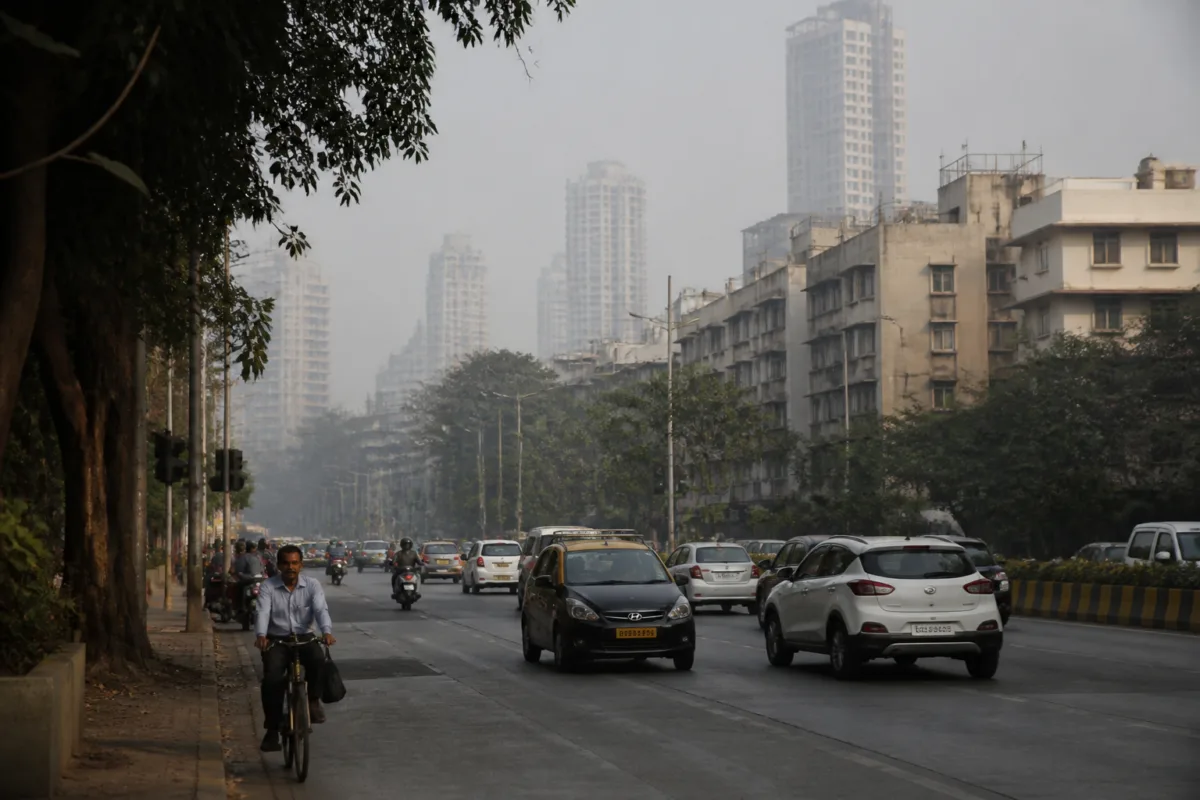
Mumbai’s air quality deteriorated sharply after Dussehra, with the city recording an Air Quality Index (AQI) of 165 and ranking fourth among the world’s most polluted cities on Wednesday, according to IQAir, a US-based air quality monitoring organisation. The reading also made Mumbai the most polluted city in India at the time, ahead of Delhi, which recorded an AQI of 164.
Kinshasa in the Democratic Republic of Congo topped IQAir’s global list with an AQI of 201, followed by Lahore in Pakistan at 190 and Kuala Lumpur in Malaysia at 180. IQAir identified PM2.5, fine particulate matter capable of penetrating deep into the lungs, as one of the prominent pollutants in Mumbai’s air.
The assessment was based on readings from six monitoring stations, including the US Consulate General in Mumbai. Its findings, however, differed from those recorded by India’s official monitoring network. The Central Pollution Control Board (CPCB) recorded Mumbai’s AQI at 113 on Wednesday afternoon, while Brihanmumbai Municipal Corporation and CPCB monitors recorded varying conditions across the city.
Among 23 active monitoring stations, Colaba recorded the highest AQI at 160, followed by Bandra Kurla Complex at 150 and Kherwadi in Bandra East at 142. Civic officials attributed the difference between the IQAir and government readings to the methodologies used by the two systems.
IQAir uses hourly averages to capture recent changes in air quality within a smaller geographical radius. CPCB and BMC monitors, in contrast, measure ambient air quality at specific locations. The different approaches can therefore produce different citywide readings from the same period, particularly when pollution levels vary significantly between neighbourhoods.
Despite the variation in measurements, official monitoring also showed that Mumbai’s air quality had worsened. The city’s average AQI had remained at 102 until Tuesday. The deterioration followed a broader early-season trend: Mumbai’s AQI crossed the 100 mark on October 2, earlier than the period when poor air quality typically becomes more persistent after the monsoon.
Mumbai commonly experiences worsening air quality during the post-monsoon months, when the withdrawal of rain leaves dust particles suspended in the atmosphere for longer periods. This year, dry weather associated with the El Niño phenomenon has contributed to an early withdrawal of the monsoon and reduced the possibility of relief from winter rainfall, according to the report.
Environmental scientist Tuhin Banerji said dry air moving from the Middle East was contributing to the conditions. He also pointed to sodium chloride from the sea being absorbed into the atmosphere and remaining suspended for longer. “There has been no relief and the air quality will further worsen in the week ahead,” Banerji told The Indian Express.
The immediate public-health picture therefore depends not only on Mumbai’s headline citywide AQI but also on neighbourhood-level readings and the pollutant measured. The difference between the two monitoring systems does not remove the evidence of deterioration: several city locations were already recording AQI levels above 140, while the city average had risen from the previous day. Further updates will depend on readings from the active monitoring stations and changes in weather conditions over the coming week.

