


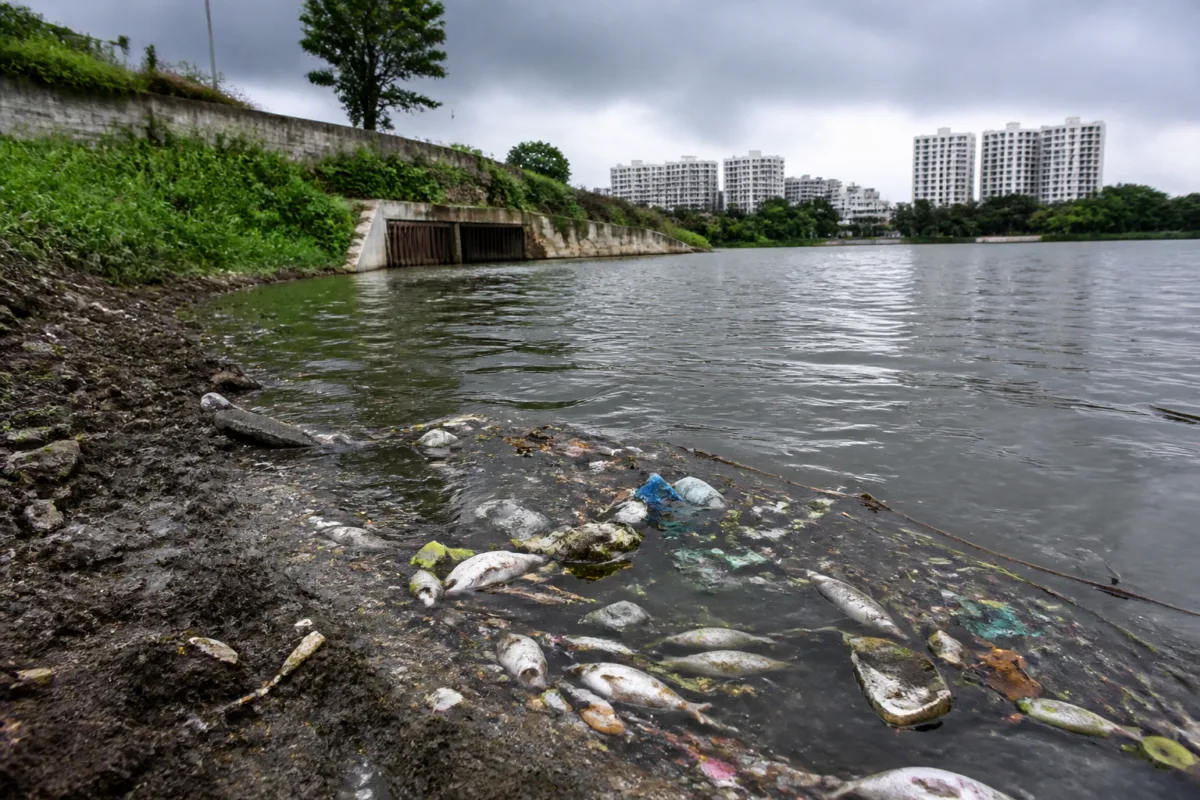
The fishkill at Siddapura lake near Brookfield is being described as a consequence of heavy rain, but the evidence in the incident points to a deeper urban systems failure: rainwater, sewage, solid waste and lake management are converging in the same drainage network. Hundreds of fish were found dead on October 19 after raw sewage and large quantities of trash reportedly entered the lake through a nearby rajakaluve, or storm-water drain.
The immediate event was visible at the water’s surface. Residents found several hundred dead fish, plastic bottles and other debris floating in the lake, while parts of the water body appeared murky and covered with algae. A strong stench was also reported. Yet the more important question is not only why fish died after one spell of rain. It is why a lake that residents say had shown signs of recovery after a restoration and plantation drive was still vulnerable to a sudden inflow of sewage and waste.
That distinction matters because the lake is not functioning as an isolated water body. It is connected to the city’s storm-water and sewage infrastructure, to nearby neighbourhoods and to the administrative systems responsible for preventing polluted inflows. When these systems fail during rain, the lake becomes the visible endpoint of a problem that begins upstream.
At Siddapura, local resident Vipin Chopra told The Hindu that he saw 500 to 600 dead fish during his morning walk. He also reported a large quantity of floating waste and said a smaller wetland near the lake had been receiving trash through a nearby drain. According to him, a barrier that had earlier prevented the waste from entering the lake appeared to have broken. He also said untreated sewage was flowing into the drain from nearby sewage pipes.
These observations establish what residents encountered, but they do not by themselves establish the precise chemical or biological cause of the fishkill. Chopra believed that the sewage and waste had caused the water to become murky and algae-covered, possibly reducing oxygen levels. A scientific water-quality assessment would be required to confirm the exact mechanism. The immediate administrative explanation, however, also points to sewage entering the lake during rainfall.
An official from the Lakes and Storm Water Drain Division of the Bengaluru East City Corporation confirmed that the department had received complaints about the incident. The official said heavy rain had caused sewage water to flow into the lake, adding that rajakaluves and manholes overflow when rainfall increases and that the resulting sewage inflow can sharply reduce water quality.
The official said the civic authorities had asked for the height of the lake inlet to be raised so that sewage would not reach the water body during rain. This is a corrective engineering measure aimed at limiting the transfer of polluted water into the lake. It also reveals the narrow point at which the administration is currently responding: after an inflow pathway has already carried contamination into the lake.
The institutional chain is more complicated than the lake’s boundary suggests. The storm-water drain carries water through the urban landscape, sewage pipes and manholes can overflow, and the lake receives whatever reaches its inlet. Residents said a Bengaluru Water Supply and Sewerage Board office is located about 500 metres from the lake and questioned why action had not followed complaints. Chopra said he had registered complaints through the contact details displayed on a board near the lake and had also written to the Karnataka State Pollution Control Board.
The report does not establish how each complaint was processed or whether responsibility for the broken barrier, sewage connections, drain maintenance and lake protection had been assigned to a single agency. That gap is central to understanding why urban water bodies repeatedly become sites of emergency response rather than continuous prevention. A complaint may be received by one authority, while the infrastructure causing the pollution is controlled or maintained by another.
Siddapura is also not presented as an isolated incident. The report notes that Bengaluru has recorded 16 major fishkill incidents this year. It also cites a study that recorded 61 fishkill incidents in the city over six years. Fish deaths were reported at Bhattarahalli, Munnekollala, Chelekere and Iblur lakes even when sewage treatment plants were present, raising questions about whether treatment capacity is being used effectively and whether treated and untreated flows are being kept separate.
The presence of sewage treatment plants, by itself, does not guarantee that lake inflows will be clean. The city’s lakes depend on the functioning of the entire network: household connections must reach the sewerage system, sewage must not enter storm-water drains, pumping and treatment infrastructure must operate, and inlets must be protected during rainfall. The Siddapura incident shows how a breakdown at any of these points can undermine restoration work carried out inside the lake.
This is why citizen-led greening and plantation drives, although valuable, cannot substitute for pollution control. Residents told The Hindu that Siddapura lake had been restored only about a year earlier and had appeared healthy since then. The recurrence of a serious fishkill suggests that visible improvements within the lake can remain fragile if external inflows are not monitored and controlled.
Madhuri Subbarao, co-founder of Friends of Lakes, urged the Greater Bengaluru Authority not to introduce aquatic life into lakes until scientific assessments confirm that the water quality is suitable for survival. She also called for mandatory quarterly water-quality monitoring of all lakes by the Karnataka State Pollution Control Board, along with timely corrective action rather than responses only after fish deaths occur.
Her position places scientific assessment before cosmetic or symbolic restoration. Introducing fish or other aquatic life into a polluted water body can make the lake appear ecologically active without addressing the conditions required to sustain that life. In the Siddapura case, the priority described by the source is not another restoration activity inside the lake but an assessment of the water and the pathways through which sewage and waste enter it.
Subbarao also described lake conservation as a joint responsibility involving scientific oversight, accountability and meaningful citizen participation. Her comments reflect the limits of a management model in which communities may invest time, effort and money in lake revival while the surrounding drainage system continues to carry pollution into the same water body. The result is a cycle in which restoration is followed by contamination, public alarm and reactive intervention.
The city’s recent incidents underline the pressure on this model. A massive fishkill was reported at Doddagubbi Lake only days before the Siddapura incident, while hundreds of fish were found dead at Sunkalpalya Lake in June. The recurrence across different lakes suggests that fishkill events should be treated as indicators of water-quality and drainage performance, not merely as isolated accidents following intense rain.
Rain is an important trigger in the Siddapura case, but it is not sufficient as an explanation. The official account says that heavy rain caused rajakaluves and manholes to overflow, sending sewage into the lake. That means the rainfall exposed the vulnerability of an infrastructure arrangement in which storm-water channels and sewage systems can interact during peak flows. The environmental damage becomes visible in the lake, but the underlying failure lies in the separation, capacity and maintenance of urban networks.
The source material does not provide laboratory results, rainfall measurements, dissolved oxygen readings, sewage-flow volumes or a completed inspection of the inlet and barrier. Those missing details prevent a definitive account of the precise cause and scale of contamination. They also show why routine monitoring is essential. Without time-series water-quality data, authorities and residents are left to infer causes from odour, colour, algae, dead fish and visible waste after the damage has occurred.
A functioning monitoring system would also clarify whether a lake is recovering or merely appearing healthy between pollution events. It could identify changes before a mass fishkill, establish responsibility for corrective action and provide a record against which restoration efforts can be assessed. The proposal for quarterly monitoring, as reported, is therefore connected to a larger administrative need: making lake health measurable and responsibility traceable.
Siddapura’s crisis ultimately raises a question about what counts as lake conservation in a fast-growing city. If conservation is limited to planting, fencing, desilting or improving the appearance of the water body, it cannot address pollution entering from outside the lake boundary. If it includes sewerage connections, drain maintenance, inlet design, waste interception, testing and public complaint systems, it becomes a citywide governance task.
The available evidence confirms that sewage and waste entered Siddapura lake during heavy rain and that the incident caused a large fishkill. It also records a wider pattern of similar incidents in Bengaluru and a demand for more systematic monitoring. What remains to be established is the precise pollution pathway, the measured condition of the water and the status of corrective work. Those details will determine whether the response remains a temporary barrier repair or becomes a broader effort to prevent Bengaluru’s drainage network from repeatedly turning its lakes into pollution sinks.

