


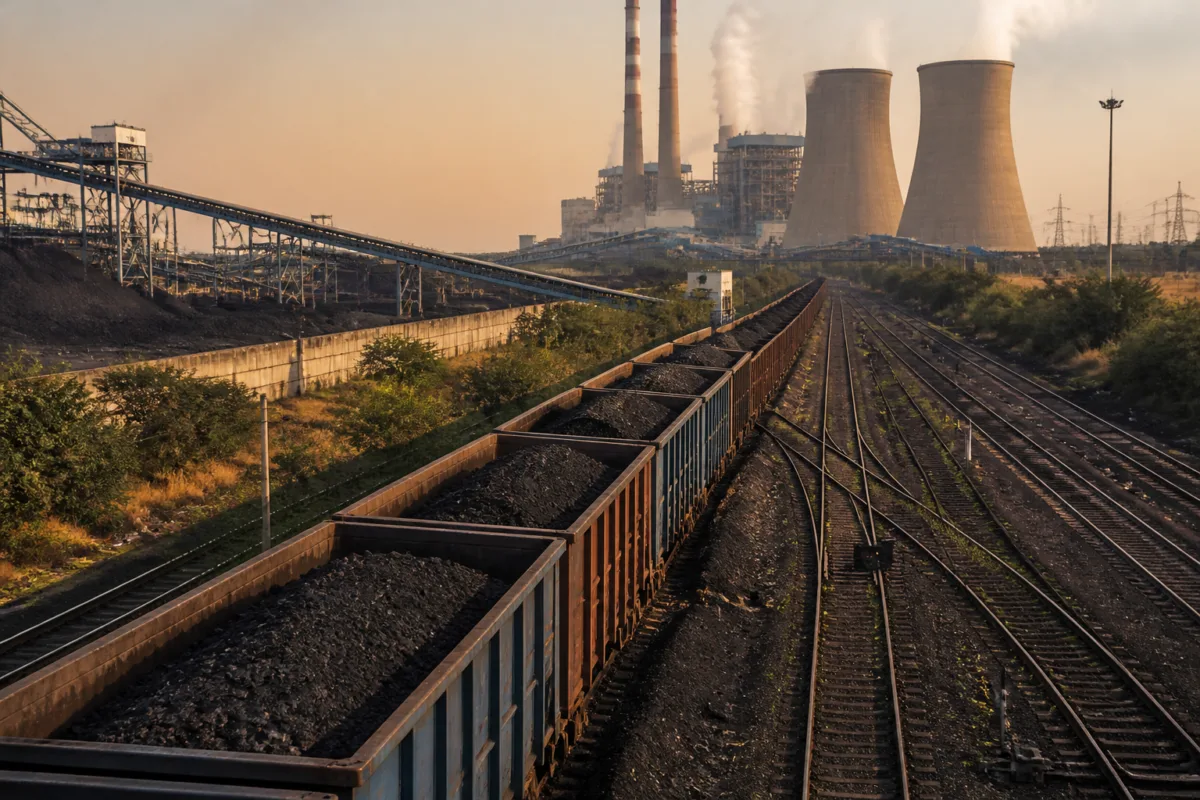
India’s coal power plants are under growing pressure as electricity demand rises, hydropower generation falls and fuel stocks decline to their lowest level in nearly five years. The immediate concern is not simply whether individual plants will run out of coal, but what the squeeze reveals about the country’s dependence on thermal generation to keep the grid stable when weather and renewable output move against it.
Central Electricity Authority data cited in the report showed that 96 of 191 coal-fired power plants had critically low stocks as of October 19, up from 60 in mid-September. Nearly half of the monitored plants had enough coal for fewer than three days of generation. The coal ministry has said that a critical-stock classification is a warning signal and does not necessarily mean a plant is about to shut down. It also said that plants with low stocks were being monitored and that supplies were being redirected to protect generation.
That distinction matters. A low-stock warning is not the same as a confirmed electricity outage. But it indicates that the operating margin between available fuel and required generation has narrowed. When demand rises unexpectedly or transport is disrupted, plants with only a few days of inventory have less capacity to absorb the shock. For a country where coal-fired generation remains central to meeting peak demand, the size and distribution of those stocks are an important infrastructure signal.
The pressure has emerged from two linked changes in the electricity system. Hotter-than-usual weather, associated in the report with El Niño, has increased electricity use for cooling and irrigation. At the same time, weaker monsoon rainfall has reduced hydropower output. The result is a larger requirement from coal plants at precisely the moment when the wider generation mix is providing less water-based electricity.
Daily peak electricity demand this year has been reported at 45 GW to 50 GW higher than a year earlier. In September, the gap between electricity demand and supply reached 560 million kilowatt-hours, the highest level since August 2023. Coal-fired power generation rose 13.3% year on year in September, while hydropower generation fell 20%, according to CEA data cited in the report.
These figures show why coal remains the system’s fallback even as India expands non-fossil generation. Nearly 55% of the country’s power generation now comes from non-fossil sources, according to the report. Yet the availability of generation is not the same as the availability of electricity when consumers need it. Solar and wind output varies, hydropower depends on rainfall and reservoir conditions, and the country does not yet have enough battery storage to retain large quantities of clean electricity for later use.
Coal therefore continues to perform a balancing role that is larger than its share in long-term energy transition narratives might suggest. When hydropower weakens and demand rises after the hottest part of summer, coal plants are expected to increase output. That makes the reliability of coal supply, rail movement and plant-level inventories an urban infrastructure issue, not merely a mining or power-sector concern.
## The supply chain behind the stock figures
The fuel squeeze is also a logistics problem. Coal has to move from mines to power stations in sufficient quantities and at the right time. The coal ministry said rail loading averaged more than 465 rakes a day in October, with the target of 470 rakes achieved on three consecutive days. It also reported higher movement by road and other modes.
The ministry has said that maintaining coal transportation at 465 to 475 rakes a day should help stabilise stocks and rebuild supplies ahead of festive-season, winter and next summer demand. This places the railways at the centre of electricity security. Even when coal is available at the mine, delays in loading, dispatch or delivery can translate into lower inventory at a power plant.
The stock data indicates that the problem has not disappeared, although the pace of depletion has slowed. Bloomberg calculations based on power ministry data showed that domestic coal-fired power plants recorded an average daily stock decline of around 48,000 tonnes during the first 17 days of October. That was about one-fifth of the daily fall recorded in September.
The slowdown gives the system some relief, but it does not erase the underlying exposure. A plant with only a few days of fuel has limited protection against a second demand spike, a transport interruption or a further fall in hydropower output. The ministry’s stated objective is therefore not only to prevent immediate disruption but also to rebuild inventories before the next period of high demand.
The government’s response also shows the tension between domestic supply, import costs and grid reliability. A proposal to ask power plants to blend imported coal with domestic supplies has reportedly been put on hold, according to Bloomberg reporting cited by the source. High international coal prices and a weaker rupee have made imports more expensive. Benchmark thermal coal prices were reported to be at their highest level in three years, while higher oil prices have added to the energy import bill.
Instead of compulsory imports, policymakers have asked state-owned Coal India to increase production and the railways to ensure that coal reaches power stations on time. This approach reduces exposure to international prices and foreign exchange movements, but it makes the domestic mining and transport system carry more of the burden. It also leaves less immediate flexibility if domestic output or rail availability fails to keep pace with demand.
## Why hydropower matters to coal stocks
The current episode demonstrates how closely different parts of the electricity system are connected. Hydropower is not simply an additional source of clean generation that can be measured independently of coal. When its output falls, coal plants must compensate if demand remains high. In September, the 20% decline in hydropower generation coincided with a 13.3% increase in coal-fired generation.
That substitution has consequences for fuel inventories. Coal plants are being asked to operate harder while receiving supplies through a network that must also serve a large and geographically dispersed fleet. The report said coal stocks at power stations had fallen by about 5% since the beginning of October. It also described current stocks as the lowest in nearly five years.
The pattern is especially important for cities. Electricity demand is concentrated in urban households, commercial buildings, transport systems, offices, hospitals, water facilities and industrial areas. Higher temperatures increase cooling loads in homes and workplaces. Irrigation demand can rise at the same time, adding pressure outside cities while competing for the same generation capacity. A national fuel-stock problem can therefore become a local reliability problem through supply restrictions, voltage management or pressure on distribution networks.
The source does not establish that widespread urban outages have occurred because of the current stock levels. Nor does it establish that the country is facing an imminent nationwide shutdown of coal plants. The coal ministry has explicitly said that critical-stock classifications are warnings rather than proof that plants are about to stop operating. The evidence instead points to a narrower operating margin and a system that is working harder to maintain generation.
## The policy choice is larger than coal imports
The decision to pause the import proposal reflects immediate cost pressures, but it also exposes a longer-term institutional question: how should India maintain reliable power while reducing dependence on fossil fuels? In the present system, coal remains the dependable source used to cover gaps created by weather-sensitive generation and rising demand. Storage, transmission and flexible generation would be needed to reduce that dependence, but the supplied report does not provide figures on the scale or pace of those alternatives.
The government has directed more than 100 captive coal-fired power plants to operate at full capacity from October 1 until the end of the year to meet expected demand growth. That order reinforces coal’s role as an emergency and peak-demand resource. It also means that fuel procurement and transportation must support not only regular operations at utility plants but also higher output from captive facilities.
The institutional responsibilities are spread across several parts of the system. The CEA tracks plant-level stocks and generation. The coal ministry monitors supply and transportation. Coal India is expected to raise production. The railways must move the fuel. Power plants must maintain operations, while distribution companies and grid managers must respond to demand and supply conditions. A shortfall at any point can weaken the performance of the entire chain.
This fragmentation makes headline stock figures difficult to interpret without context. The number of plants with critical stocks is a warning indicator, but it does not by itself measure the probability of an outage. Plant efficiency, location, daily consumption, delivery schedules and access to alternative supply all influence how long an inventory can last. The report provides the national trend, but not a plant-by-plant assessment of operational risk.
## What the evidence confirms
The available evidence confirms four developments. First, the number of coal plants reporting critically low stocks increased sharply between mid-September and October 19. Second, electricity demand has risen while hydropower generation has weakened. Third, coal generation has increased to compensate, accelerating pressure on inventories. Fourth, the government is prioritising higher domestic production and improved rail logistics over compulsory imports, partly because international coal prices and the weaker rupee have raised import costs.
There are also signs of stabilisation. The pace of stock depletion slowed in October compared with September. Coal supplies to the power sector were reported by the ministry to be around 36% higher than September levels. Rail loading improved, and the government expects demand to ease as temperatures fall. Forecasts cited in the report indicate that average temperatures may decline slightly over the following two weeks, although they are expected to remain above the 30-year average.
The uncertainty lies in whether these improvements will be sufficient to rebuild inventories before the next demand cycle. The report does not provide a definitive forecast of outages or a complete assessment of plant-level risks. It does, however, show that India’s power system remains vulnerable when several pressures occur together: hotter weather, weaker rainfall, higher demand, limited storage and dependence on a coal supply chain that must move hundreds of rail rakes every day.
The larger urban question is whether electricity planning is keeping pace with the changing conditions under which cities operate. Demand is rising not only because of population and economic activity, but also because heat changes how buildings, households and infrastructure use power. At the same time, rainfall variability affects hydropower and the reliability of a major generation source. The present squeeze is therefore both a fuel-management problem and a test of whether the wider electricity system has enough flexibility.
For now, the immediate measure to watch is whether coal stocks stop falling and begin to recover as temperatures moderate and supply improves. The next milestones are the maintenance of daily rail loading, higher domestic coal production, the operation of captive plants through the end of the year and the performance of hydropower during the weaker-rainfall period. Those indicators will show whether the current warning remains manageable or becomes a wider reliability challenge.

