


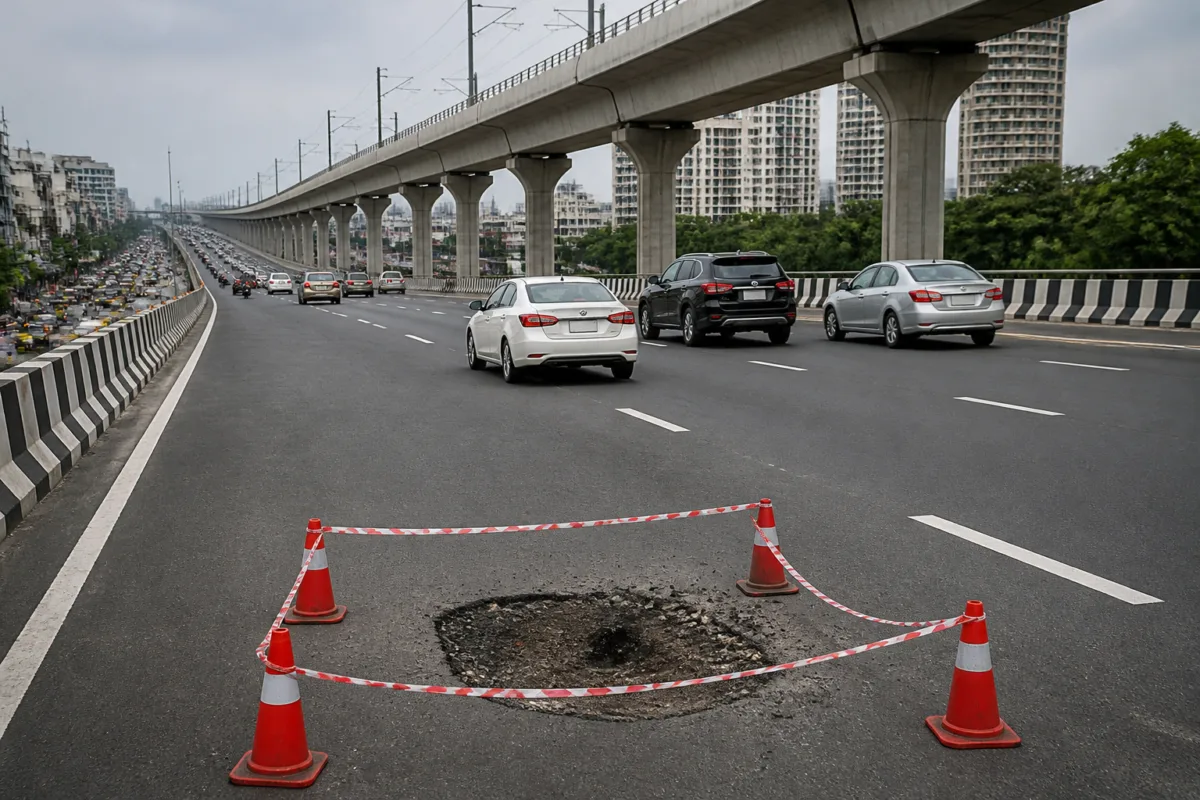
Noida’s proposed six-lane elevated road from the Rajnigandha underpass near Sector 3 to Sector 60 has reached the detailed project report stage, while a fresh pothole on the existing elevated road has triggered a structural investigation by the Noida Authority, IIT Roorkee and the Uttar Pradesh State Bridge Corporation.
The proposed road will be 5.49 kilometres long and is expected to cost around ₹850 crore, according to a report by Live Hindustan – NCR. The Noida Authority commissioned IIT Roorkee to prepare the DPR. The institute is expected to submit the report to the authority within a week, the report said.
The elevated route is planned to begin at the Rajnigandha underpass in Sector 3 and pass through Sector 10, Sector 12, the Sector 22 T-point and Sector 57 before reaching Sector 60. The authority has recently approved a change in the alignment near the Rajnigandha underpass, a modification that had delayed the project because the route had not been finalised.
The most technically challenging section is expected to be the turn near the Sector 12 and Sector 22 T-point. IIT Roorkee has given particular attention to the curve design at this location, according to the report. Once completed, the route is expected to make travel between the Delhi-Noida Direct Flyway and Sector 62 easier by providing a direct elevated connection towards the northern sectors.
The proposed corridor is being advanced as the existing road network continues to face maintenance concerns. A pothole was reported on Tuesday near the ISKCON temple in Sector 33, on the elevated road section serving traffic towards Sector 18. The affected structure forms part of the approximately 4.8-kilometre elevated road between Sector 27 and Sector 60.
The Noida Authority has barricaded the affected area and started an investigation with IIT Roorkee and the State Bridge Corporation. The pothole occurred on the road surface in an area of about half a square metre. According to authority engineers cited in the report, the condition of the road aggregate and bituminous layer needs to be examined to determine whether the surface material has broken or sunk.
The affected section is disrupting traffic across roughly two lanes and has caused difficulty for vehicles approaching from Sector 61. The report said the surface had earlier subsided on the road leading towards Sector 18. Repairs were carried out and traffic was allowed to resume, but the subsequent pothole led the authority to order a structural technical test after bridge corporation engineers were unable to establish the cause immediately.
A similar subsidence had also been reported last month while vehicles were descending towards Sector 18. The repeated defects have raised concerns among road users about the construction and maintenance of the existing elevated corridor. The authority’s technical investigation and the forthcoming DPR submission are the next official steps for the two connected infrastructure issues.

