


The Nashik district administration has ruled out releasing dam water for religious rituals, including the Dhwajarohan ceremony of the Simhastha Kumbh Mela scheduled for October 31, citing government rules and drought-related water concerns. Officials have instead directed civic authorities to prevent sewage from entering the Godavari and improve water conditions at key pilgrimage sites.
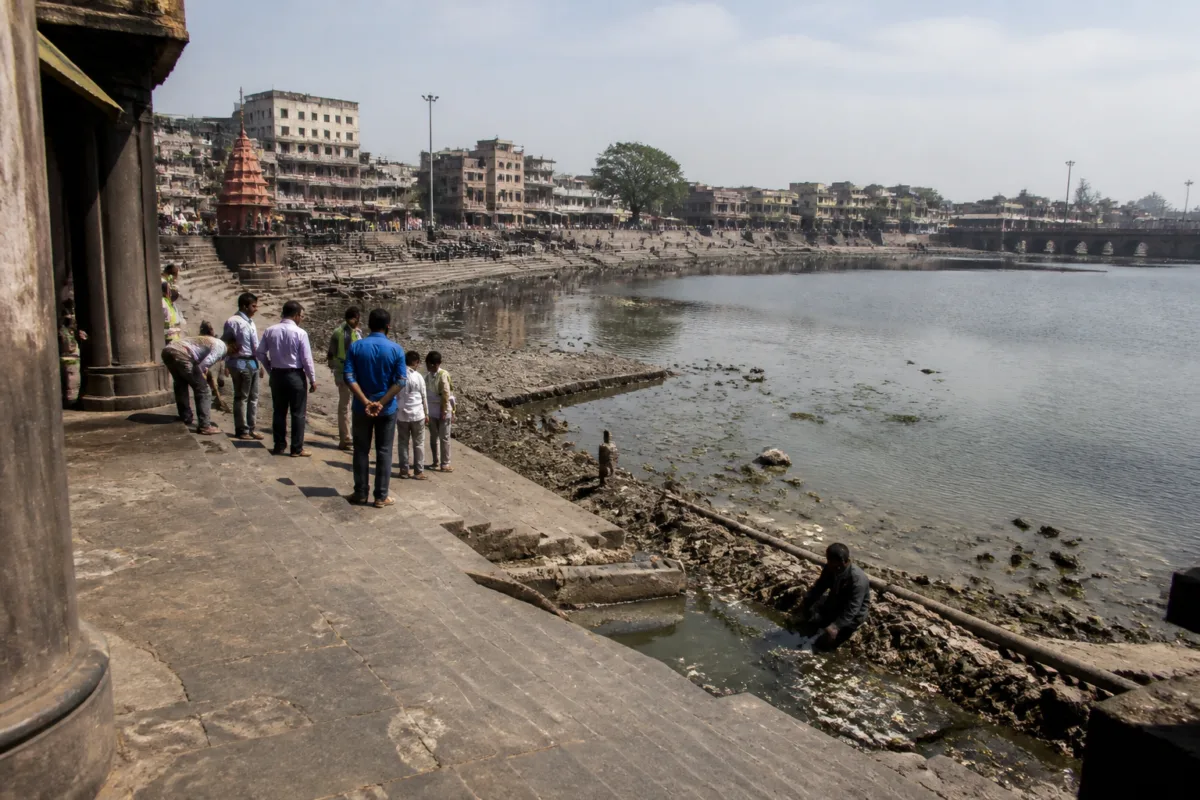
The decision was discussed at an October 16 meeting of the Nashik Trimbakeshwar Kumbh Mela Authority (NTKMA), chaired by Kumbh Mela minister Girish Mahajan. Officials reviewed the dry conditions at Ramkund and the Aruna-Godavari confluence, where water levels have also been affected by ongoing construction activities.
A senior NTKMA officer said the Nashik Municipal Corporation had been asked to ensure that drainage was not released into the Godavari and to remove stagnant water from affected areas. The need to maintain at least two feet of water at the locations was also discussed, the officer said.
NTKMA commissioner Shekhar Singh said a meeting with the water resources department would be held to assess the situation. “Against the backdrop of the drought, a meeting will be held with the water resources department to assess the situation and take a call,” he told reporters on Sunday.
However, collector Ayush Prasad said releasing water for religious events was not permitted under the existing policy framework. “We have not received any such demand from NTKMA. Since the govt resolution does not allow the release of water for this purpose, we cannot release it,” Prasad said.
The administration’s position comes despite relatively high reservoir storage in the district. Nashik’s reservoirs currently hold 67 TMC of water, or about 95% of their combined capacity, compared with 92.5% during the same period last year. Storage in the Gangapur dam complex stands at 9.9 TMC, or 96.5% of capacity, against 98.8% last year.
Officials said reservoir storage alone does not determine whether an area is drought-affected. The district administration attributed the drought situation to the distribution of rainfall and falling groundwater levels, which have increased water demands from villages. Water reservations also have to account for requirements from local bodies, industries, farmers and other users.
A senior district official said Nashik taluka itself was not classified as drought-hit, while downstream Niphad taluka fell under the drought category. The official also said unexpected water demands had emerged, while some formal proposals were still awaited.
The administration has therefore placed the immediate focus on river pollution control and conditions at pilgrimage locations rather than diverting stored dam water for ceremonies. The NTKMA is expected to consult the water resources department before further decisions are taken, while civic authorities are responsible for stopping sewage discharge into the Godavari and clearing stagnant water from affected areas.

