


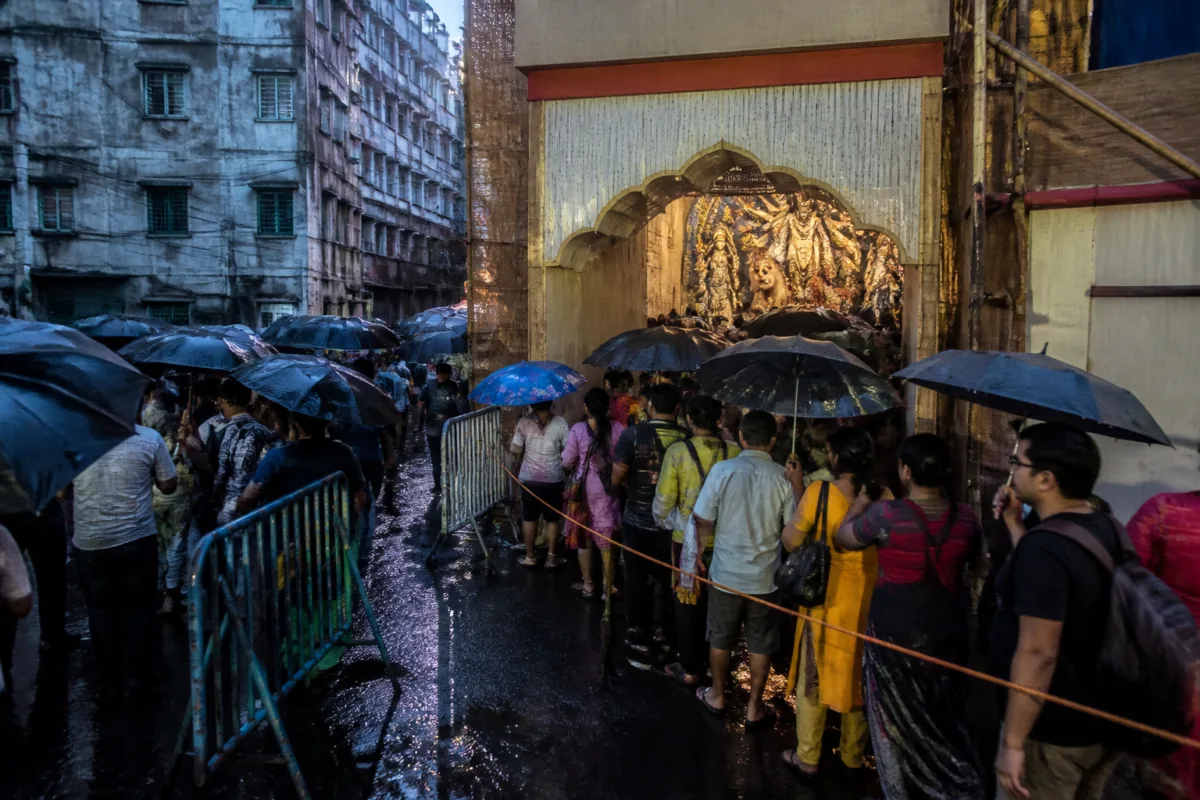
The Kolkata stampede at a Durga Puja pandal, which killed 19 people and injured 25, has brought an ordinary but often neglected part of urban safety into sharp focus: the design and management of the space between a public event and the street. The reported sequence at the Chorbagan pandal involved rain, a large crowd, a narrow access point and a single opening being used for both entry and exit. The investigation now extends beyond the people arrested after the incident to the organisers, temporary home guards, police, fire services and authorities that approved the event.
The immediate facts are devastating. The stampede took place on Saturday evening as rain affected visitors at the north Kolkata pandal. Residents told the Times of India that people already inside waited for the weather to improve while those outside pressed towards the overcrowded marquee. One local resident said the queue extended to Mahatma Gandhi Road, around 700 metres away. The account suggests that the crowd was not confined to the pandal itself; it stretched into the surrounding public realm, where weather, queue management and the movement of pedestrians became part of the safety system.
That is important because crowd disasters rarely depend on one failure alone. In this case, the reported conditions combined a concentrated destination, restricted space, a sudden change in weather and a movement arrangement that could not keep people entering and leaving apart. The state’s account of the site, as reported, differs from the initial briefing received by the chief minister. After visiting the location, he said the incident occurred at the common entry and exit gate rather than inside the dimly lit pandal. The distinction matters: the point at which people were expected to enter, leave, wait and take shelter appears to have become the critical pressure point.
The Kolkata stampede and the design of movement
According to the report, the common opening was divided by a rope held by home guards. The chief minister claimed that when the rain began, the personnel dropped the ropes and moved to shelter, leaving the separation between incoming and outgoing movement ineffective. This remains a claim to be examined by the investigation, but it identifies a basic crowd-management principle: a temporary barrier is only as reliable as the people, procedures and contingency plans supporting it.
A rope does not create two independent circulation systems if the opening itself is too narrow, if there is no protected place for people to wait, or if staff leave their positions during a weather emergency. It can mark a boundary, but it cannot by itself regulate volume, speed or direction. Once people outside are trying to get in and those inside are attempting to get out, even a small loss of control can turn a queue into opposing flows.
The reported layout also raises questions about the relationship between the pandal and its approach roads. Residents described limited space and heavy crowds, while the queue reportedly reached several hundred metres. That means the safety assessment needed to cover more than the marquee, its gate and its interior. It also needed to consider where visitors would stand during rain, how people would be held back from an overcrowded entrance, how emergency responders would reach the site, and how an evacuation would work if the main route became blocked.
The report does not establish the approved capacity of the pandal, the width of the opening, the number of personnel deployed at the site, or the exact crowd size at the time of the surge. Those details will be central to determining whether the event was inadequately designed, inadequately supervised, or overwhelmed by circumstances that had not been addressed in advance. The absence of those figures in the supplied material is itself a limit on what can be concluded at this stage.
Responsibility is distributed across the system
The investigation announced after the incident is significant because responsibility for a crowded public event is rarely held by one actor alone. The state government is examining the role of temporary home guards, while the organisers and the authorities that issued permissions are also under scrutiny. The report says the Kolkata Police, the Kolkata Municipal Corporation and the fire services department have been kept out of the proposed Special Investigation Team, which is to be headed by a sitting Calcutta High Court judge if the state receives the Chief Justice’s approval.
This proposed structure points to the central governance issue: event safety depends on coordination between private or community organisers and several public agencies with different responsibilities. Organisers control the layout, volunteers and visitor movement within the event premises. Police personnel manage public order and access. Fire services assess fire and emergency risks. The municipal corporation is connected to the surrounding civic environment and permissions. When these functions are treated as separate approvals rather than one integrated safety plan, a gap can emerge between what is permitted on paper and what happens on the ground.
The reported decision to examine the role of personnel deployed at the pandal also highlights the difference between staffing numbers and operational readiness. The chief minister said the home guards were not new recruits and had been deployed for the third consecutive year, following appointments in 2024 and 2025. But previous deployment does not by itself establish whether the personnel were trained for crowd movement, whether they had clear instructions for heavy rain, or whether there was a supervisor empowered to stop entry when the space became unsafe.
The police custody proceedings add another layer to the investigation. A Bankshal Court remanded seven arrested people to 10 days of police custody after police sought 14 days, according to the report. A defence lawyer said the accused were outsiders who had come to attend the celebrations and had attempted to help during the emergency. Their custody and the allegations against them remain matters for the legal process. The arrests should therefore not be treated as a final account of responsibility while the wider role of organisers and authorities is still being examined.
What the reported evidence shows
The strongest evidence available in the supplied report is not a single allegation but the convergence of several accounts. The state government’s site assessment identifies the common entry and exit gate as the location of the incident. The same account describes a temporary rope division that failed when rain began. Local residents independently pointed to sudden rainfall, limited space, overcrowding and insufficient deployment of volunteers and police. Together, these accounts describe a system that became vulnerable when demand increased and the weather changed.
The timing of the rain appears to have been a decisive trigger, but the residents’ accounts suggest that the crowd had already accumulated. People inside reportedly stayed under cover, while those outside sought entry. In such conditions, the event’s effective capacity is not simply the number of people the marquee can hold. It also depends on the number of people who can safely wait outside, the rate at which they can enter and leave, and the availability of space to absorb a sudden pause in movement.
The report also states that the pandal was dimly lit. It does not establish whether poor lighting directly contributed to the deaths, but it identifies another condition that investigators will need to examine. Visibility affects the ability of visitors to identify exits, respond to instructions and locate people in distress. It also affects the work of those attempting rescue. The reported fact that the incident occurred at the gate rather than inside the pandal may have limited the area involved, but the chief minister’s warning about the possible consequences of an incident inside the structure underlines the importance of internal as well as external circulation.
The queue length cited by a local resident—around 700 metres to Mahatma Gandhi Road—provides a measure of the pressure building around the site, although it is not an official crowd count. It shows that the event’s footprint extended deep into adjoining streets. The investigation will need to establish whether access roads were monitored, whether the queue was physically channelled, and whether people were informed or prevented from entering when the internal space was full. None of these details is established in the supplied report.
From permission to live monitoring
The episode raises a question about what event permissions are expected to achieve. The chief minister said the permission-issuing authorities should have ensured that identified problems were rectified beforehand, while also placing the organisers under scrutiny. That statement points to a gap between approval as a document and safety as a live operating condition.
A plan can specify an entry gate, an exit route and personnel deployment, but public events change rapidly. Rain can compress an outdoor queue into a covered area. A popular attraction can draw more visitors than anticipated. A temporary barrier can become ineffective if staff are not present. The reported incident shows why approvals need to be connected to on-site monitoring and the authority to pause entry before a dangerous concentration develops.
The proposed SIT, subject to the required judicial approval, is expected to examine these institutional questions alongside the conduct of individuals. Its composition will matter because the agencies being examined are also the agencies responsible for managing public safety. An inquiry led by a sitting High Court judge could provide a framework for examining the sequence of decisions, the permissions issued, the site conditions and the actions taken once the rain began. The supplied report does not yet provide the terms of reference or a confirmed timeline for the inquiry.
The legal process and the administrative investigation will address different parts of the same event. The court will consider the cases against those arrested. The SIT will examine the broader chain of responsibility. For the public, the crucial distinction is whether the outcome is limited to identifying individuals or also establishes how the system allowed a single narrow opening, a temporary divider and a weather disruption to become a fatal bottleneck.
The bigger urban safety question
Public celebrations are part of how cities use streets, neighbourhoods and temporary structures. Their safety cannot be assessed only within the boundaries of a pandal. The Chorbagan incident, as described in the supplied report, involved the interaction of a temporary event with a dense urban setting: a narrow approach, a long queue, changing weather, a crowded marquee and multiple public agencies.
That interaction is the larger urban issue exposed by the Kolkata stampede. A city’s ability to host large gatherings depends not only on policing after a problem occurs but on designing movement before the crowd arrives. It depends on separating flows, preserving emergency access, planning for rain and ensuring that staff remain operational when conditions deteriorate. It also depends on clear responsibility among organisers, police, fire services and municipal authorities.
The evidence currently confirms the scale of the tragedy and identifies several reported contributing conditions. It does not yet establish the precise sequence of failures, the approved capacity, the crowd count, the adequacy of staffing or the legal responsibility of the arrested people. Those questions will need to be answered through the court proceedings and the proposed investigation. The next significant developments are the outcome of the state’s request for approval to constitute the SIT, the findings on the roles of organisers and permission-issuing authorities, and the court process involving the seven accused.

