

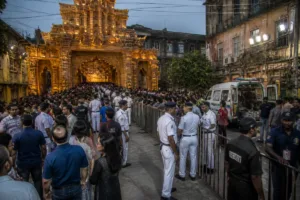
The reported stampede at a puja pandal in Chorbagan, Kolkata, has raised a question larger than the conduct of any single organiser or police unit: how can a public venue pass through several rounds of inspection and still allegedly leave visitors facing a narrow entrance, inadequate emergency support and unmanaged crowd pressure? Bartaman Patrika reported that the incident occurred on Saptami night and that visitors were questioning the responsibility of both the organisers and the police.
The report said that injured people had to be taken to hospital using app-based cabs and motorcycles because ambulances were not available at the site. This account was attributed to eyewitnesses. The report also said that visitors alleged they received little assistance from Kolkata Police after the incident. These are serious claims, but they remain claims in the supplied report and require formal investigation before responsibility can be conclusively assigned.
The incident brings into focus the safety chain surrounding large temporary public structures. A puja pandal is not only a place of worship or cultural display during the festival period. It becomes a high-footfall public venue, with an enclosed or semi-enclosed structure, controlled entry and exit points, temporary roads and pathways, private security personnel, police deployment and emergency-service requirements. Failure at any one of these points can increase pressure on the others.
According to the report, police and fire-service representatives had informed the Chorbagan organisers during an inspection that the entrance intended for general visitors was too narrow. They allegedly advised the organisers to widen it immediately. The report said the organisers did not act on that advice and were instead accused of trying to increase footfall inside the pandal. If established, that would indicate a gap between identifying a risk and enforcing a corrective measure before the venue opened to the public.
The report also questioned the number of VIP passes issued by the organisers. It said that a large number of such passes had been distributed, while an exact account of the passes was not available. The role of private security guards deployed outside the pandal has also come under scrutiny. These details matter because crowd safety depends not only on the physical width of an entrance, but also on how many people are permitted to enter, how different visitor categories are managed and whether security personnel can prevent opposing flows of people from colliding.
The reported sequence of inspections suggests that responsibility was distributed across several institutions. Local police station officers reportedly began collecting information on the theme pandals of prominent and large puja committees about a month before the festival. Officers of the relevant police division then inspected the structures. Later, Kolkata Police Joint Commissioner (Headquarters) Sudip Sarkar reportedly reviewed the condition of pandals across the city with fire-service representatives.
The reported inspection process covered the structural safety of the pandal, visitor protection, the width of entry and exit routes, the space left on roads and compliance with fire-safety rules. After Mahalaya, Kolkata Police Commissioner Ajay Nanda also reportedly inspected the pandals. The existence of repeated inspections therefore raises an institutional question: what exactly does an inspection certify, and what happens when the inspecting authority identifies a defect?
An inspection can be meaningful only if it is linked to a documented correction, a deadline, a follow-up visit and an enforceable consequence. The supplied report does not establish whether the advice to widen the Chorbagan entrance was recorded in a formal notice, whether a deadline was issued, whether a follow-up inspection took place or whether the venue was permitted to operate subject to conditions. Those details will be central to determining whether the failure was one of design, enforcement, monitoring or emergency response.
The case also illustrates the difference between structural approval and operational readiness. A temporary structure may satisfy a physical inspection on one day but become unsafe when visitor numbers rise sharply. Entry routes that appear adequate when empty can become bottlenecks once people queue, stop for security checks, move towards a popular display or attempt to leave at the same time. Crowd safety therefore requires continuous operational control, not only a pre-opening inspection.
The report said that the police leadership had assigned security responsibility at the Chorbagan pandal to the Kolkata Police Deputy Commissioner of the Special Task Force and the Deputy Commissioner of the Enforcement Directorate. It further reported that these two officers were not known to have experience managing such large-scale events. The supplied material does not independently establish their prior experience or explain the precise duties assigned to them. However, the reported deployment raises the question of whether major public festivals require specialised crowd-management command structures rather than assignments based mainly on rank or availability.
Large public events typically involve multiple agencies, but that arrangement can create ambiguity if command responsibilities are not clearly defined. Organisers control access arrangements, passes, volunteers and private guards. Police manage public order, traffic, crowd movement and emergency coordination. Fire services assess fire and structural risks. Senior officials review preparedness. If no single authority is responsible for confirming that identified defects have been corrected, an inspection system may become a sequence of visits rather than a functioning safety protocol.
The reported absence of an ambulance at the scene points to a second layer of preparedness: the ability to respond after prevention fails. The account that injured visitors were transported in app cabs and on motorcycles, if confirmed, would indicate a breakdown in emergency access and on-site medical planning. A crowded festival venue needs a route that remains usable for ambulances, personnel who can identify and assist injured people, and a clear system for moving casualties without worsening the crowd situation.
This is particularly important because crowd incidents can escalate quickly. When people fall or are unable to move, those behind them may not immediately understand what has happened. Delayed assistance can increase injuries and make evacuation more difficult. The supplied report does not provide the number of people injured or killed, the exact sequence of events, the size of the crowd or the time taken to reach hospital. Those facts are necessary for a complete assessment and should form part of the official investigation.
The controversy over VIP passes also points to a governance problem in public festivals: access is often managed through several overlapping systems. General visitors, invited guests, sponsors, local residents, volunteers and emergency personnel may use different routes or permissions. If the total number of people inside a pandal is not tracked, or if special access creates additional movement through an already narrow route, the crowd-control plan can become unreliable. The report’s observation that the number of passes had not been reconciled makes record-keeping an important part of the investigation.
The police inspection structure described by Bartaman Patrika indicates that Kolkata has an established administrative process for reviewing major puja venues. Local officers, divisional officers, fire-service representatives, senior police officials and the police commissioner were all reported to have roles at different stages. The problem raised by the incident is therefore not simply whether a process existed. It is whether information moved effectively through the process and whether officials had the authority and willingness to stop or restrict a venue when a serious defect remained unresolved.
The distinction matters for accountability. If organisers ignored a written direction, the issue would concern compliance and enforcement. If officials identified a narrow entrance but did not verify that it had been widened, the issue would concern follow-up supervision. If the entrance was altered but became inadequate because crowd volumes exceeded the plan, the issue would concern capacity assessment and real-time management. If emergency vehicles could not reach the venue, the issue would concern the operational plan. These possibilities should not be treated as established conclusions without documentary and investigative findings.
The report also described criticism from experienced police officers, who allegedly felt that there had been a lack of seriousness at the senior level in managing this year’s puja arrangements. It further said that the police commissioner briefed the force on security and crowd-control arrangements only after a large flow of visitors reached the pandal late at night on the second day of the festival. This account is attributed to police sources and should be tested against deployment records, briefing orders and the official timeline.
The larger urban lesson is that public safety cannot be measured only by the number of inspections conducted. The relevant question is whether inspections change the conditions on the ground. A narrow entrance must be widened, a blocked road must be cleared, a fire-safety deficiency must be corrected and an emergency route must remain open. Each action requires an accountable officer, a verifiable record and a final decision before crowds arrive.
The Chorbagan incident, as described in the supplied report, establishes the existence of a serious public-safety controversy but does not by itself establish legal liability. The facts that require scrutiny include the condition of the entrance, the organisers’ response to the reported warning, the number and management of VIP passes, the deployment of police and private guards, the availability of ambulances, the timing of senior-level briefings and the records of all inspections. The outcome of the investigation and any official findings will determine whether the failure lay primarily in venue design, organiser compliance, police supervision, emergency planning or a combination of these factors.