


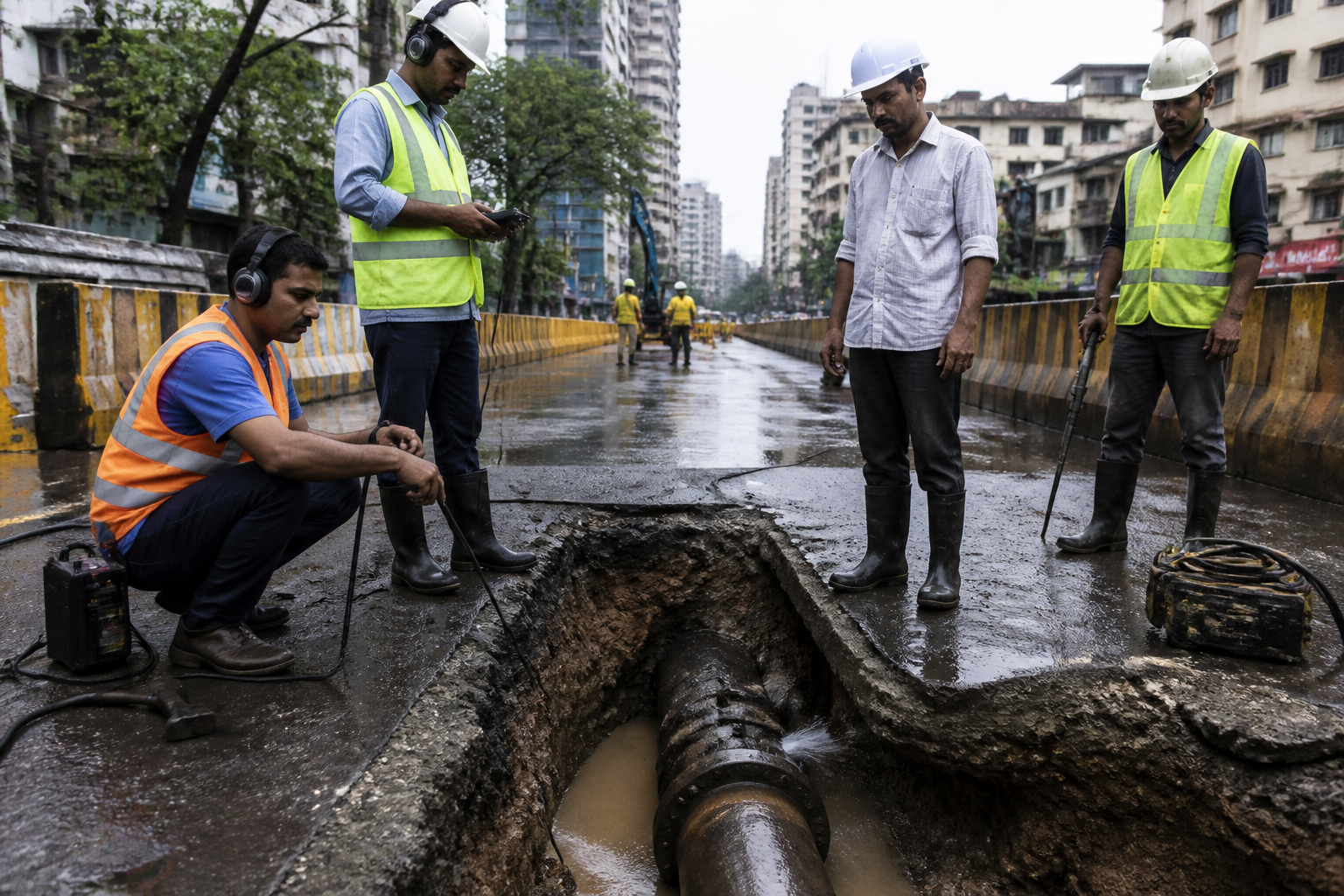
Mumbai’s water crisis is not only a question of how much rain fills the city’s lakes. It is also a question of how much water survives the journey from those reservoirs through an ageing underground network to homes, businesses and institutions. The Brihanmumbai Municipal Corporation (BMC) estimates that nearly 34 per cent of the water it supplies—around 1,394 million litres per day (MLD)—is lost to leakages and water theft. Its proposed response combines a new leak-detection method with a fivefold increase in annual pipeline replacement.
The intervention comes as Mumbai faces a 10 per cent water cut after deficient rainfall. The civic body supplies approximately 4,100 MLD against daily demand of around 4,600 MLD, while the city depends on seven lakes—Tulsi, Vihar, Bhatsa, Tansa, Modak Sagar, Upper Vaitarna and Middle Vaitarna—for its water supply. These reservoirs are replenished by the monsoon, and the stored water is carried across the metropolitan system through a pipeline network that stretches nearly 6,000 km.
That combination makes the distribution network central to Mumbai’s water security. When rainfall is weak and temperatures accelerate evaporation, the city has less room to absorb losses before restrictions reach consumers. The BMC’s current proposal therefore shifts attention from reservoirs alone to the infrastructure between the source and the tap.
The civic body is considering Sound Navigation and Ranging, or SONAR, technology to locate underground leaks. The system uses sound waves to detect objects and identify changes beneath the surface. The intended benefit is operational: instead of repeatedly opening roads around the visible signs of a leak, field teams could use acoustic information to narrow down the actual location before excavation.
Abhijit Bangar, BMC Additional Municipal Commissioner (Projects), told The Indian Express that water often emerges on the road at a point different from the source of the leakage. Officials then have to calculate possible locations, identify suspected points and continue digging until the leak is found. According to Bangar, this repeated excavation damages roads and can leave the actual source undetected for some time.
The proposed technology is significant because underground water loss is also a problem of information. A visible burst provides a clear signal, but a concealed leak can continue while the surface shows only indirect evidence. The BMC’s plan indicates that the civic administration is seeking to reduce the time and disruption involved in finding such failures, although the supplied information does not establish the technology’s expected detection rate, cost, procurement model or performance in Mumbai’s specific ground conditions.
The scale of the network makes that question particularly important. The BMC currently replaces around 60-70 km of pipelines each year, equivalent to barely 1 per cent of its nearly 6,000-km network. Its proposed target is 250-300 km annually, or around 5-6 per cent of the network. Bangar said the civic body aims to replace 25-30 per cent of the existing old pipelines over the next four years.
On paper, the increase would materially change the pace of renewal. At the current rate, only a small portion of the system is replaced each year. The proposed rate would allow the BMC to work through five to six times as much network annually. But replacement is not the same as eliminating losses across the entire system. The outcome will depend on which sections are prioritised, how leaks are measured, whether theft is reduced alongside physical losses and how quickly newly replaced sections are connected and maintained.
The BMC’s own figures show why prioritisation will matter. An estimated 1,394 MLD is lost through leakage and theft, a volume equivalent to a substantial share of the water supplied to the city. The reported loss figure combines two different problems: physical water escaping from the network and water taken through unauthorised or unmetered connections. A pipeline replacement programme can address deteriorated infrastructure, but it cannot by itself resolve every form of unauthorised use.
That distinction is reflected in the BMC’s plan to expand its Water for All policy, introduced in 2021. Under the policy, the civic body provides dedicated water connections to slum settlements, bringing more households into the formal supply network. The stated objective is to extend access while curbing water theft. According to BMC data cited by The Indian Express, the civic body has received 35,697 applications and granted 29,110 connections so far.
Formal connections change the administrative relationship between the utility and the consumer. They make households visible within the supply system and give the civic body a defined connection to manage. However, the figures also show that applications and granted connections are not identical. The supplied report does not explain the reasons for the gap, the geographic distribution of applications, or whether the granted connections have reduced measured losses in the areas covered. Those details will be important in assessing the policy beyond its headline numbers.
The proposed measures also reveal the division of responsibilities inside a large municipal water system. The BMC must manage reservoirs and bulk distribution, maintain thousands of kilometres of pipelines, respond to road-level failures, extend formal connections and plan capital replacement. Each function has a different operational requirement, but water security depends on all of them working together.
The decision to appoint a consultant is the next institutional step. The consultant is expected to assess the feasibility of the proposed interventions and prepare a detailed report within six months. The BMC plans to begin implementing the measures around the middle of 2027. This means the current announcement is a planning and preparation phase rather than an immediate citywide deployment of SONAR or a completed pipeline-renewal programme.
That timeline is relevant because Mumbai’s present water stress is immediate, while the infrastructure response will take longer. The current 10 per cent cut has been imposed to ensure available stocks last until September next year, according to the report. The city’s supply system must therefore manage short-term scarcity while undertaking a multi-year renewal programme. The two timeframes cannot be treated as interchangeable: emergency conservation can protect stored supplies, but it does not repair old pipelines; replacement can reduce future losses, but it will not instantly solve the present deficit.
The data supplied by the BMC also points to a mismatch between demand, supply and recoverable water. Daily demand is around 4,600 MLD, while supply is approximately 4,100 MLD. Against that supplied volume, estimated leakage and theft account for around 1,394 MLD. These figures are not a simple measure of water that could immediately be added back to the city’s usable supply, because losses occur at different points and include different causes. They do, however, show why reducing non-revenue water has become central to the city’s response.
The water system’s physical geography adds another layer of complexity. Mumbai’s reservoirs are located across the city’s suburbs and neighbouring districts, while the distribution network runs through dense urban areas and beneath roads. A failure in this system is therefore not only a utility problem. It can also become a road-maintenance problem, a traffic disruption and a source of prolonged repair work. The BMC’s explanation of exploratory digging connects water-loss management directly to the condition and usability of public streets.
The larger urban question is whether Mumbai can build a water-supply system that is resilient not only at the source but across the full chain of delivery. Reservoir levels and rainfall remain essential, but they do not tell the whole story. A city can secure water in lakes and still lose a significant share before it reaches users if its network is old, difficult to monitor or unevenly formalised.
The BMC’s proposal confirms the scale of the challenge and sets out three linked responses: identify underground leaks more accurately, replace ageing pipelines at a faster rate and expand formal connections through Water for All. What remains uncertain is how the proposed SONAR system will be tested, funded and evaluated; which pipeline sections will receive priority; and whether the reported loss figure will fall as interventions are implemented. The consultant’s feasibility report and the planned implementation from around mid-2027 will be the next milestones in determining whether Mumbai’s water strategy can move from managing scarcity to reducing the losses built into its distribution system.

