


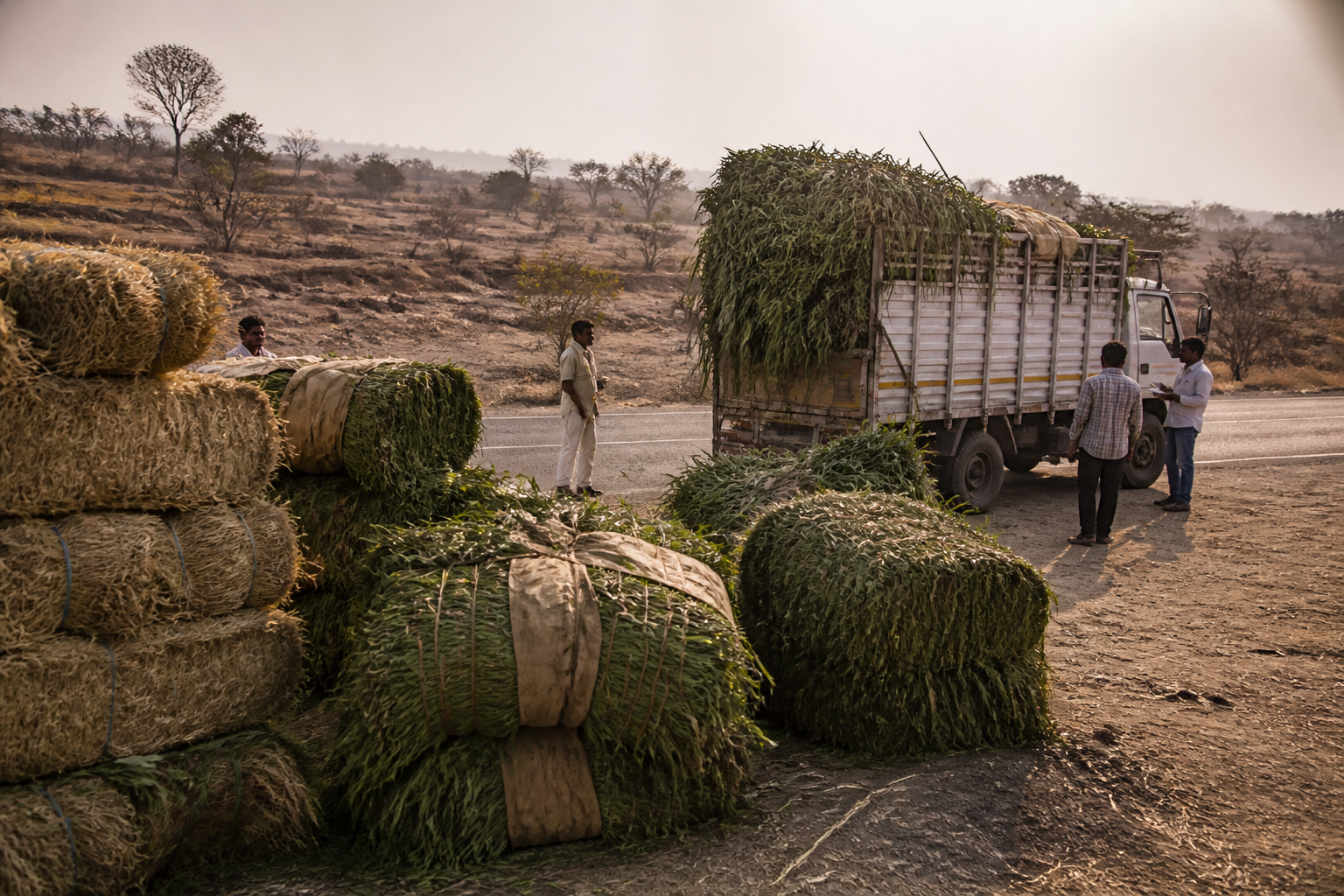
Pune district administration has imposed an immediate ban on the transport and sale of dry and green fodder from the district to other districts or outside Maharashtra, citing drought conditions and the need to protect livestock feed supplies during the 2026 kharif season.
The restriction covers all types of dry and green fodder, including kadba, kutti and straw. It applies to eight talukas—Bhor, Velha, Khed, Shirur, Baramati, Indapur, Daund and Purandar—where the administration has identified the risk of fodder shortages against the backdrop of drought.
Pune District Collector and District Disaster Management Authority chairperson Jitendra Dudi issued the preventive order after the administration assessed that fodder produced in Pune could be sent in large quantities to other districts and neighbouring areas. Such movement, the order states, could create shortages within the district and pose a threat to the survival of livestock.
The administration has also cited the possibility of law-and-order problems if fodder availability becomes severely constrained. The order is being implemented with immediate effect and will remain in force until further instructions are issued.
Anyone violating the restriction may face legal action under Section 223 of the Bharatiya Nyaya Sanhita, 2023. The provision has been invoked as the legal basis for enforcing the preventive measure and controlling the movement of fodder from Pune district.
The ban does not apply to fodder transport authorised under government schemes or approved by the Animal Husbandry Department or the district administration. These exemptions are intended to allow officially sanctioned supply arrangements to continue while restricting unauthorised commercial movement.
The administration said it was taking measures to ensure that fodder required for animals remains available within Pune district. The order places district-level control over a commodity that links agricultural production, livestock care, rural livelihoods and inter-district trade, making enforcement at transport points and across local markets central to its implementation.
The restriction has been issued ahead of the 2026 kharif season. Its duration, the scale of fodder stocks available in the affected talukas and the conditions for lifting the ban will depend on subsequent directions from the district administration.

