


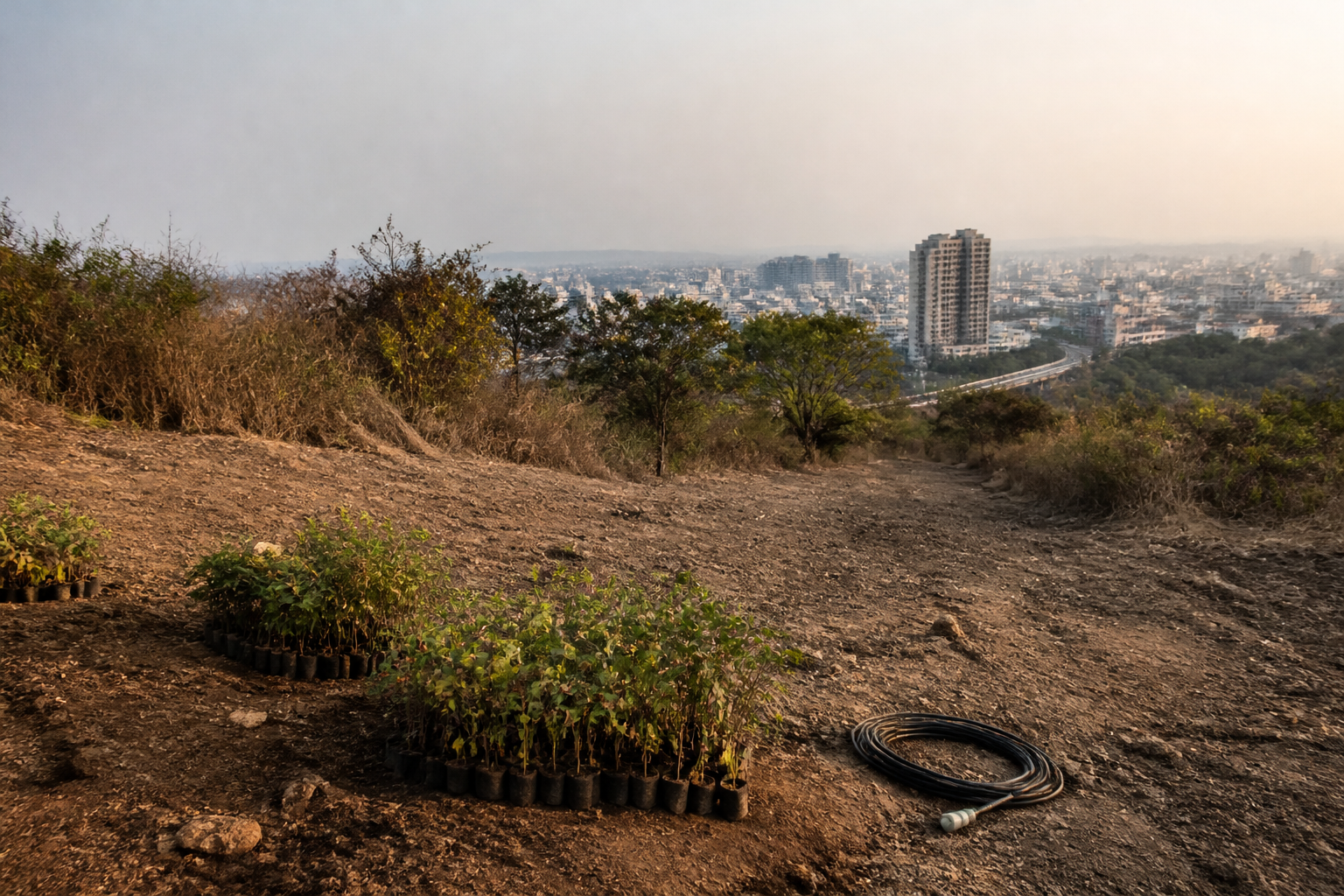
Pune’s proposed Miyawaki plantation on cleared forest land has brought a basic urban question into sharp focus: can a water-intensive greening method be justified when the city and the wider state are facing water scarcity? Citizens have questioned the Pune forest department’s decision to remove gliricidia vegetation from Kothrud hill for a plantation involving 30,000 saplings per hectare, while the state government has announced a minimum 10% water cut across urban and rural local bodies from October 16.
The dispute is not simply about one hill or one plantation technique. It reflects a wider tension in urban ecological projects: the desire to rapidly create dense green cover can conflict with the water availability, soil conditions and natural vegetation of the landscape where the project is implemented. In Pune, citizens and ecologists say the proposed intervention may be poorly timed and ecologically mismatched. The forest department, however, says the removal was approved under working plans and that non-potable water can be used for irrigation.
The immediate controversy concerns forest land along the road to the National Defence Academy in Kothrud. According to the report, gliricidia vegetation at the site had been removed, although the proposed Miyawaki plantation had not yet begun. Citizens also said gliricidia vegetation had been uprooted at other sites across the Pune forest division in the previous month, without plantation work having started.
The scale of the proposed work is significant. The project involves planting 30,000 saplings per hectare, a high-density approach associated with Miyawaki plantations. Citizens have raised concerns that the saplings would need substantial watering during their initial years, particularly because the work is expected to proceed after the monsoon season. Their concern is sharpened by the state’s water situation: a government resolution dated October 5 cited deficient monsoon rainfall and El Nino-related water scarcity while directing a minimum 10% water cut.
The resolution also established a clear order of priority. Drinking water is to receive the highest priority, followed by the needs of livestock and fodder. Water for irrigation and other uses is to be released only after those requirements are met, while rabi, foodgrain and fodder crops have also been prioritised. The document, as described in the report, does not specifically address Miyawaki plantations, but its stated allocation priorities provide the administrative context for the dispute.
That context makes the timing of the plantation central to the debate. Prajakta Divekar, a city resident, questioned how a programme requiring regular watering during the early establishment phase could be undertaken after the monsoon, when a drought situation was already affecting water management. Another citizen who wrote to the forest department said that planting large numbers of saplings after the monsoon could create survival challenges while placing additional demands on limited water resources.
The issue is therefore not only whether trees should be planted. It is also whether a plantation method should be selected independently of the site’s rainfall pattern and water budget. A project can be described as an urban greening measure while still creating a short-term demand for water that the surrounding system may not be able to reliably supply. The available account does not establish how much water the proposed plantation would require, where that water would come from, or how long irrigation would continue. Those details are important because the project’s ecological and administrative feasibility depends on them.
The site’s existing vegetation and landscape characteristics add another layer. Pushkar Kulkarni, a Pashan resident, said the Miyawaki method’s dense planting model may not be suitable for Pune’s dry deciduous, thorny scrub and grassland ecosystems, particularly in a year of deficient rainfall. Citizens have called for plantation methods that are less water-intensive and better aligned with local ecological conditions.
Ecologist Gurudas Nulkar raised concerns about both soil and water. He said Miyawaki plantations require deep trenches filled with soil brought from elsewhere, while many of Pune’s hills have thin soil cover. In his view, undertaking such work would not be ecologically prudent or economically justified, and irrigation would remain a concern during water shortages.
Nulkar also argued that species adapted to Pune’s natural precipitation cycles would be more appropriate on hills where gliricidia is removed. His position points to a fundamental distinction between restoring or strengthening an existing ecosystem and imposing a standardised plantation model. The report does not provide an ecological assessment comparing the proposed Miyawaki plantation with native or site-adapted alternatives, so the relative costs, survival rates and maintenance requirements remain unestablished.
The forest department’s response addresses one part of the criticism but leaves other questions open. A senior forest official told The Times of India that the central government permits vegetation removal under approved working plans, provided there is a provision for subsequent plantation. The official said the department was not removing vegetation and leaving the land bare, and that drinking water would not have to be used for the plantations. Water unfit for drinking, the official said, could be used instead; otherwise, it might be discharged into a river.
This response shifts the debate from whether water will be needed to what kind of water can be used. That distinction matters, but it does not by itself resolve the question of supply. The report does not specify the volume of non-potable water available, its source, the infrastructure required to transport it, or whether it can be supplied throughout the period when saplings need irrigation. Nor does it establish whether using such water would create other environmental or operational costs.
The official also said that removal of vegetation for Miyawaki plantations was being carried out at sites across Maharashtra where the work had been approved under respective working plans. This indicates that the Kothrud proposal forms part of a broader administrative approach rather than being an isolated local experiment. At the same time, approval under a working plan does not settle the site-specific questions raised by citizens and ecologists: whether the area is suitable, whether the timing is appropriate, and whether water and soil requirements have been assessed for the particular hill.
The reported extent of land cleared is itself unresolved. The official said he had received a complaint about the area cleared at the National Defence Academy site and would visit the location to measure it. He indicated that the area known to him was around one hectare, while citizens had reported that four hectares had been cleared. Until the site is measured, the scale of the intervention remains disputed.
That measurement is more than a procedural detail. The number of hectares affects the number of saplings, the volume of soil required, the irrigation network, the maintenance burden and the extent of vegetation removed before replacement planting begins. A 30,000-sapling-per-hectare model would also make the difference between one and four hectares materially significant. The report does not provide the final cleared area or a confirmed plantation schedule.
Pune’s case illustrates how urban greening can become entangled with competing public priorities. Forest land within a growing city is expected to provide ecological value, landscape protection and public benefits, but interventions on that land also involve administrative approvals, material inputs and continuing maintenance. When water availability is constrained, the success of a plantation is not measured only by the number of saplings planted. It also depends on whether those saplings survive without diverting scarce water from higher-priority uses.
The state government’s water-cut resolution creates a formal hierarchy in which drinking water, livestock and fodder requirements come first. The forest department’s position suggests that plantation irrigation can be separated from drinking-water demand through the use of non-potable sources. The unresolved institutional task is to demonstrate how that separation will work in practice. Without a documented source, quantity, delivery plan and maintenance period, the assurance remains incomplete from a public-accountability perspective.
The dispute also exposes the limits of treating plantation density as a proxy for ecological success. A target of 30,000 saplings per hectare can communicate ambition and speed, but it does not by itself establish survival, habitat suitability or long-term maintenance. In Pune’s hills, the available evidence raises specific questions about thin soils, dry deciduous and scrub ecosystems, seasonal rainfall and the removal of existing gliricidia vegetation. Those conditions require the plantation model to be evaluated against the landscape rather than only against the number of saplings proposed.
At present, the supplied information confirms four important facts: gliricidia vegetation has been removed at the Kothrud site; a Miyawaki plantation has been proposed but had not yet begun; the state has announced a minimum 10% water cut amid deficient rainfall and scarcity; and citizens, an ecologist and a forest official disagree over the project’s suitability and water requirements. It does not establish the final area cleared, the plantation’s exact start date, the irrigation volume, the source of non-potable water or the expected survival rate.
Those unanswered questions will determine whether the project becomes a viable ecological intervention or a water-dependent plantation imposed on a dry hill landscape. The next documented steps are the forest official’s proposed site measurement and the department’s decision on whether and how to proceed with planting at Kothrud and other approved locations.
