


Telangana projects are at the centre of a renewed debate over whether political access in New Delhi is translating into administrative clearances, funding and implementation. The immediate trigger is the Centre’s return of the Detailed Project Report for the Palamuru-Rangareddy Lift Irrigation Scheme, or PRLIS, because unresolved inter-State issues over Krishna river waters prevented its techno-economic appraisal. But the larger issue is how major urban, transport and irrigation projects move through India’s federal approval system—and where that process can stall.
The report by Telangana Today links the PRLIS setback to criticism of Chief Minister A Revanth Reddy’s repeated visits to the national capital. It says Reddy has visited New Delhi about 79 times since the Congress government came to power in December 2023, meeting Union Ministers and Prime Minister Narendra Modi to seek funds and approvals for Telangana projects. Several demands, however, continue to remain pending, according to the report.
That contrast between political activity and administrative progress is the central institutional question. A chief minister’s meetings may help place a project on the national agenda, but they do not by themselves resolve technical appraisal, inter-State water disputes, funding conditions or statutory approvals. The PRLIS case demonstrates the difference between access to decision-makers and the completion of the documentary and inter-governmental processes required for a project to advance.
PRLIS is not merely a state-level construction proposal. The Centre reportedly returned its DPR after stating that a techno-economic appraisal could not be taken up because of unresolved issues concerning Krishna river waters. Telangana was asked to pursue holistic planning to achieve the intended benefits of the project. This means the project’s progress is tied to a wider dispute over how water from a shared river is assessed and allocated between States.
The distinction matters because irrigation projects often combine engineering, finance, water allocation and inter-State coordination. A DPR can describe the proposed infrastructure and its intended benefits, but appraisal depends on whether the underlying water and institutional questions are sufficiently settled. In PRLIS, the reported obstacle is therefore not presented as a simple delay in construction. It is a problem at the intersection of project design and river-basin governance.
The political consequences are being felt in Palamuru, the Chief Minister’s home district, where people have been demanding early completion of PRLIS and other pending irrigation projects. The report also places the development against protests by Telangana farmers over inadequate power supply and water availability for crops. These details connect a file-level decision in New Delhi to the operating realities of agriculture: water projects are judged locally by whether they improve reliability for cultivation, not by the number of meetings held or representations submitted.
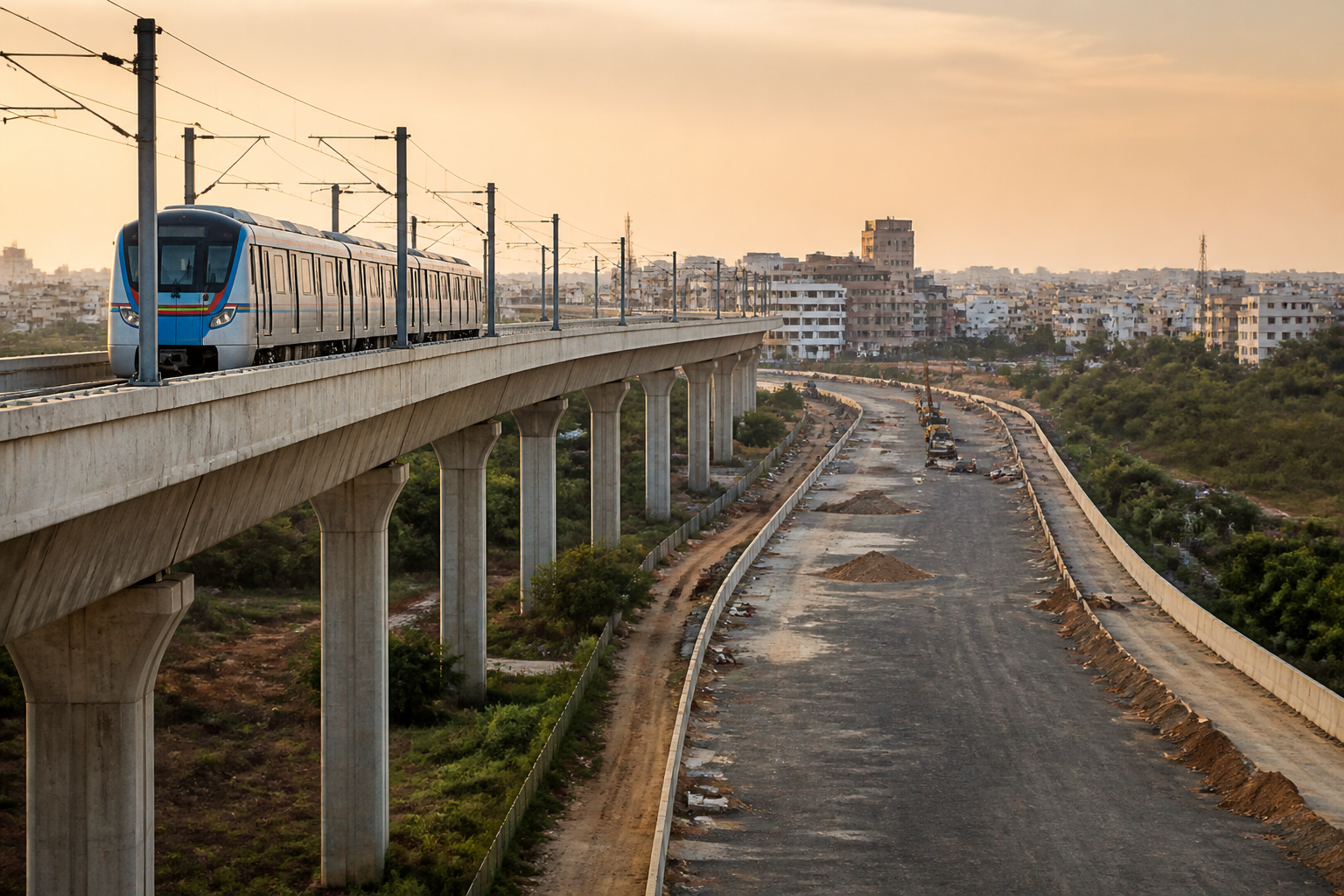
The same gap between announcement and implementation appears in Telangana’s urban and transport agenda. At a recent conclave in New Delhi, Reddy reportedly said that projects including the expansion of Hyderabad Metro, the Regional Ring Road and national highway projects were pending with the Centre. Each belongs to a different infrastructure system, but all require coordination beyond the State government.
Metro expansion affects the daily movement of Hyderabad’s residents and the city’s ability to connect employment centres with growing residential areas. A Regional Ring Road would shape the metropolitan region beyond the existing urban core, influencing access, freight movement and future development patterns. National highway projects involve another layer of Central responsibility and approval. Taken together, the pending list suggests that Telangana’s infrastructure challenge is not confined to one project or one department.
Yet the supplied report does not establish that all these projects are stalled for the same reason. PRLIS is specifically linked to unresolved Krishna water issues. The reasons for the pending status of Hyderabad Metro expansion, the Regional Ring Road and national highway projects are not detailed in the report. That distinction is important. Treating every delay as evidence of political neglect would flatten separate approval processes into a single narrative that the available information does not prove.
The comparison with Andhra Pradesh Chief Minister N Chandrababu Naidu adds a political dimension to the debate. According to Telangana Today, Naidu used his Delhi visit to seek financial assistance for drought relief, support for the Polavaram project, river-linking proposals and approvals for major infrastructure projects. His requests also included Central assistance for projects connected to the upcoming Godavari Pushkarams, approval for the proposed Visakhapatnam Metro, and support for the proposed Outer Ring Road in Amaravati. He also briefed the Prime Minister on the proposed Beach Road project.
The contrast is not simply between two chief ministers visiting the same city. It is between two reported agendas presented as different in breadth and framing. Telangana’s recent visit was described in the report alongside Reddy’s participation in a Congress protest demanding the resignation of Chief Election Commissioner Gyanesh Kumar and a luncheon meeting with INDIA bloc MPs. Naidu’s visit, by contrast, was described primarily through financial, irrigation and infrastructure demands.
That comparison has fuelled criticism in Telangana, but it does not by itself demonstrate that Andhra Pradesh has secured final approvals for every project it raised or that Telangana’s pending projects were delayed solely because of the Chief Minister’s political schedule. It does, however, show how intergovernmental negotiations are publicly evaluated: not only by formal outcomes, but also by whether a State’s Delhi engagement appears focused, project-specific and connected to a clear administrative follow-up.
The funding dimension is especially significant. The report says Naidu highlighted deficient rainfall and El Nino conditions affecting Andhra Pradesh’s agricultural sector while seeking support for drought relief. It also says he sought assistance for major infrastructure projects and irrigation proposals. Telangana’s government, meanwhile, has repeatedly stated that the State is not receiving adequate support from the Centre. The competing claims point to a broader federal contest over financial assistance, project prioritisation and the political presentation of development needs.
For citizens, the institutional process is visible mainly through delays and incomplete infrastructure. Farmers waiting for irrigation benefits encounter unresolved water questions. Urban residents waiting for expanded metro access encounter pending project decisions. Regional communities looking for improved road connectivity depend on approvals that may involve several authorities. The administrative language of DPRs, techno-economic appraisal and inter-State issues ultimately becomes a question of whether public infrastructure reaches the ground.
The PRLIS episode also shows why political messaging cannot substitute for procedural clarity. If a project is returned because of unresolved river-water issues, the next step must involve addressing those issues through the relevant inter-State and technical mechanisms. The report says Telangana was asked to pursue holistic planning, but it does not provide details of a revised DPR, a new appraisal timetable or a negotiated water-sharing arrangement. Those missing details are central to assessing whether the return is a temporary procedural setback or a deeper obstacle to implementation.
Similarly, the status of the Hyderabad Metro expansion, the Regional Ring Road and national highway projects requires project-by-project information. The report identifies them as pending, but does not specify the stage reached by each proposal, the authority currently examining it, the funding model under consideration or the next formal milestone. Without those details, public debate risks becoming centred on the frequency of Delhi visits rather than on measurable progress through the approval chain.
This is the larger urban governance lesson in the current dispute. Infrastructure delivery depends on multiple forms of work that are often invisible in political narratives: preparing a technically acceptable DPR, establishing the project’s financial basis, resolving jurisdictional questions, securing inter-State agreement where necessary and obtaining formal approval from the competent authority. A meeting can create momentum, but only a documented decision and an implementation pathway can convert momentum into infrastructure.
The evidence presently confirms that PRLIS has not entered techno-economic appraisal because of unresolved Krishna water issues, that Telangana has several projects described as pending, and that the State government is facing criticism over its engagement with the Centre. It also confirms that Andhra Pradesh has used a Delhi visit to place a broad set of financial, irrigation and infrastructure demands before the Union government. What remains unclear is the precise status and next step for each Telangana project, including whether revised proposals or additional negotiations are under way.
Those details will determine whether the current controversy produces administrative movement or remains a political comparison between two States. The next developments to watch are any revised PRLIS planning, clarification of the Krishna-water issues, formal updates on Hyderabad Metro expansion and the Regional Ring Road, and evidence of concrete Central decisions on the projects identified as pending.
