


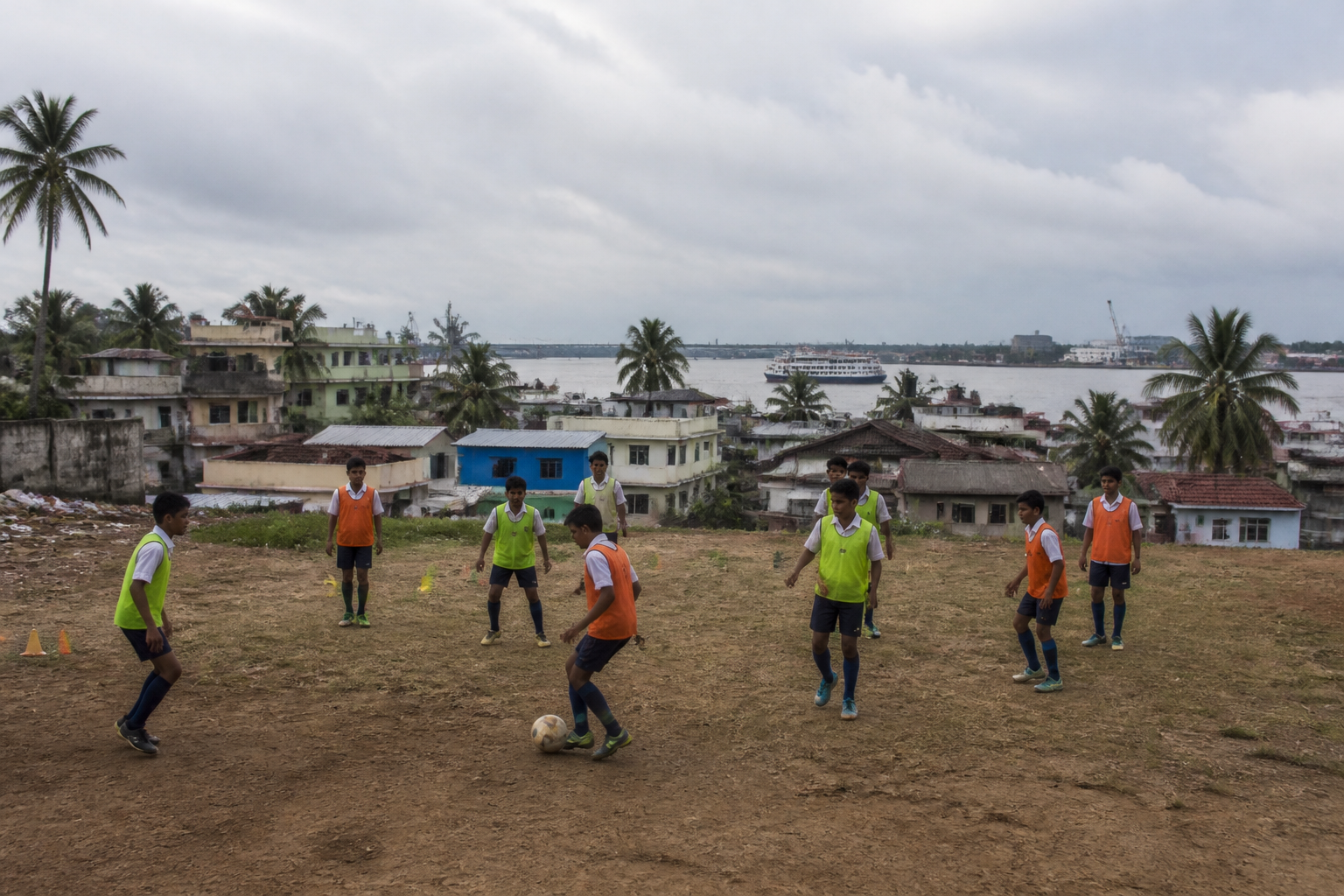
The absence of accessible sports grounds in Vypin is turning a routine school sports meet into a measure of the island’s wider urban failure. As the Vypin sub-district sports meet takes place at Maharaja’s College ground in Ernakulam, students from the island are travelling several kilometres to find space for basic training. Kerala Kaumudi – Kochi reports that the sub-district’s 51 schools are facing an uncertain sporting future because playgrounds remain unavailable in several local panchayats.
The issue is not simply that students lack a venue for competitions. It is that an essential public facility has not been planned as part of the everyday infrastructure of a densely settled coastal region. A playground is simultaneously a school resource, a public-health asset, a youth facility and, in Vypin’s case, potentially a water-safety resource. When it is absent, schools, families and young athletes are forced to depend on distant facilities, private turfs or spaces that are not available for regular training.
According to the report, Edavanakkad, Kuzhuppilly and Nayarambalam panchayats do not have playgrounds. Other grounds that were once active, including the Illathupadi Sangham ground in Edavanakkad, Jaihind Maidan in Njarakkal, the Nayarambalam ground and the Malippuram ground, are described as having lost their earlier role in supporting local sport. The decline has left students without dependable neighbourhood spaces for football, cricket, volleyball, sepak takraw and other activities.
The gap is particularly striking because Vypin has already demonstrated sporting ability. The report identifies Pallippuram native Prince Noble, who won a silver medal in the skiff rowing event at the Asian Games, as one example of the island’s sporting potential. Students from the area have also made their presence felt at national level in cricket, football, sepak takraw and volleyball. The reported record suggests that the constraint is not a lack of interest or talent, but the limited availability of training infrastructure and sustained institutional support.
That distinction matters for how local authorities assess public expenditure. Sporting success is often treated as an individual achievement, but it depends on a chain of facilities: a usable ground near a child’s home, access to coaching, safe transport, equipment, school participation and pathways to higher-level competition. If the first link is missing, the rest of the system becomes difficult to build. Children who might otherwise train regularly must either travel, pay for access or abandon the activity.
The affordability barrier is explicit in the report. Private turfs are said to be beyond the reach of ordinary families. This creates a two-tier sports environment in which children with the ability to pay can secure playing time, while others depend on school grounds or public land. Where public grounds are absent or inaccessible, sport becomes less a shared civic opportunity and more a fee-based service.
The concern also extends beyond competitive sport. Kerala Kaumudi – Kochi reports that most students in the island region do not receive swimming training, despite Vypin being surrounded by water. The report refers to several drowning deaths and to criticism that local institutions have not responded effectively. The source does not provide a consolidated death count or a detailed account of the responsible agencies, but the connection between the region’s geography and the absence of swimming access is clear: water is part of the daily environment, while water-safety training remains unavailable to many students.
This is where the playground question becomes a broader public-safety question. A sports facility in a coastal or island settlement cannot be assessed only by counting pitches and stadiums. It should also be considered as part of a local network of youth services, physical activity and basic safety skills. The report’s reference to swimming centres at ward level points to a demand for smaller, distributed facilities rather than a model based only on a few large grounds.
The institutional responsibility is spread across the local government system. The report calls for the three tiers of panchayats to take the initiative, consult schools and athletes, prepare development plans and seek government funding through elected representatives. This reflects the administrative reality of facilities that are local in use but may require state-level financial support. A panchayat can identify land and local demand, schools can describe usage needs, athletes can identify training gaps, and higher levels of government can determine funding support. Without coordination, each institution can treat the shortage as somebody else’s responsibility.
The most important evidence of this coordination problem is that some grounds have reportedly received substantial investment but are still not being made available to students for training. Malippuram Swathanthra Maidanam, Munambam Kacheri Maidanam and Njarakkal Jaihind Maidanam are reported to have been renovated at a cost of Rs 1 crore each. Yet the report says these facilities have not been released for student training. The available material does not specify the reason, ownership arrangements, operating rules or maintenance conditions behind the restricted access. Those details would be important for evaluating whether the problem is funding, administration, scheduling, safety certification or another form of institutional delay.
The reported spending therefore raises a question that is more consequential than the headline cost of construction: what happens after a ground is renovated? A facility is not fully delivered when civil works are completed. Its public value depends on opening hours, booking systems, maintenance, lighting, safety, coaching access and whether schools can use it without prohibitive charges. In Vypin, the reported gap between capital expenditure and actual student access suggests that infrastructure delivery and service delivery are being treated as separate tasks.
The same issue appears in the history of the older grounds. Facilities that were once active are described as no longer providing the same support to young players. The report does not establish when or why each ground declined, but the pattern indicates that creating or upgrading sites is only one part of a long-term sports policy. Grounds require continuous maintenance, local management and predictable access. Without those arrangements, a public field can exist physically while disappearing from the daily life of a neighbourhood.
The geography of Vypin makes a centralised solution less practical. Students already travel to Ernakulam for the sub-district sports meet. If regular training also requires crossing distance to a limited number of facilities, the time and cost burden falls most heavily on families with fewer resources. A network of ward-level mini-playgrounds, school-linked facilities and swimming-training centres would address access differently from a single large venue, although the source material does not establish whether such a network has been formally planned or costed.
The report also cites warnings from excise officials that the absence of playgrounds may push children towards mobile games and substance use. That claim is presented as an official warning, not as evidence that every child without a playground will develop such behaviour. It nevertheless points to the way public-space shortages are understood by enforcement and welfare institutions. A lack of recreational infrastructure reduces the number of supervised, social and physically active alternatives available to young people, particularly after school hours.
For schools, the consequences are immediate. Physical education becomes dependent on whatever space is available, while talented students may not receive the regular practice needed to progress. For families, the absence of nearby facilities raises travel and user costs. For local governments, the issue exposes the limits of counting projects without measuring access. For the wider island community, it shows how a shortage in one category of infrastructure can affect health, safety, education and social development at the same time.
The evidence currently establishes a clear shortage, identifies three panchayats without playgrounds, names several underused or inaccessible grounds and records the reported Rs 1 crore renovation expenditure on three facilities. It does not establish a complete inventory of available land, the precise operating status of every ground, the number of students seeking training, or the timeline for proposed swimming centres. Those are the missing administrative facts that would determine the scale of the intervention required.
Vypin’s sports-ground crisis is therefore not only about producing more athletes. It is about whether local urban planning treats open space as essential social infrastructure. The immediate question for the panchayats and other authorities is whether existing and renovated grounds can be made reliably available to schools, while the longer-term question is how every student can access a safe place to play and, in a water-surrounded region, learn to swim. Until those questions are answered through a coordinated plan, the island’s sporting promise will remain stronger than its public infrastructure.

