


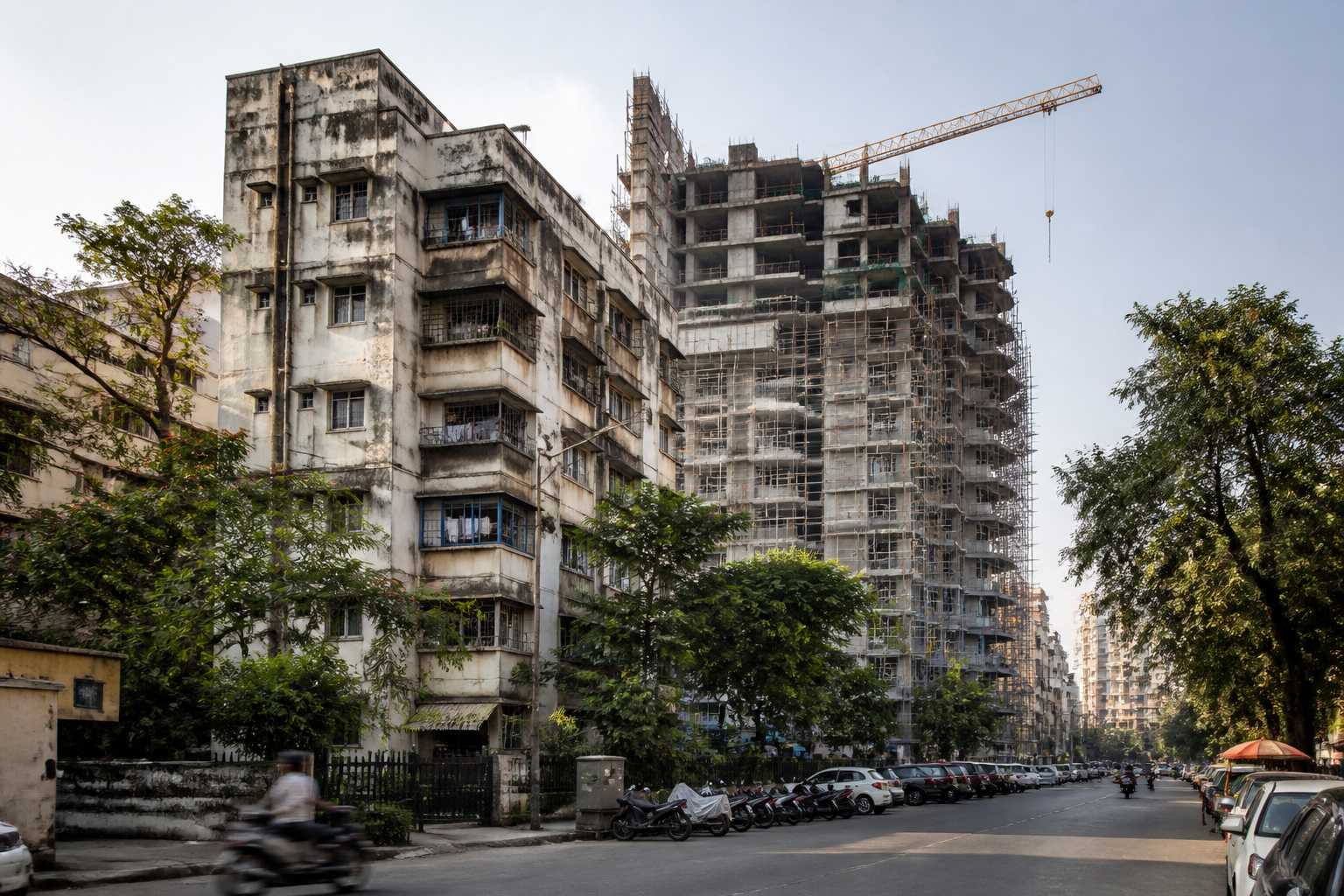
Pune’s redevelopment market has moved from a marginal segment of new housing activity to a significant part of the city’s real estate pipeline. A report by real estate startup Dreams Redeveloped says 629 redevelopment projects were registered under the Real Estate (Regulation and Development) Act, or RERA, across Pune district since 2017. Of these, 244, or about 60%, are located in Kothrud.
The numbers point to a concentrated transformation of established neighbourhoods rather than an even spread of redevelopment across the city. They also show why redevelopment is becoming an important urban question for Pune: the process affects not only builders and property buyers, but also existing flat owners who must agree to replace or reconstruct their housing.
According to the report, Dreams Redeveloped analysed 4,823 RERA-registered projects in Pune district during the period. Redevelopment projects accounted for only 3.6% of new RERA registrations in 2017. Their share rose to between 20% and 26% in 2023, indicating that redevelopment had become a substantially larger component of the city’s registered housing activity by that point.
The figures do not establish that redevelopment is occurring at the same pace in every part of Pune. Instead, they show a strong geographic concentration in Kothrud and a growing presence in a group of established central and western neighbourhoods. The report identifies Erandwane, Karvenagar, Deccan, Parvati, Sahakarnagar, Shivajinagar, Sadashiv Peth and Navi Peth as areas where redevelopment is beginning to gain ground.
The concentration in Kothrud has several implications for how Pune’s housing market is changing. The neighbourhood has already experienced redevelopment for around two decades, according to Vishal Gokhale, CMD of Gokhale Constructions. Gokhale said residents in the area are highly aware, while awareness levels in housing societies in the eastern parts of the city are increasing.
That observation places resident decision-making at the centre of the redevelopment process. Existing housing societies are not passive sites awaiting construction. Their members must deal with documentation, disputes among flat holders, development agreements and the consequences of moving out of their homes while work is undertaken. The supplied report does not provide details of individual agreements or resident outcomes, but it identifies these internal and administrative processes as key factors affecting project timelines.
The spatial data also suggests that redevelopment is linked to the maturity of established residential areas. Kothrud leads the report’s project count, while Shivajinagar has the highest redevelopment share among the other listed neighbourhoods at 46%, followed by Parvati and Sahakarnagar. These figures should not be read as a ranking of construction quality or resident benefit. They indicate the extent to which redevelopment features in the registered project activity of those areas.
For buyers, redevelopment is being presented as a way to access homes in established locations. Manish Jain, president of CREDAI Pune, said Kothrud leads the redevelopment trend and described redevelopment as an important part of the real estate life cycle because it offers prospective buyers an opportunity to purchase property in a prime area.
That market logic explains the appeal of redevelopment in neighbourhoods that already have an established residential identity. A new project in such an area can combine replacement housing for existing occupants with additional units for sale. However, the report does not provide the number of replacement flats, saleable units, land parcels or residents affected. It therefore supports a conclusion about the scale and distribution of registered redevelopment activity, but not a broader assessment of whether residents are receiving better housing or whether projects are financially viable.
The implementation record is more complicated than the headline growth. Of the 629 redevelopment projects identified in the report, 373 are described as being in active redevelopment. The report says 91 projects are due for completion in 2026 and another 123 are due for completion in 2027. It also records delays: 30 projects scheduled for completion in 2026 have missed their deadlines, while 53 projects have received at least one extension.
These figures highlight a central tension in Pune’s redevelopment cycle. Registration and launch activity can rise quickly, but completion depends on a chain of approvals, resident coordination and construction execution. A project may therefore appear in the city’s redevelopment pipeline without delivering homes to occupants within the original timeline.
S Laxminarayan, the founder of Dreams Redeveloped, identified inadequate documentation, disputes among flat holders and incomplete sanction of development plans obtained by developers from authorities as major causes of delay. He also said the government had allowed a four-month leeway because of geopolitical tensions, and that this was recorded as an extension. The report does not specify how many of the extensions were linked to that leeway, so the relative contribution of each cause cannot be established from the available data.
The distinction between a registered project, an active project and a completed project is therefore important. The report counts 629 registered redevelopment projects, but only 373 are described as active. It separately identifies projects with scheduled completion dates and those that have missed deadlines or received extensions. These are different stages of the development process and should not be treated as interchangeable measures of delivery.
The data also shows why redevelopment requires more than a real estate response. Its progress depends on the ability of housing societies to maintain records, reach decisions and resolve internal disagreements; on developers obtaining sanctioned plans; and on authorities completing the relevant approval process. A weakness at any of these stages can affect residents who may already have vacated their homes or committed to a project based on an agreed schedule.
Pune’s redevelopment pattern is consequently both a housing-market trend and an administrative test. The report establishes that redevelopment has gained a much larger share of new RERA registrations than it had in 2017. It also establishes that activity is concentrated in Kothrud and is spreading into other established localities. But the same evidence shows that the scale of registration does not automatically translate into timely completion.
For the city’s established neighbourhoods, the next significant measure will be delivery against the 2026 and 2027 completion schedules. The report identifies 91 projects due in 2026 and 123 due in 2027, while also recording missed deadlines and extensions. Those milestones will show whether Pune’s expanding redevelopment pipeline can convert resident agreements, developer plans and regulatory registrations into completed housing.
