


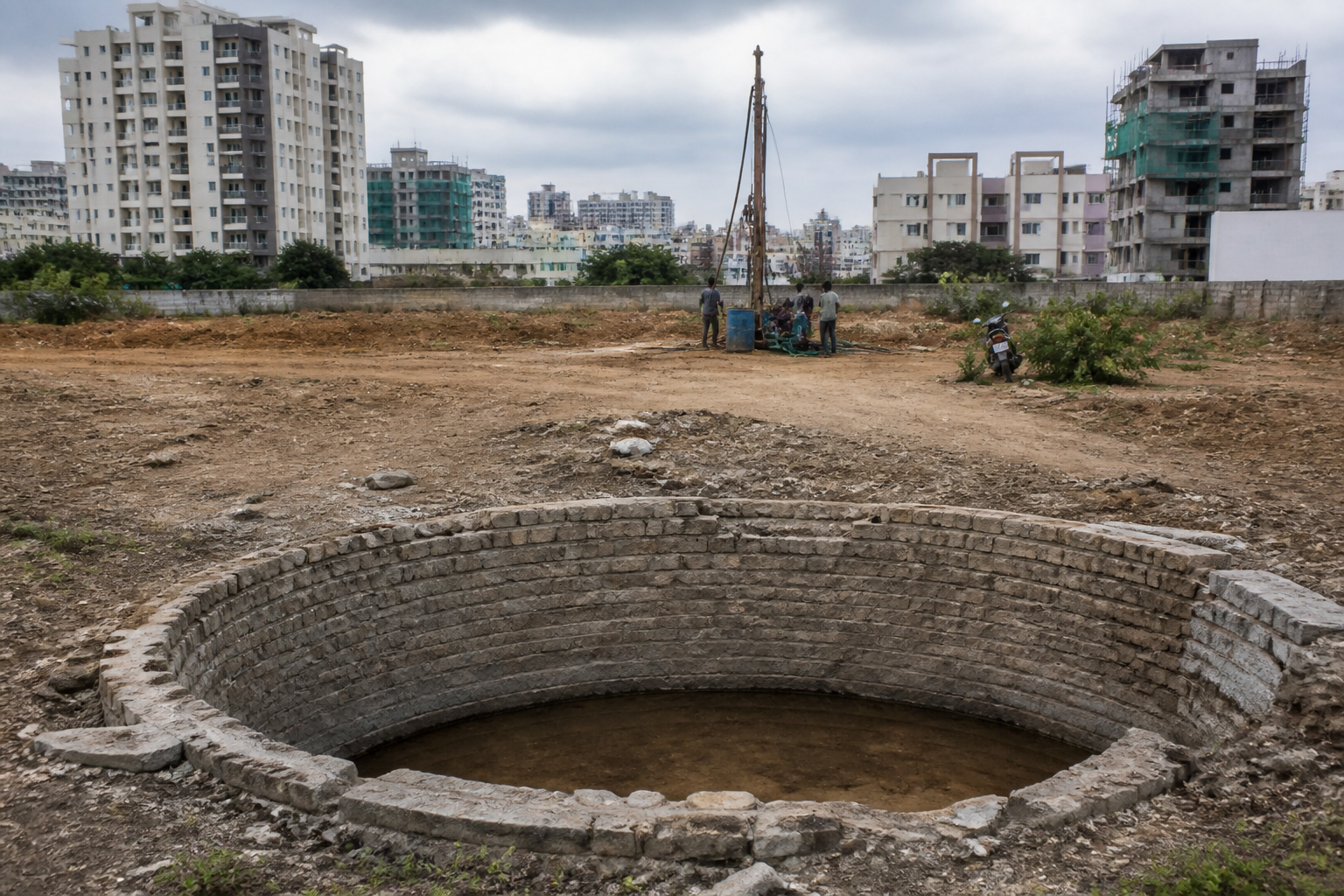
Hyderabad’s groundwater levels have fallen by an average of 22.5 feet in a year across the CURE metropolitan region, as 33 of 46 monitored mandals recorded deficient monsoon rainfall, according to the latest assessment by the Telangana Ground Water Department.
The average groundwater depth across the GHMC-CMC-MMC region stood at 38 feet below ground level in September, compared with 15.5 feet during the same period last year. The decline has increased pressure on water reserves across Hyderabad and its expanding peripheral areas, where several locations are now reporting groundwater depths of 65 feet or more.
Kukatpally, Quthbullapur, Uppal, Hayathnagar, Medipally and Shankarpalle were identified among the most stressed areas. At the mandal level, groundwater depth reached 67.8 feet in Kukatpally and 63.8 feet in Hayathnagar. Monitoring stations recorded substantially deeper levels in some locations: 155 feet below ground level at the Kukatpally MRO Office, 121.4 feet at a monitoring point in Quthbullapur, 85.7 feet in Fathulaguda, Uppal, and 84.3 feet in Medipally.
The CURE region received 457 mm of rainfall up to September 30, against a normal of 619 mm, representing a deficit of 26%. Only 13 of the 46 monitored mandals received normal rainfall. The remaining 33 mandals recorded deficits ranging from 21% to 49%.
The monsoon provided only limited relief. Groundwater levels improved by 1.4 feet from the pre-monsoon position recorded in May, but the increase was not enough to offset the year-on-year depletion. The data indicates that seasonal rainfall recharge has been insufficient to restore groundwater reserves across the metropolitan region.
B Venkateshwar Rao, former JNTUH professor of water resources, said the crisis was not solely the result of deficient rainfall. He attributed part of the problem to inadequate rainwater harvesting and recharge practices, saying that rainfall could have contributed more to groundwater replenishment if recharge pits and related infrastructure had been implemented effectively.
Rao said government agencies needed to prioritise and scale up rainwater harvesting and groundwater recharge pits across Hyderabad, while strengthening local recharge infrastructure. Such measures, he said, could help create a groundwater buffer and reduce the city’s vulnerability during years of poor rainfall.
The distribution of groundwater levels shows that the stress extends across a substantial part of the metropolitan region. Only about 2% of the area has groundwater within 16 feet of the surface, while 22% lies between 16 and 33 feet. The largest share, 46%, has groundwater between 33 and 49 feet. Another 24% lies between 49 and 66 feet, and 6% has groundwater deeper than 66 feet.
The Telangana Ground Water Department’s assessment comes as the CURE region continues to experience deficient rainfall and limited seasonal recharge. The immediate monitoring focus will remain on groundwater levels, rainfall patterns and the implementation of recharge measures across the stressed mandals.
