


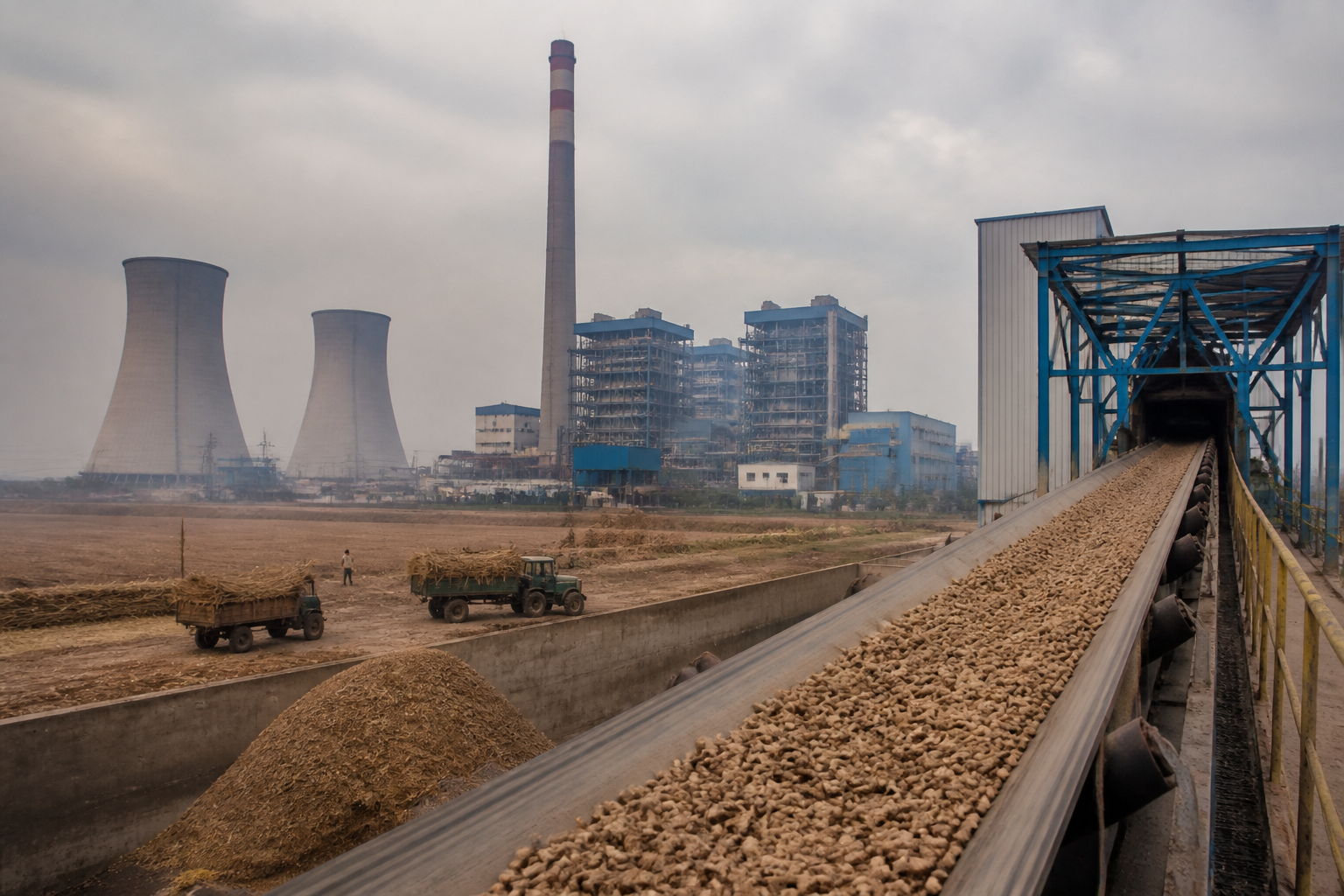
The Central Pollution Control Board’s defence of Rs 61.9 crore in environmental compensation imposed on six thermal power plants has brought a recurring Delhi-NCR air-pollution problem into sharper focus: the gap between a policy designed to reduce stubble burning and the industrial systems needed to implement it. The case before the National Green Tribunal is not only about penalties. It is also about whether India’s thermal power plants can reliably absorb agricultural residue into their fuel systems, and how regulators should respond when compliance depends on a supply chain that power producers say remains underdeveloped.
The Commission for Air Quality Management imposed the combined compensation on six coal-based thermal power plants for failing to meet biomass co-firing requirements during 2024-25. The plants include Deenbandhu Chhotu Ram Thermal Power Plant in Yamunanagar, Rajiv Gandhi Thermal Power Plant in Hisar and Talwandi Sabo Power Ltd in Punjab. The Central Pollution Control Board has defended CAQM’s regulatory action in a written submission filed before the tribunal in response to appeals by some of the plants.
The largest penalty, about Rs 33 crore, concerns the Punjab plant. Panipat Thermal Power Station accounts for approximately Rs 8.9 crore, the Yamunanagar plant for Rs 6.7 crore and the Hisar plant for Rs 5.6 crore. Together, these amounts show how a policy originally framed as an air-quality intervention has become an enforcement issue involving power generation, agricultural waste management and inter-state pollution governance.
Under the 2023 rules, coal-based power plants are required to use a 5% blend of biomass pellets or briquettes made from crop residue with coal. For 2024-25, plants were required to achieve more than 3% co-firing to avoid environmental compensation. The distinction between the broader 5% requirement and the annual threshold applied for avoiding compensation is central to understanding the dispute. The immediate question before the tribunal is whether the plants did enough to meet the applicable target during the relevant period.
The policy’s urban purpose is direct. Paddy straw has traditionally been burned in fields in parts of north India, contributing to seasonal air pollution that affects Delhi and the wider National Capital Region. Biomass co-firing is intended to create an alternative use for that residue while reducing dependence on open-field burning. The approach links an agricultural practice outside the city to the quality of air experienced by millions of urban residents.
But the policy also depends on an industrial chain that extends well beyond the power station. Crop residue must be collected, processed into usable pellets or briquettes, transported and fed into plants that were primarily designed to burn coal. The plants challenging the compensation have cited difficulties in sourcing adequate quantities of suitable biomass, particularly torrefied pellets. They have also pointed to technical and procurement constraints.
The Association of Power Producers made a similar argument last year, saying the domestic market for torrefied pellets was underdeveloped and that supply limitations, rather than unwillingness, contributed to the shortfall. This position presents non-compliance as a capacity and procurement problem. In that interpretation, a plant may be willing to co-fire biomass but unable to secure fuel of the required quantity and quality through a dependable market.
CAQM has rejected a purely availability-based explanation. The authority has maintained that the issue was not simply whether biomass existed in the market, but whether individual plants made adequate efforts to procure and use it. This shifts the regulatory test from a broad question of supply sufficiency to a plant-level assessment of conduct. Procurement records, tendering efforts, contracts, technical preparations and actual utilisation become important to determining whether a shortfall resulted from circumstances beyond a plant’s control or from inadequate compliance efforts.
That distinction matters for environmental enforcement. If every supply constraint automatically excuses a plant from meeting its target, the obligation risks becoming difficult to enforce precisely when the supply chain is weakest. If regulators disregard genuine shortages and technical limitations, however, the policy may impose penalties without addressing the infrastructure and market conditions required for compliance. The NGT proceedings therefore place implementation capacity and regulatory accountability in the same frame.
The authorities have argued that the plants received repeated directions and sufficient opportunities to comply. The plants, meanwhile, have challenged the penalties by citing procurement and operational difficulties. The competing positions reveal two different views of the policy. CAQM treats the requirement as an enforceable obligation for individual generators. The plants’ submissions emphasise that compliance depends on the availability of a specialised fuel market and on the technical compatibility of biomass with existing power-generation systems.
The tribunal has granted conditional interim relief in some of the appeals, requiring the plants to deposit 50% of the compensation. CAQM said in August that Rs 30.9 crore, half of the total penalty, had been received following the NGT’s interim orders. This arrangement does not resolve the underlying dispute, but it establishes a temporary financial consequence while the appeals proceed. It also indicates that environmental compensation can operate as an immediate enforcement mechanism even before the final legal position is settled.
The case highlights an institutional challenge in Delhi-NCR’s air-quality framework. The pollution problem is regional, but responsibility is distributed across several systems: agricultural residue management, state-level power generation, fuel procurement, environmental regulation and tribunal oversight. CAQM is responsible for coordinating air-quality management in the region, while CPCB has defended the regulatory action before the NGT. The power plants are operated by entities in different locations, including Haryana and Punjab, even though the air-quality consequences extend into Delhi-NCR.
This geography makes the policy more complicated than a city-level pollution-control measure. The source of the residue is often rural, the fuel conversion and combustion occur at industrial facilities, and the public-health consequences are experienced across urban and peri-urban areas. A compliance framework must therefore connect agricultural supply, industrial operations and regional air-quality targets. The current dispute shows what happens when one part of that chain—plant-level compliance—is enforced while the plants question the readiness of another part—the biomass market.
The numbers also demonstrate the financial scale of enforcement. The combined compensation is about Rs 61.9 crore, with the Punjab plant alone accounting for Rs 33 crore. The amount received under interim orders, Rs 30.9 crore, represents half of the total compensation cited by CAQM. These figures are not merely accounting details. They show that the policy has moved beyond guidance and into a system where failure to meet the co-firing target can produce a substantial financial liability for operators.
At the same time, the available material does not establish whether the plants had access to sufficient biomass, whether procurement attempts were adequate in each case, or how much biomass each facility actually used during 2024-25. It also does not establish the tribunal’s final view on the appeals. Those unresolved facts are important because the dispute turns on the difference between an avoidable compliance failure and a shortfall caused by supply, technical or procurement limitations.
For cities, the broader question is whether an air-pollution policy can succeed without a complete implementation ecosystem. Biomass co-firing seeks to address two linked problems: crop-residue burning and emissions from coal-based power generation. Its effectiveness depends not only on setting a blending obligation, but also on whether residue can be converted into a consistent industrial fuel and whether power plants have the equipment, contracts and operational systems to use it.
The NGT proceedings have therefore made the thermal plants’ compliance record a test of the policy’s institutional design. CPCB and CAQM are defending the principle that mandatory targets must have consequences. The plants are challenging the assumption that the required fuel and operating conditions were adequately available. The final outcome will determine how those competing claims are assessed in this group of appeals, while the immediate record already shows that Delhi-NCR’s air-quality strategy is being judged inside the power sector as much as in the fields where stubble is produced.
