


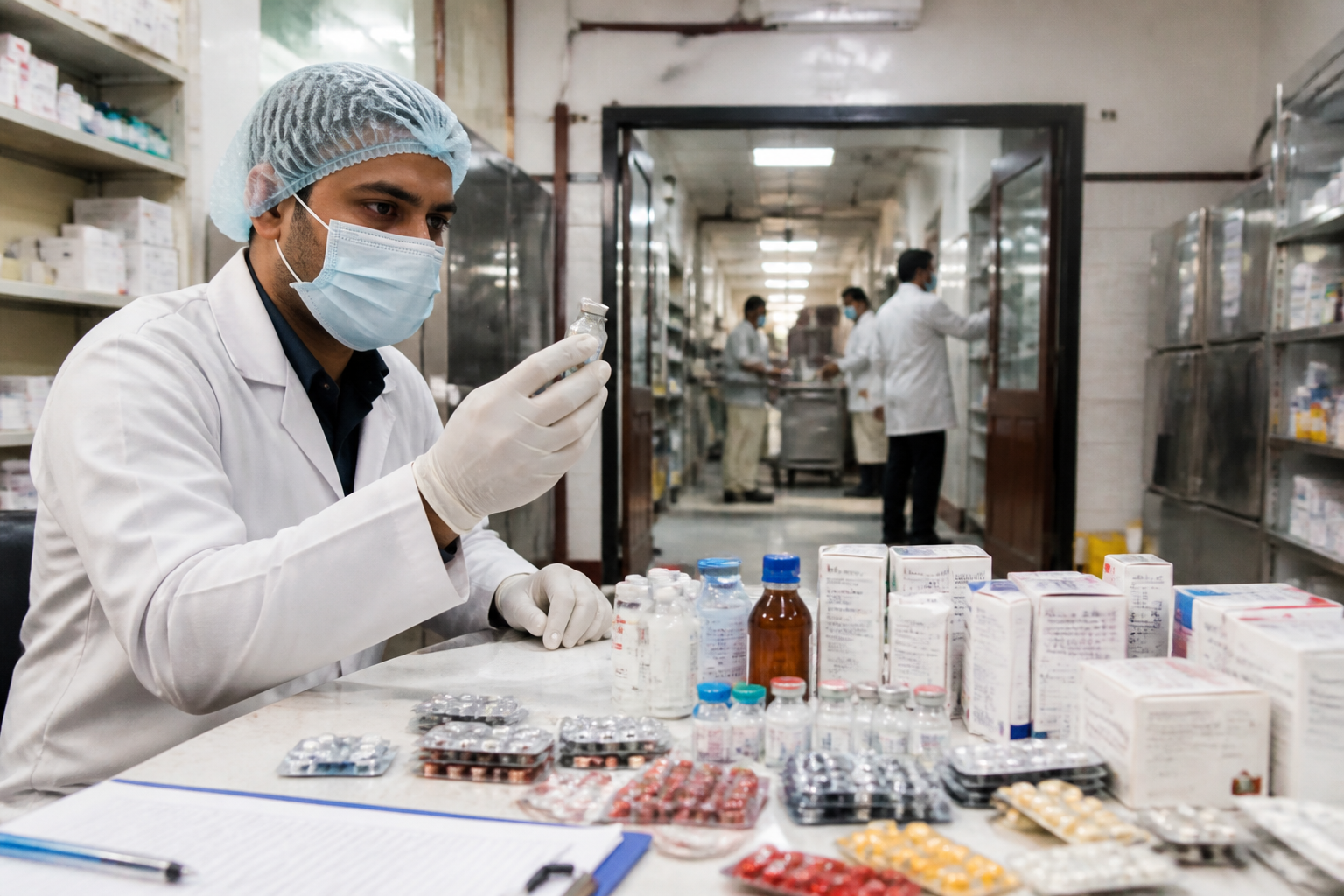
Repeated drug-quality failures reported at Delhi’s Ram Manohar Lohia Hospital point to a problem that extends beyond individual batches: the safety chain between procurement, laboratory testing, hospital storage and patient use is not reliably stopping defective medicines before they reach clinical systems.
According to a report by Jagran – New Delhi, Delhi’s drug-control department seized and sealed 2,675 vials of oxytocin from RML Hospital in July after testing found that the medicine’s active ingredient did not meet the prescribed standard. Two months later, the hospital issued four notices between 7 and 14 September directing that 10 batches of medicines be withdrawn from use and returned. Eight of those batches were classified as not of standard quality, while two contained tablets that had turned into powder inside their strips.
The report does not establish that patients suffered serious harm from the affected medicines. RML Hospital said the medicines had been taken out of use, alternative medicines had been arranged and no serious adverse effect had been reported. But the sequence raises a more important administrative question: at what point in the supply chain are medicines being tested, and why are quality problems continuing to be detected only after supplies have entered a large public hospital?
The oxytocin case is particularly significant because the medicine is used to initiate labour and to control excessive bleeding after childbirth. The 2,675 vials seized in July were manufactured by Jackson Laboratories Private Limited, Amritsar. The report says drug inspectors collected samples from the hospital in June and sent them to a government laboratory, where the active ingredient was found not to conform to the required standard.
That timeline shows the importance of batch-level controls in institutional healthcare. A medicine can pass through procurement, delivery, receipt and storage before a sample is formally tested. If testing occurs only after distribution or clinical availability, the hospital’s quality system may be functioning as a detection mechanism rather than a prevention mechanism. The supplied report does not specify the exact internal testing protocol followed by RML, the number of samples tested from each batch or the time taken between receipt and testing. Those gaps limit what can be concluded about the precise point of failure.
The September withdrawals covered a broad range of medicines and formulations. The affected products included sodium valproate 200 mg, spironolactone 50 mg and imipramine 25 mg tablets, as well as injections of adenosine, methyl ergometrine, multivitamins, pheniramine maleate and ascorbic acid. These eight batches were found not to be of standard quality. Isosorbide mononitrate 20 mg and metoprolol 50 mg tablets were found in powder form inside their strips. Both batches were manufactured by Glosun India Labs Private Limited.
The range of products matters because it suggests that the reported issue is not confined to one therapeutic category or one dosage form. The cases involve an injectable medicine, tablets and medicines used across different areas of hospital care. That does not by itself prove a common manufacturing or procurement cause. It does, however, make the hospital’s receiving, sampling, storage and recall procedures central to understanding how defective or physically compromised products entered the system.
The institutional responsibilities are divided. Manufacturers are responsible for producing medicines that meet quality standards. Drug inspectors and government laboratories are responsible for regulatory sampling and testing. The hospital, meanwhile, must manage procurement, receipt, storage, internal distribution, withdrawal and substitution. The report identifies the Delhi drug-control department’s seizure of oxytocin and RML’s later notices, but it does not provide details of any manufacturer-level enforcement action, procurement review or departmental investigation.
That distinction is important. Returning a defective batch removes an immediate risk, but it does not necessarily explain how the batch was accepted in the first place. A complete quality-control system would need a traceable record of the supplier, manufacturer, batch number, delivery date, sample collection, laboratory result, stock position, departments supplied and final recall. The supplied report does not say whether such records were reviewed or whether the hospital changed its procedures after the July seizure.
The two-month interval between the oxytocin seizure in July and the 10-batch withdrawal in September also raises questions about institutional learning. The events may involve different manufacturers and different products, and the report does not establish that they share a single cause. But their proximity makes it relevant to ask whether the hospital’s quality assurance process was strengthened after the first incident, whether testing was expanded, and whether other medicines from the same suppliers or procurement cycle were examined.
The numbers provide the clearest indication of the scale of the reported problem. One incident involved 2,675 oxytocin vials. The later action involved 10 separate medicine batches, of which eight reportedly failed quality standards and two showed physical deterioration inside their strips. The report does not state the total number of units in the 10 batches, the proportion of hospital stock affected or the number of patients who may have encountered the medicines. Without those figures, the operational scale of the September recall cannot be measured fully.
The absence of reported serious adverse effects should also be read carefully. It indicates that RML had not received information about a serious reaction linked to the affected medicines at the time covered by the report. It does not establish that the quality failures were harmless. A medicine with an inadequate active ingredient, a compromised formulation or visible physical deterioration can create a clinical risk even when no serious incident has yet been recorded. The risk is especially consequential in a hospital because medicines are administered to patients with different levels of vulnerability and often under time pressure.
The hospital’s response, as described in the report, had two immediate elements: stopping the use of the affected medicines and arranging alternatives. Those steps are necessary for containment. The unresolved issue is whether the response also included a preventive review. The report does not mention a publicly disclosed audit of the hospital’s procurement system, a review of vendor performance, an examination of storage conditions or a revised testing schedule.
Quality control in a public hospital is not only a laboratory function. It is also a governance function. Procurement rules determine which suppliers qualify. Contract conditions determine what happens when a batch fails. Pharmacy and stores departments determine how medicines are received and segregated. Clinical departments determine how quickly alerts travel to doctors and nurses. Drug regulators provide an external check. Weakness at any point can allow a defective batch to move closer to patients before it is identified.
The report also highlights an information gap. Jagran – New Delhi said it contacted RML’s public relations officer by phone and WhatsApp for the hospital’s response but did not receive a reply. The hospital’s stated position on stopping use, arranging alternatives and receiving no report of serious adverse effects is included in the report, but the article does not provide further details about the investigation or corrective action. For a public institution handling medicines, the absence of a detailed public account leaves patients and staff without information about how the system is being repaired.
The central question, therefore, is not simply why individual medicines failed quality testing. It is whether the hospital can demonstrate that its system identifies failures before medicines are distributed and that each failure produces a documented correction. That requires more than a recall notice. It requires visibility across the full chain, from the manufacturer and tender process to laboratory testing, storage, ward-level distribution and adverse-event monitoring.
The available evidence confirms two separate episodes within a short period: the seizure of 2,675 oxytocin vials in July and the withdrawal of 10 medicine batches in September. It also confirms that RML stopped using the affected products and arranged alternatives. What remains unclear is the total quantity of medicines involved, the results of any internal investigation, the regulatory action against the manufacturers and whether the hospital has changed its quality-assurance procedures. Those are the next facts needed to determine whether the reported failures were isolated incidents or signs of a wider weakness in the public hospital drug-supply system.
