


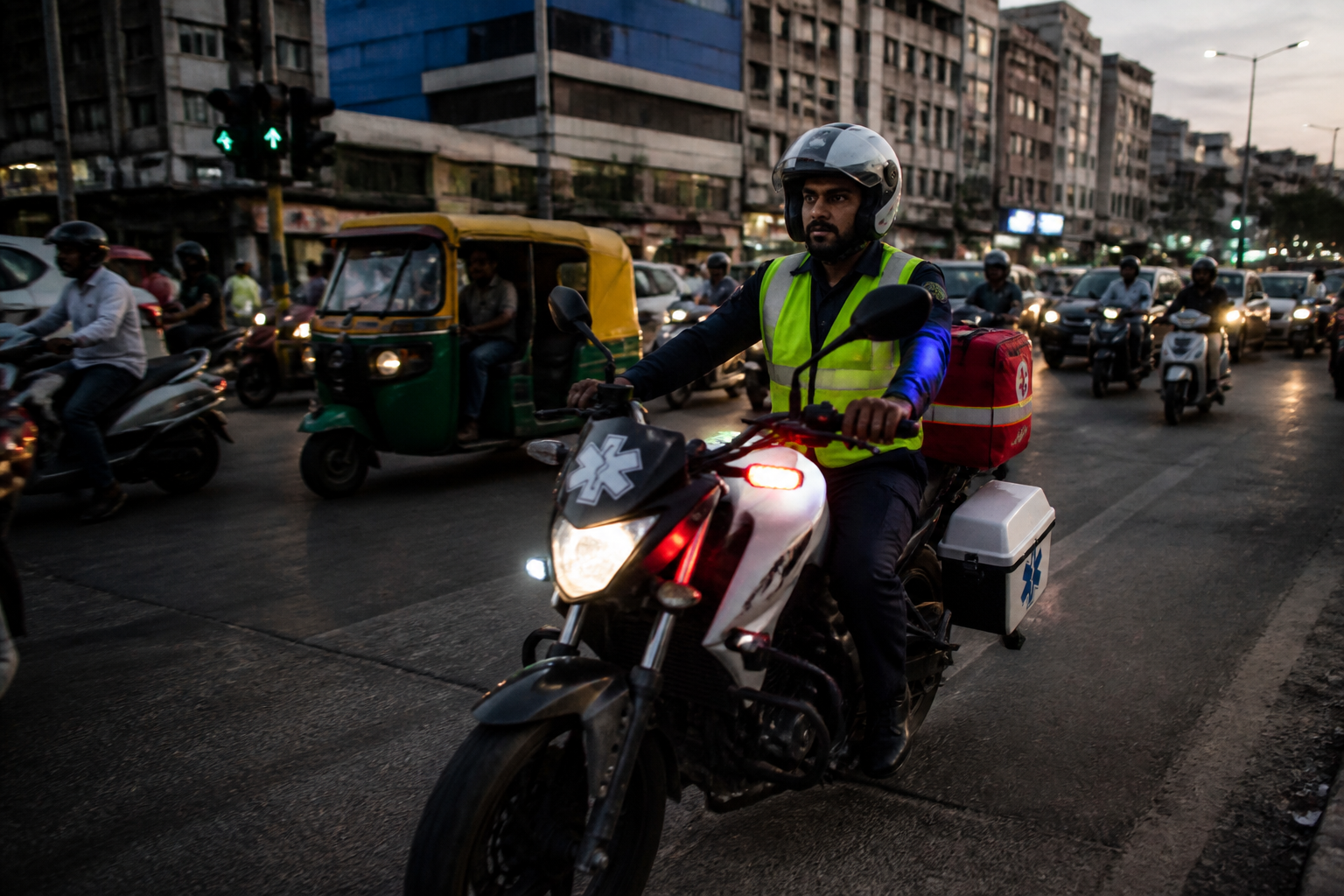
Bengaluru has launched a first-responder bike ambulance service to reach patients faster in traffic-choked areas, narrow roads and locations that conventional ambulances may struggle to access. The Manipal First Responder Service will send trained bike paramedics ahead of regular ambulances to begin emergency care at the scene and relay real-time medical information to hospital teams.
The service, introduced by Manipal Hospitals on Thursday, has been deployed across several high-traffic parts of the city, including Old Airport Road, Indiranagar, Domlur, Halasuru, Hebbal, R.T. Nagar, Nagawara, Whitefield, Varthur, Marathahalli, Sarjapur Road, Yeshwanthpur, Rajajinagar, Malleshwaram, Vasanth Nagar, Yelahanka and Hennur.
The initiative was formally launched by Karnataka Health and Family Welfare Minister U.T. Khader, who flagged off the First Responder Bike Ambulances. C. Mallikarjun and Gyanendra Kumar, Additional Commissioners in the Department of Transport, and Dr. H. Sudarshan Ballal, Chairman of Manipal Hospitals, were also present at the launch.
According to the service details reported by The Hindu, the bike ambulances carry first-aid kits, portable oxygen cylinders, trauma supplies, portable electrocardiogram machines and Automated External Defibrillators. Each motorcycle has a compact medical storage compartment at the rear, while oxygen cylinders and fire extinguishers are mounted on the sides. Sirens and beacon lights are intended to help the vehicles move through congested streets.
The service will operate through the helpline 080-22221111. When an emergency call is received, an emergency room doctor and the command centre will assess the situation and dispatch the nearest bike ambulance along with a conventional ambulance. The bike paramedic is expected to reach the patient first, conduct an initial assessment and begin immediate care before the regular ambulance arrives.
The first responder will also transmit the patient’s health data to the hospital emergency team in real time. Once the regular ambulance reaches the location, the patient will be handed over for transport to the hospital. This arrangement is designed to separate the tasks of rapid access and patient transport, allowing medical intervention to begin while the larger ambulance negotiates traffic.
Both the rider and pillion rider will use safety helmets equipped with built-in microphones to maintain communication with patients, ambulance personnel and hospital emergency teams. Pillion riders will also carry reflective emergency backpacks to improve visibility while moving through busy streets, particularly at night.
The launch places a private hospital network’s emergency response system within Bengaluru’s wider challenge of providing timely care across a congested and unevenly accessible road network. The service’s operational coverage, response times and patient outcomes will determine how effectively bike-based first response complements the city’s existing ambulance system. The helpline and dispatch centre are now the primary points of access for the service.

