


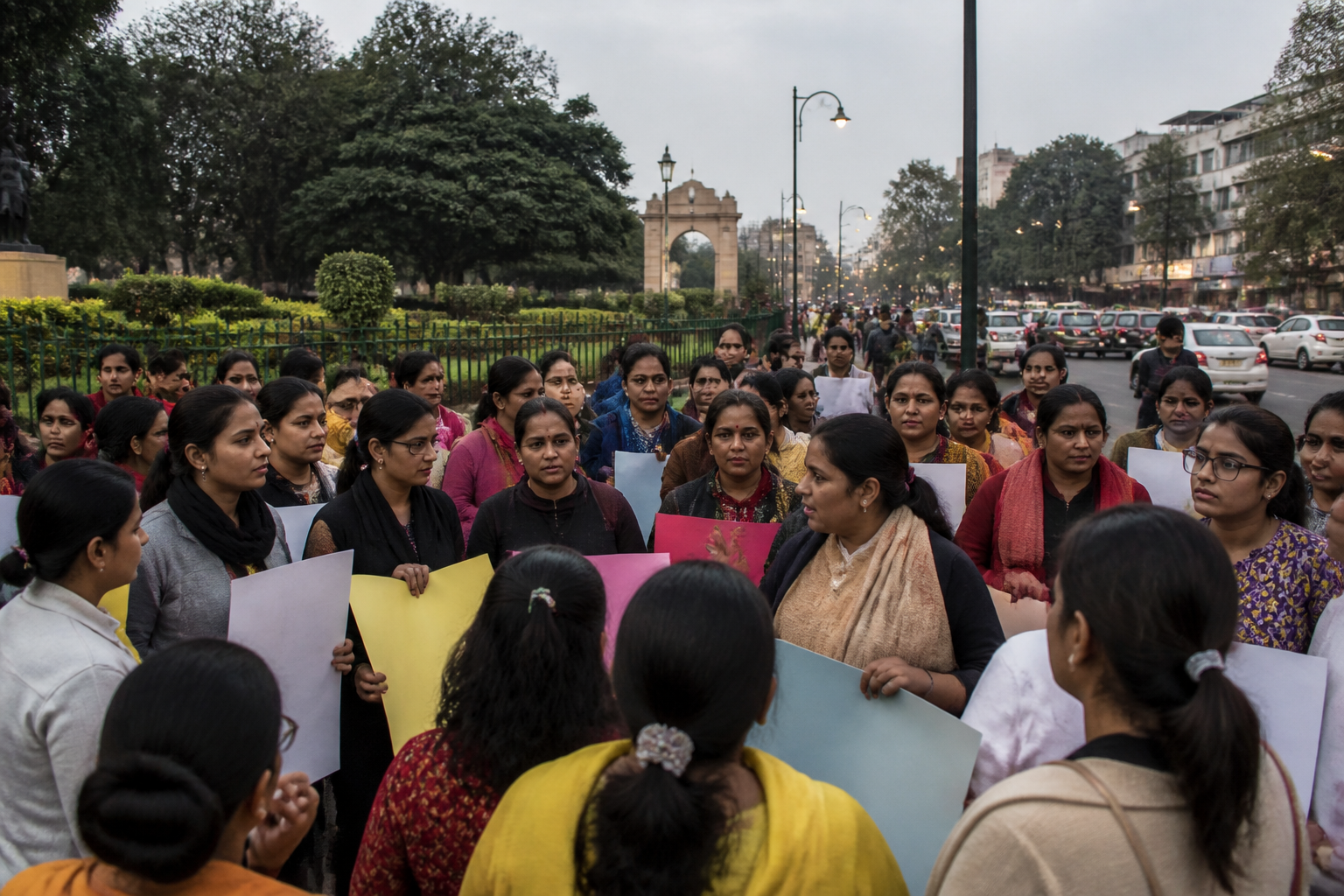
The latest debate around Delhi women safety protests has shifted from the safety of women in public spaces to the language used by protesters. A report by Live Hindustan – NCR says women and girls took to the streets after a reported gangrape of a 17-year-old girl at Astha Kunj Park, amid wider references to crimes ranging from harassment and abuse to rape, gangrape and murder. The argument over slogans has since created a second dispute: whether slogans directed at men unfairly generalise an entire gender.
That dispute is not irrelevant. But it changes the centre of gravity of the conversation. The immediate urban question is not only what protesters say, but why women feel compelled to protest for safety in the capital’s streets and parks, and what institutions are expected to do when public spaces are experienced as unsafe.
The supplied report does not provide a police case number, court record, official response or detailed account of the Astha Kunj Park incident. It attributes the incident and the surrounding protest context to its own report. That limitation matters. The central concern, however, is clearly identified in the article: women are demanding safety, while public attention is being absorbed by a debate over protest slogans.
The slogans listed in the report are deliberately confrontational. They use humour, repetition and broad references to men as a social group. Some protesters are quoted or represented as saying that men are untrustworthy, that men are responsible for women’s pain, or that men should be condemned collectively. Men objecting to the slogans argue that such language treats every man as responsible for the actions of offenders.
This is a familiar tension in public protest. Movements often use compressed and provocative language because a slogan has to be heard in a crowd, remembered quickly and shared beyond the site of the demonstration. A slogan is not a police complaint, a charge sheet or a policy document. It is a form of political expression. Its purpose is to make an experience visible, even when the language is intentionally sharper than an institutional statement.
At the same time, a protest slogan can shape how an issue is received. When a broad social category is described as the source of danger, people who do not identify with that behaviour may respond defensively. The Live Hindustan report notes that some men have objected to what they see as the generalisation of male behaviour and male identity. That objection cannot simply be dismissed if the goal is to build a wider public understanding of women’s safety.
But the reverse problem is equally serious. If the public discussion focuses only on whether particular slogans are fair, the original safety demand can disappear. The report itself contrasts the protest language with a long list of misogynistic expressions used in everyday speech and literary references. Its point is not that one form of generalisation cancels out another. Rather, it shows how arguments about language can become selective, with attention falling on women’s anger while the social language that normalises contempt towards women receives less scrutiny.
This creates a structural problem for urban governance. Safety in a city is not produced by slogans alone, and it cannot be assessed only through the presence or absence of a protest. It depends on how public authorities respond to complaints, how incidents are investigated, how parks and streets are managed, and whether women can use public places without having to calculate the risk of harassment or violence.
The supplied material does not establish which specific failures occurred at Astha Kunj Park. It does not state whether lighting, surveillance, staffing, access control, policing or maintenance played a role. Those facts should not be assumed. Yet the location is significant at an urban level because parks are public assets intended for recreation and everyday use. When a serious crime is reported in such a space, the question extends beyond the individual case to the systems that govern public access and safety.
A park is not made safe by a signboard or a single security measure. Responsibility is usually distributed across several institutions, even though the report does not identify the agencies involved in this case. Police handle criminal investigation and immediate security. Civic or land-owning agencies may manage lighting, boundaries, maintenance and access. Local administrations may coordinate responses to public complaints. Political representatives and neighbourhood groups can also influence how safety concerns are raised and addressed.
That institutional distribution can make accountability difficult for citizens to follow. A woman reporting danger may experience the street or park as one continuous environment, while government responsibilities are divided between departments. If the public conversation remains at the level of competing slogans, the administrative chain behind safety remains invisible. The practical questions are harder: who received the complaint, who inspected the site, which agency controls the park, what remedial measures were ordered and when will those measures be reviewed?
The report gives no data on the number of incidents, the condition of the park or the response of Delhi authorities. It also does not provide evidence to compare Astha Kunj Park with other public spaces. As a result, the article cannot establish a citywide trend from this incident alone. It can, however, identify a recurring pattern in public debate: a safety demand is translated into a culture-war argument before the underlying institutional questions are answered.
This pattern affects the quality of urban decision-making. If public authorities respond mainly to the controversy over slogans, they may avoid the more difficult task of explaining what happened and what will change. If critics of the protest respond only by defending men as a group, they may also shift attention away from the conditions that produced the demonstration. The result is a debate about tone without a corresponding examination of safety systems.
That does not mean language should be beyond criticism. Public movements are accountable for the effects of their words, especially when they claim to represent a broad constituency. A slogan that treats all men as equally responsible may alienate potential supporters and make it easier for institutions to portray the protest as unreasonable. A more precise public vocabulary could distinguish between individual offenders, social practices that enable violence and institutions that fail to respond.
Precision, however, cannot become a demand that women express fear and anger in language that makes everyone else comfortable. The report describes protests by women and girls who are asking for safety after a serious alleged crime and amid concerns about violence against women. Their anger is part of the evidence of a broken relationship between citizens and public institutions. It should not be treated as the cause of the problem merely because it is expressed in language some listeners find offensive.
The larger issue is therefore not whether slogans are perfectly framed. It is whether the city can move from protest to institutional response without losing the original demand. That requires the incident to be investigated through due process, the affected public space to be examined on the basis of evidence, and responsible authorities to communicate clearly about the steps being taken. None of these requirements is established as having occurred in the supplied report, which is why the next official actions remain important.
Delhi’s women safety protests reveal a difficult but necessary distinction. The language of a movement can be debated, challenged or improved. The demand that women should be able to use the city without fear cannot be postponed until that debate is settled. The available report confirms the existence of a public dispute over slogans and identifies women’s safety as the underlying concern. What remains to be established is the official account of the Astha Kunj Park case, the condition and management of the site, and the concrete measures authorities will take in response.
