


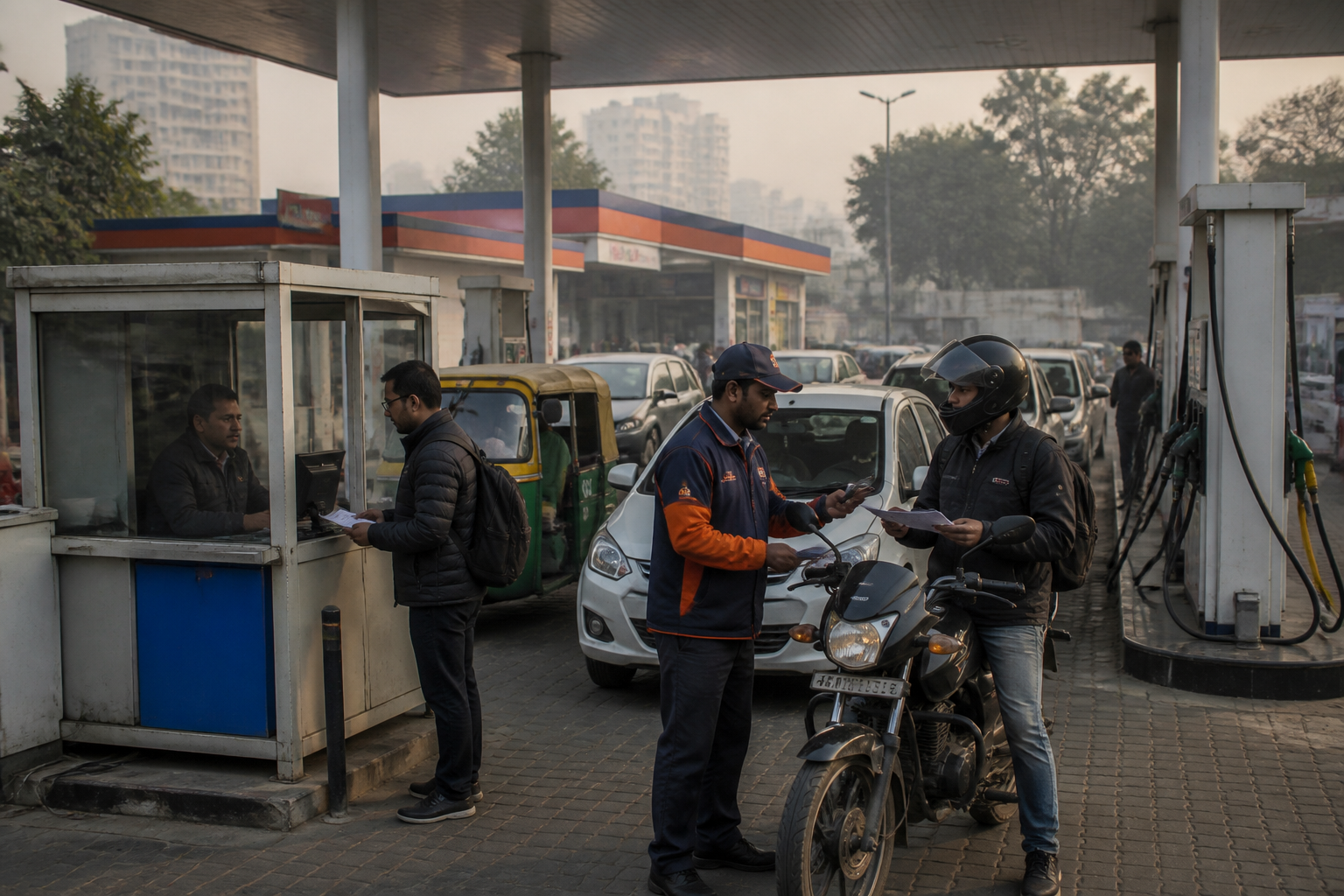
Delhi-NCR vehicle owners will need a valid Pollution Under Control certificate to buy petrol or CNG from 1 October, under directions issued by the Commission for Air Quality Management (CAQM) ahead of the region’s winter pollution season.
The measure follows a review meeting of CAQM’s sub-committee on 29 September, where enforcement against pollution sources and preparations for the winter period were discussed. The directions apply across the National Capital Region and require state governments and enforcement agencies to implement stricter measures.
According to the reported CAQM order issued on 15 May 2026, vehicles without a valid PUC certificate will not be allowed to refuel from 1 October. The restriction is intended to improve compliance with vehicle-emission standards by linking fuel access to proof that a vehicle has passed the prescribed pollution-control check.
The directions also include preparations to install Automatic Number Plate Recognition systems at fuel stations. The reported review examined the implementation of these systems, which are intended to help identify vehicles and support enforcement at dispensing points. The material supplied does not specify how many fuel stations will receive the systems or when the installations will be completed.
CAQM has separately tightened the entry rules for buses arriving from outside the region. During the first stage of the Graded Response Action Plan, only electric, CNG and BS-VI diesel buses from outside states will be allowed to enter Delhi-NCR. Other categories of buses will face restrictions at the first GRAP stage.
The reported directions also expand restrictions on older, higher-emitting light vehicles when GRAP Stage III is imposed. The ban on BS-III petrol and BS-IV diesel light motor vehicles, or vehicles below those standards, will now cover Sonipat as well. It had earlier applied to Delhi, Ghaziabad, Noida, Greater Noida, Gurugram and Faridabad.
The wider coverage reflects the region’s interconnected transport and air-quality system, in which vehicle movement across municipal and state boundaries affects enforcement. The order places implementation responsibilities on the governments and agencies administering cities across the NCR, rather than limiting the measures to Delhi alone.
CAQM’s winter preparations also include action on stubble burning in Punjab, Haryana and Uttar Pradesh. The reported meeting reviewed preparations to prevent paddy-residue burning in these neighbouring states, one of the sources considered during seasonal pollution-control planning.
Rules governing diesel generator sets have also been revised. Under the modified GRAP framework, restrictions on diesel generator sets connected with construction and demolition activities will begin at Stage I instead of Stage II. This means their use can be stopped at an earlier stage when air quality begins to deteriorate.
The revised construction-related provisions retain restrictions on construction activity during GRAP Stage III but allow essential work such as repairing potholes. The exemption is intended to ensure that urgent road maintenance continues even when wider construction activity is restricted.
The fuel restriction and other measures will come into force from 1 October. Their implementation will depend on enforcement by fuel stations, state governments and agencies across Delhi-NCR under the CAQM directions.
