


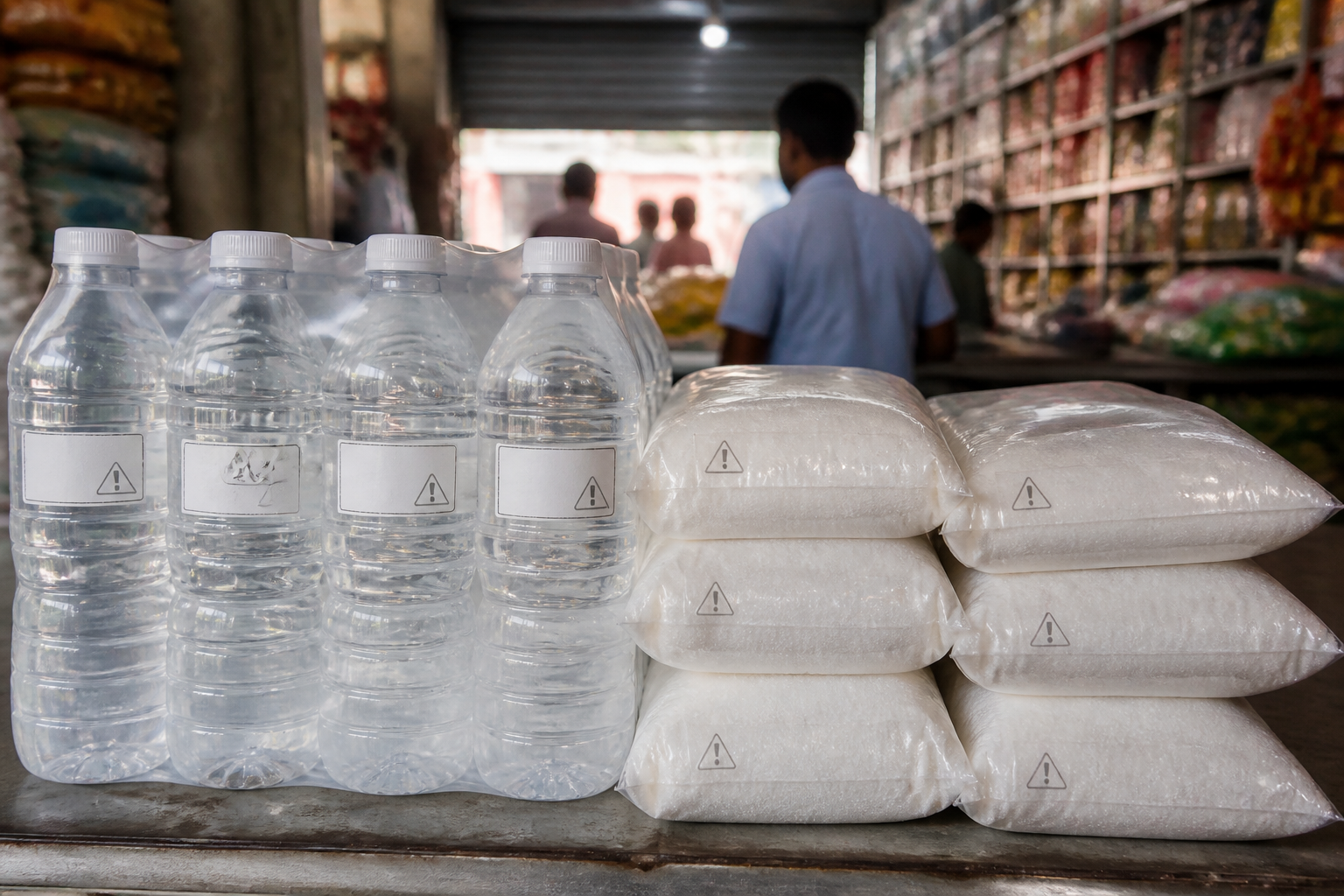
The Madras High Court has upheld mandatory microplastic warning labels on PET bottled water and plastic packets used to sell sugar and salt, rejecting review applications filed by the Food Safety and Standards Authority of India (FSSAI). The court said informing consumers about the possible presence of microplastics was a necessary minimum safeguard while further risk assessment is undertaken.
A special bench of Justice N Sathish Kumar and Justice D Bharatha Chakravarthy said India’s consumption patterns and water-supply conditions made comparisons with developed countries inappropriate. In its order, the bench noted that tap water is generally consumed in developed countries, while households in India often consider tap water unsafe and buy and store crates of bottled water.
The court also cited the problem of counterfeiting and the refilling of PET bottles as an India-specific concern. These factors, it said, made disclosure about microplastics a grave and important issue. The bench held that the absence of similar labels in developed countries could not by itself make the Indian requirement unnecessary.
The review applications concerned an earlier order mandating labels declaring the presence of microplastics in PET bottles and in plastic packets used for sugar and salt. The court’s latest decision leaves that labelling direction in place, according to the report by Times of India – Chennai.
The bench referred to domestic and international studies and scientific literature on the potential effects of microplastics on multiple human systems. These included the digestive and gastrointestinal, cardiovascular, renal and excretory, reproductive, endocrine and metabolic systems, as well as cellular and molecular processes. The court also noted concerns about possible long-term carcinogenic effects.
The order stated that studies had found that bio-non-degradable particles, once inside the body, could cross biological barriers and enter the bloodstream, allowing them to move to other organs. The court further referred to its earlier observation that micro- and nanoplastics had been detected even in placentas and said the possibility of such particles crossing the placenta and reaching a developing embryo presented a serious concern.
The court did not describe the warning as a final determination of the health risk posed by every PET bottle or plastic food packet. Instead, it characterised the labelling requirement as the “barest essential minimum” needed to inform consumers that food or water may contain micro- or nanoplastics. The bench said this balance had been considered while FSSAI continued its further enquiry into risk assessment.
The ruling places consumer disclosure at the centre of an issue that connects packaged-water use, food safety regulation and the limits of existing urban water systems. For consumers, the immediate change is the continuation of a warning-label requirement covering commonly purchased products. For regulators and manufacturers, the next stage will depend on the further risk assessment referred to by the court and on how the labelling direction is implemented.
The Madras High Court’s review dismissal is therefore the immediate operative development. FSSAI’s continuing enquiry into the risks associated with microplastics will determine the next regulatory steps identified in the court’s order.
