


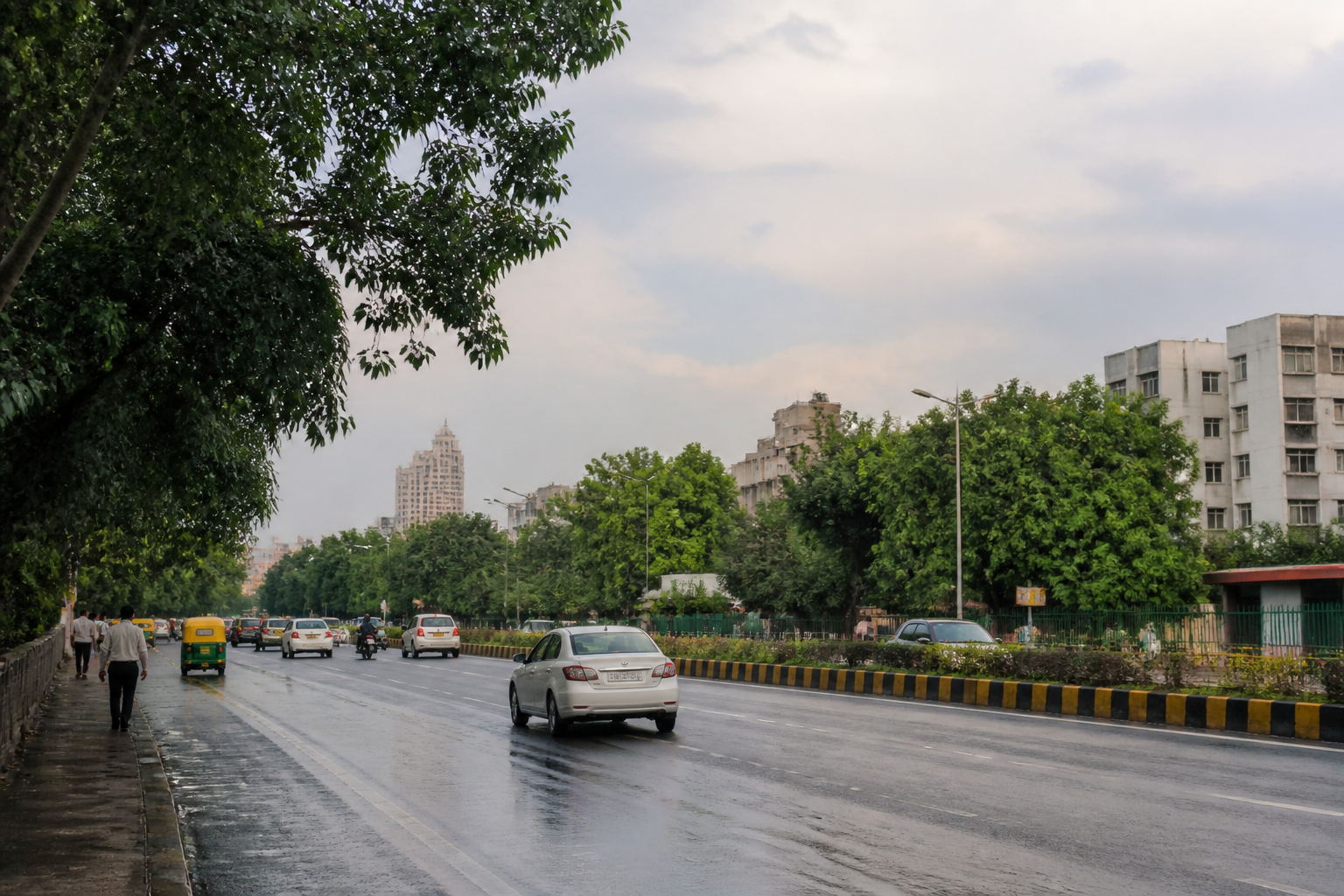
Delhi’s lowest September minimum temperature in 18 years, combined with five consecutive days of satisfactory air quality, has offered a brief demonstration of how closely the capital’s everyday urban environment is tied to atmospheric conditions. The India Meteorological Department recorded a minimum temperature of 21 degrees Celsius on Tuesday, 2.3 degrees below normal, while the Central Pollution Control Board recorded a 24-hour average Air Quality Index of 71.
The immediate weather event was unusual but not isolated from the wider functioning of the city. The India Meteorological Department attributed the recent conditions to atmospheric systems over the region and rainfall activity. It expects the cooling to ease as the rain system moves away, with north-westerly winds continuing over the next few days. The episode therefore provides a useful, evidence-based picture of how temperature, rainfall, wind movement and air quality can change together over a short period.
The temperature reading was the second-lowest September minimum recorded in the city, according to the report. The previous comparable reading was 20.8 degrees Celsius on 6 September 2008. The source also records minimum temperatures of 20.6 degrees Celsius on 29 September 2008 and 20.7 degrees Celsius on 30 September 2008. Tuesday’s 21-degree reading was 0.2 degrees higher than the 6 September 2008 figure, but it was still sufficiently low to mark the coldest September night in Delhi in 18 years as reported by the weather department’s data.
The city-wide figure also conceals substantial variation between weather stations. Palam recorded a minimum of 19.7 degrees Celsius, 3.8 degrees below normal. Lodhi Road recorded 20.4 degrees, Ridge 16.9 degrees and Ayanagar 20.6 degrees. These differences matter because Delhi is not experienced as a single climatic space. Its built form, open areas, tree cover, local terrain and exposure to wind can produce different conditions across neighbourhoods, even during the same weather event.
The Ridge’s 16.9-degree minimum was the lowest among the stations cited in the report. Palam’s reading, meanwhile, shows that the departure from normal was not confined to one central or relatively open location. The available figures do not establish the precise reasons for the station-to-station variation, but they show why city-level weather summaries can be insufficient for understanding what residents experience at street level.
The same weather episode also affected daytime conditions. Delhi’s maximum temperature was 32.4 degrees Celsius, 2.3 degrees below normal. The contrast between the lower daytime maximum and the cooler night-time minimum indicates a generally milder spell rather than a change limited to overnight conditions. For residents, the practical effect is likely to be felt differently depending on housing quality, access to ventilation, exposure to outdoor work and the timing of daily travel. The supplied report does not quantify these effects, but its station-level readings demonstrate that the weather shift was geographically uneven.
The air-quality data add another layer to the event. The CPCB recorded an average AQI of 71 on Tuesday, placing Delhi in the satisfactory category for the fifth consecutive day. Under the classification cited in the report, an AQI of 0 to 50 is considered good, 51 to 100 satisfactory, 101 to 200 moderate, 201 to 300 poor, 301 to 400 very poor and 401 to 500 severe.
An AQI of 71 does not mean that all pollution concerns have disappeared. It places the city’s average reading in the satisfactory range, but the classification itself indicates that the air is not in the best category. More importantly, a city-wide 24-hour average does not describe every locality or every hour equally. The report provides no neighbourhood-level AQI breakdown, so the available evidence cannot establish whether all parts of Delhi experienced the same improvement.
What the report does establish is a temporal association between rainfall, changing atmospheric conditions and improved average air quality. The IMD linked the recent weather to atmospheric systems and rain activity, while the CPCB data showed five consecutive days in the satisfactory category. The evidence supports describing this as a period of improved air quality during a rainy and cooler spell. It does not, by itself, establish how much of the improvement came from rainfall, wind, reduced emissions or other factors.
That distinction is important for urban governance. Air quality is measured and communicated through a city-wide index, while the causes and effects of pollution operate through multiple systems. Weather determines how air moves and disperses. Rain can alter atmospheric conditions and wash some pollutants from the air, while wind direction and speed can change the movement of pollutants across the region. At the same time, the city’s transport, construction, industrial and household activity contributes to the emissions environment. The supplied report does not provide an emissions inventory, so no claim can be made here about the relative contribution of those sources during this episode.
The forecast suggests that the improvement in temperature and air quality should be read as a weather-linked phase rather than as a permanent shift. The IMD expected mainly clear skies on Wednesday, with a minimum temperature of 20 to 22 degrees Celsius and a maximum of 32 to 34 degrees. On Thursday, the maximum was expected to rise to 33 to 35 degrees, while the minimum would remain around 20 to 22 degrees. For 2 October, the forecast range was 33 to 35 degrees for the maximum and 21 to 23 degrees for the minimum.
The direction and speed of the wind are another important part of the forecast. The IMD expected mainly north-westerly winds over the following days, reaching up to 18 kilometres per hour on Wednesday and Thursday and up to 25 kilometres per hour by Friday afternoon. These figures provide a short-term indication of changing atmospheric movement, but the report does not state how the forecast winds would affect AQI in specific parts of Delhi.
For the city’s residents, the central lesson is that weather information is also urban infrastructure information. Temperature and AQI affect decisions about commuting, outdoor work, school activities, ventilation and exposure. A difference of several degrees between monitoring stations can matter to people who spend long hours outdoors, particularly when a city combines dense construction, heavy traffic and large variations in access to sheltered or green spaces. The available report does not provide a demographic or occupational impact assessment, but it supplies the weather and air-quality data against which such questions can be examined.
The episode also underlines the importance of reading weather and air-quality data together. A cooler night is not automatically evidence of cleaner air, and a satisfactory AQI does not mean that temperature conditions are uniform across the city. In this case, both the temperature readings and the AQI moved in a relatively favourable direction during a period associated by the IMD with rainfall and atmospheric systems. That combination is useful for understanding the city’s environmental conditions, but it should not be treated as a simple or permanent formula.
Institutionally, the report points to two different but connected monitoring responsibilities. The IMD provides temperature observations, weather explanations and forecasts, while the CPCB provides the AQI classification. Their data answer different questions: the first describes atmospheric and thermal conditions, while the second translates pollution measurements into a public-facing air-quality category. A fuller urban assessment would require these datasets to be read alongside local station readings and emissions information, none of which is supplied in the report.
The short-term forecast also shows why timing matters in interpreting urban environmental data. The city moved from a rainy and cooler spell towards clearer skies and higher daytime temperatures. North-westerly winds were expected to strengthen by Friday afternoon. As these conditions change, the temperature and AQI observed on one day may not represent the conditions residents face several days later. The report therefore records a moving urban environment rather than a fixed improvement.
Delhi’s September weather episode confirms three specific facts. The city recorded a minimum temperature of 21 degrees Celsius, its lowest September minimum in 18 years according to the report. Several monitoring stations recorded lower temperatures than the city figure, with the Ridge at 16.9 degrees Celsius and Palam at 19.7 degrees. And the CPCB recorded an AQI of 71, in the satisfactory category, for the fifth consecutive day. What remains unresolved from the supplied evidence is the precise contribution of rainfall, wind, emissions and local urban form to the readings. The next developments to monitor are the forecast rise in daytime temperatures, the movement of north-westerly winds and whether the city’s AQI remains in the satisfactory range as the weather system changes.
