


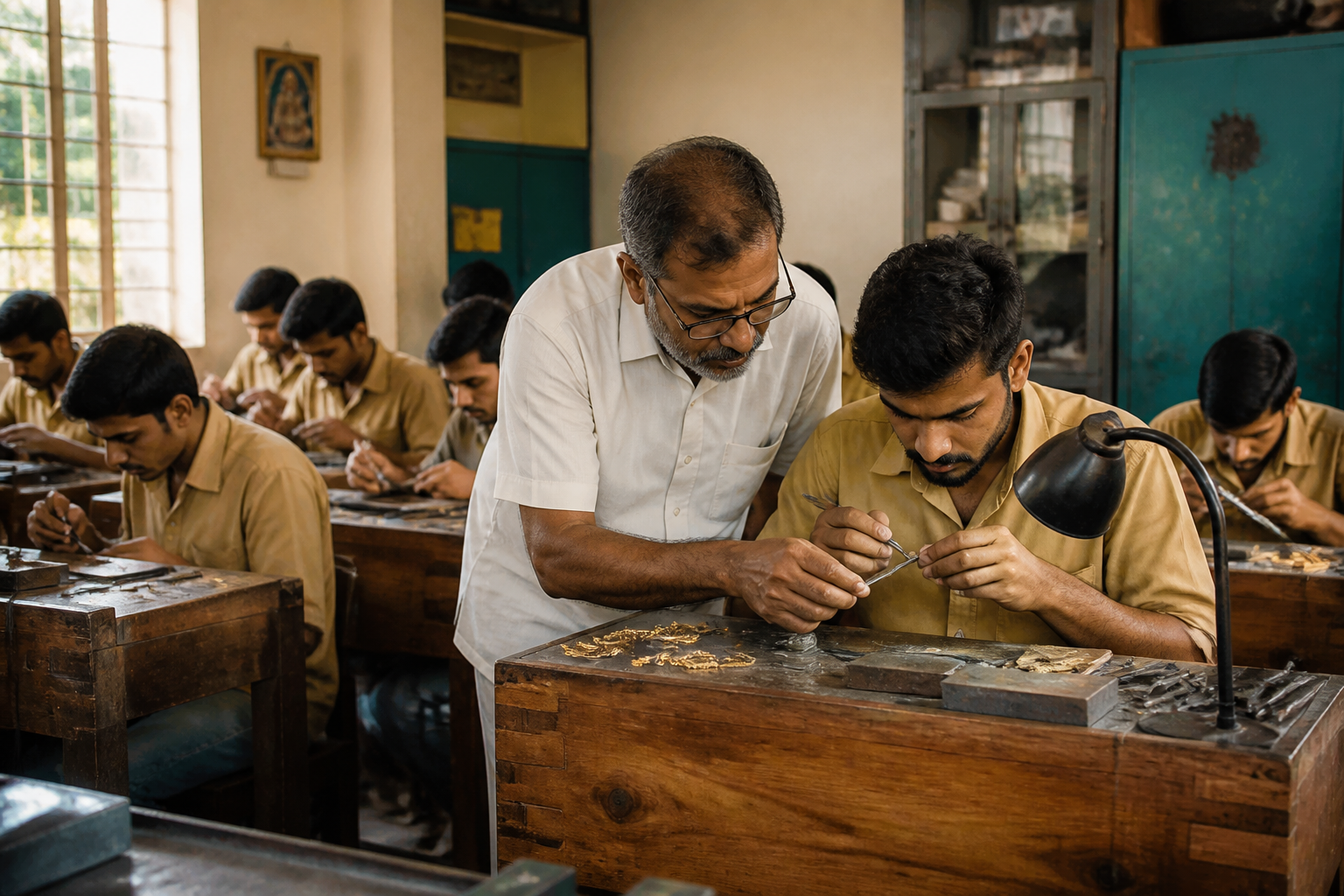
West Bengal is considering recognised training degrees for jewellery craftsmen through government industrial training institutes and a private partnership model, as the state seeks to strengthen the skills pipeline for its established gems and jewellery sector.
Higher Education minister Jagannath Chattopadhyay said the state had included a jewellery-industry representative in the task force implementing the National Education Policy in West Bengal. Speaking at a gems and jewellery summit organised by the Indian Chamber of Commerce, he said the government wanted industry members to use government ITIs for five years under a proposed 2:1 financial model.
The minister said an ongoing short-term training programme for gems and jewellery artisans had certified 3,000 trainees, of whom 1,500 had been absorbed by the industry. He also invited the sector to help establish a dedicated Skill University for aspiring artisans in West Bengal, saying the government would support the initiative by facilitating space and institutional assistance.
The proposal places vocational training institutions at the centre of a broader attempt to formalise a craft-based workforce. Chattopadhyay said the jewellery industry should participate in apprenticeships, internships and industry-led training. The state’s plan would rely on a partnership between government ITIs and industry members rather than on public institutions alone.
The Indian counterpart of the World Gold Council has proposed funding the dedicated Skill University and has also suggested setting up a Karigars’ Park in West Bengal. The proposals are aimed at developing artisans and craftsmen, although the source report does not specify a final location, investment amount, construction schedule or legal structure for either facility.
Suvankar Sen, a member of the state task force on NEP implementation, said artisans were being provided insurance facilities through an industry association as a short-term measure. He said young people were also being trained and absorbed through the government’s National Apprenticeship Scheme, while master artisans in Domjur and Midnapore were being encouraged to train younger workers.
Sen said discussions were under way with the state government to make artisan work a recognised profession through degree-based qualifications. He added that talks on a dedicated university formed part of the sector’s longer-term plans. The statements indicate that recognition of jewellery craftsmanship is being considered alongside training, insurance and employment pathways.
The initiative comes as the Indian International Bullion Exchange prepares to open a vault at Manikam SEZ in Kolkata by Diwali. Ashok Gautam, its managing director and chief executive officer, said the facility would allow jewellers in Bengal to take delivery locally instead of sourcing bullion from Chennai or GIFT City.
Gautam said nearly 50 qualified jewellers and tariff-rate quota holders in Bengal were already associated with the exchange. The proposed vault would bring bullion-delivery infrastructure closer to the region’s jewellery trade, but the report does not specify the exact opening date or operational capacity.
The next steps involve continued discussions between the state government, industry representatives and institutions over the proposed financial model, degree recognition, apprenticeships, the Skill University and the Karigars’ Park. The bullion exchange has separately indicated that its Kolkata vault is expected to open by Diwali.
