


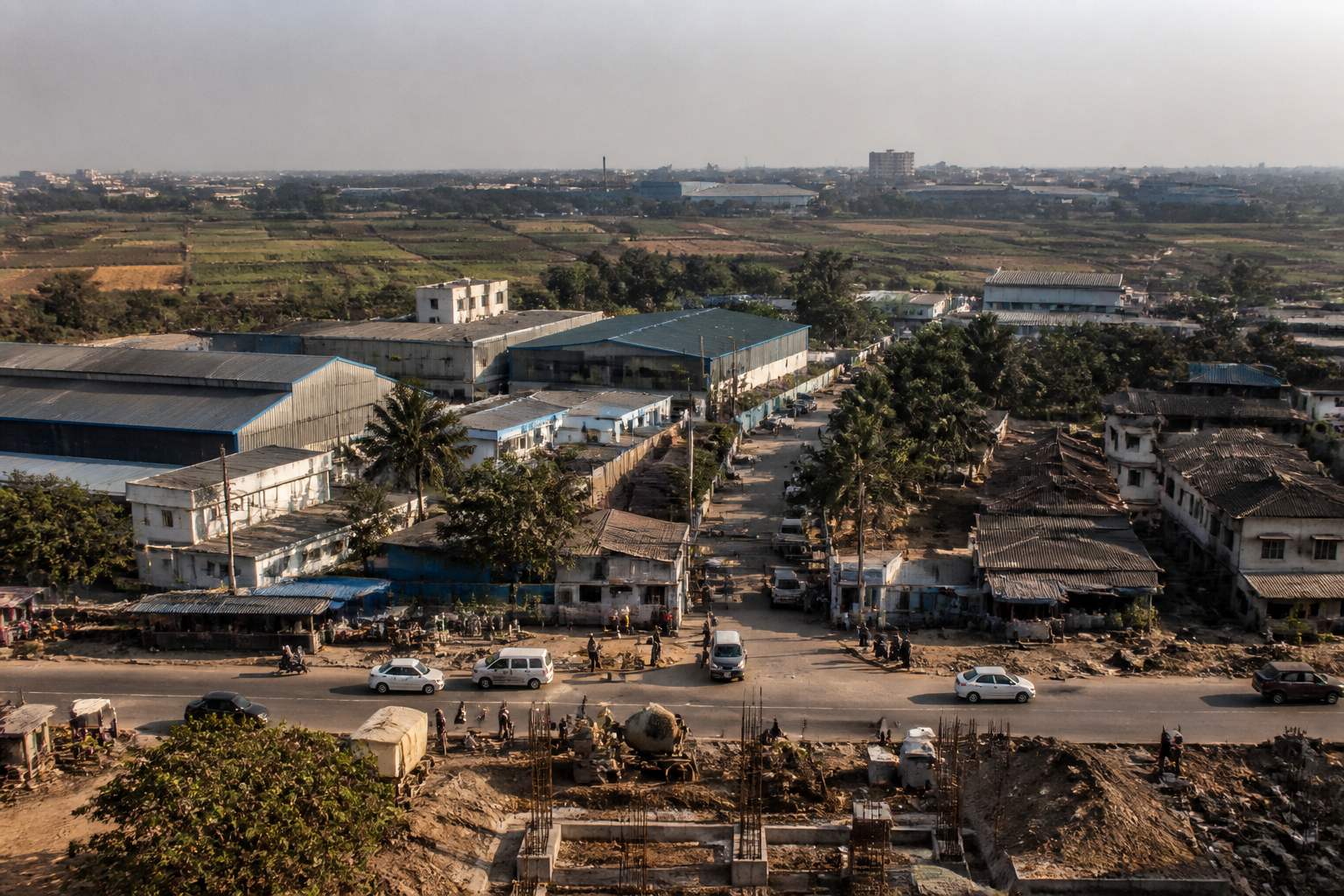
Pune Rural’s changing crime profile is closely tied to the spread of urbanisation and industrialisation, according to Superintendent of Police Sandeep Singh Gill, who identified land disputes, threats to industrial clusters, narcotics and the use of sharp-edged weapons as growing policing challenges in the district. His remarks point to a wider transition: areas once governed primarily as rural settlements are increasingly dealing with the conflicts, land pressures and security demands associated with expanding urban economies.
The most direct link between development and crime, in Gill’s account, is land. Land-related disputes remain a major concern in belts where urbanisation and industrialisation are accelerating, he said, adding that land prices have “skyrocketed” and that such cases are often complex because records may not be fully updated and contain grey areas. This is not simply a property dispute problem. It is also an administrative challenge created when land values rise faster than the systems that establish ownership, record transactions and resolve competing claims.
Pune Rural occupies an important position in the region’s expanding urban and industrial geography. The police superintendent said the district has five Maharashtra Industrial Development Corporation clusters. These clusters bring capital, employment and new economic activity into areas that may still retain local social and institutional structures. That combination can generate opportunity, but it can also create friction when the benefits of industrial growth are contested or when local groups attempt to extract money from companies.
Gill said industrial representatives had reported threats and extortion calls from local gangs and anti-social elements. Police have held meetings with companies, registered cases and made arrests, he said. The police have also advised companies to file complaints immediately after receiving such calls. According to Gill, delays sometimes occur because companies consult legal teams before approaching the police, while in other cases legal responses take time. He also urged companies to take local residents into confidence and engage with them.
This response reveals an important feature of security in industrial areas: policing cannot be separated from the relationship between a company and its surrounding settlement. A factory or logistics facility may be legally established, but its presence can alter land values, traffic, employment patterns and access to local opportunities. When companies do not communicate with nearby communities, or when local residents believe that development has bypassed them, the resulting mistrust can create space for intermediaries, pressure groups and criminal actors. The superintendent’s emphasis on local engagement suggests that industrial security is partly a governance and integration problem, not only a deployment problem.
The land question is made more difficult by the pace of peri-urban change. Gill described land records as an area with gaps and grey zones, but the interview does not provide details on the nature or scale of those records, nor does it identify particular land parcels or disputes. What it does establish is that the police are encountering cases in locations where rural land is being absorbed into a more valuable and contested urban economy. The institutional responsibility therefore extends beyond the police to land-record administration, local government and planning authorities, although the interview does not specify the role of each agency in individual cases.
The same transition is visible in the nature of violent crime. Gill said there is no single gang formally known as a “Koyta Gang”, but acknowledged that local gangs or smaller criminal groups in rural areas use sharp-edged weapons in property offences and personal disputes. Many such weapons are available for agricultural or domestic use, he said. At the same time, the use of illegal firearms is rising, according to his assessment, and police are taking what he described as multipronged measures to curb it.
This distinction matters because labels can obscure the geography and causes of crime. A popular term may suggest a centralised organisation, while the police account describes smaller groups and locally available weapons. In a rapidly changing rural-urban fringe, the same object can move between legitimate and criminal contexts: an agricultural implement can be used for work, but can also become a weapon in a property or personal dispute. The evidence supplied in the interview does not establish a single organised structure behind these incidents. It instead describes a dispersed enforcement challenge involving local groups, personal conflicts and illegal arms.
Drug use is another pressure emerging alongside this transformation. Gill said narcotics use remains a growing concern in rural areas and is concentrated in particular pockets. Pune Rural registered 10 cases involving mephedrone and other drugs in Shirur taluka alone during the year, he said. The interview does not provide comparative figures for previous years, the number of people arrested, seizure quantities or the status of prosecutions. It therefore cannot establish a district-wide trend in numerical terms. It does, however, record the police’s assessment that the problem is growing and that youth-awareness work is being carried out alongside enforcement.
The focus on Shirur is significant because it shows how policing priorities are becoming geographically specific. A district-wide label such as “rural drug menace” can conceal differences between settlements, transport corridors, industrial areas and villages. Gill referred to particular pockets rather than describing uniform growth across Pune Rural. That suggests the need for authorities to understand where demand, supply and vulnerability intersect, though the supplied material does not detail the police’s mapping or prevention methods.
The interview also places child safety within a broader community and institutional framework. Following two cases involving the rape and murder of minor girls, Gill said the police had begun a campaign called Saksham Surakshit Sankalp. He referred to government departments responsible for awareness on women and children, village-level committees and Police Patils. The police had previously focused on the “Good touch-Bad touch” concept, but he said awareness must also include children’s rights and the collective responsibility of families, neighbourhoods, communities and villages.
This approach shifts the discussion from isolated awareness sessions to the local institutions that surround children. In rural and peri-urban areas, safety depends not only on police response after an offence but also on whether families, schools, village committees and local officials recognise risks and know where responsibility lies. The interview does not provide data on the campaign’s reach or outcomes, so its effectiveness cannot yet be assessed. It does show that the police see prevention as requiring participation beyond the police department.
The Ketan Agarwal murder investigation, which formed the starting point of the interview, illustrates another dimension of policing in a changing landscape: the use of digital and technical evidence. Gill said the police noticed inconsistencies after a death at a fort was reported in the Daily Crime Report. They examined CCTV footage from an Archaeological Survey of India ticket counter, identified a third person, and later used call-detail records, internet-protocol detail records and other CCTV footage in the investigation. He said a 5,000-page chargesheet was filed on September 19, the 89th day after arrest, and that three people had been arrested for murder and conspiracy.
Gill described the case as supported by circumstantial, technical and witness evidence, including phones, calls, chats and the alleged use of fake Instagram accounts. These are police claims about the prosecution case, not a judicial finding of guilt. The interview records the superintendent’s confidence that the chain of evidence has been established, while the defence has argued that the investigation suffered from tunnel vision. The court’s assessment of the evidence is not provided in the supplied material.
Taken together, the interview presents Pune Rural as a territory where the boundaries between rural administration, industrial development and urban crime are becoming harder to separate. Rising land values create disputes; industrial investment creates new targets and new relationships with surrounding communities; accessible agricultural weapons coexist with illegal firearms; and digital platforms increasingly feature in both crime and investigation. None of these developments can be reduced to a single cause, and the supplied evidence does not support a claim that urbanisation itself produces crime.
What the evidence does confirm is that policing is being asked to respond to a more complex peri-urban system. The police are dealing simultaneously with property conflicts, industrial security, narcotics, weapons, child protection and technology-led investigations. The next measure of institutional capacity will be whether these issues are addressed through coordinated land administration, timely company reporting, community engagement, targeted prevention and evidence-based prosecution. For now, the interview’s clearest message is that Pune Rural’s security challenges are increasingly shaped by the way the region is developing.
