


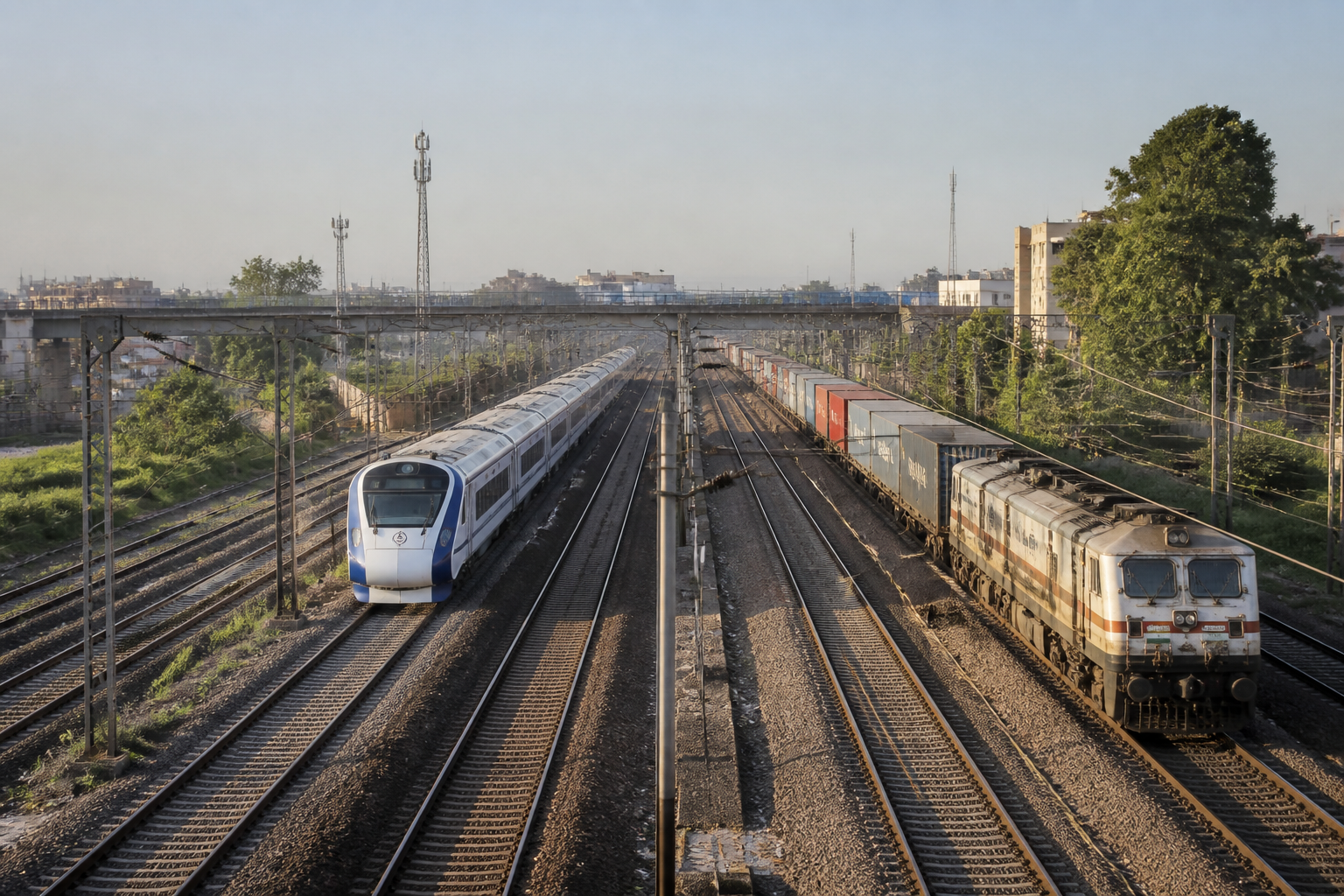
The Delhi-Ambala rail line will receive two additional tracks under a ₹5,983-crore project aimed at easing severe capacity pressure, improving train punctuality and increasing the movement of passengers and freight along one of North India’s important railway corridors.
The 194-km project will add third and fourth lines between Delhi and Ambala. The route currently carries more than 150 trains a day, including Shatabdi, Rajdhani and Vande Bharat services, as well as freight trains. According to the report, train operations on the section are running at around 166% of its capacity, leading to trains being held at outer areas or smaller stations.
The expansion is expected to address conflicts between passenger and freight services. Railway officials said the additional infrastructure would help remove constraints affecting train speeds and punctuality. The project is also expected to improve access for passengers travelling towards Jammu, Srinagar, Vaishno Devi and Shimla, although the report does not specify revised journey times or operating schedules.
The Union government approved the construction of the two additional lines on the 194-km section in February this year. The project is estimated to cost ₹5,983 crore and was preceded by the preparation of a detailed project report that began about five years ago.
The first phase covers the section between Sabzi Mandi and Ambala Cantonment. A tender worth ₹3,612 crore has been invited for construction of the additional lines. The package includes civil works, track construction, signalling, telecommunications and overhead electrification. The deadline for submitting bids is February 1, according to the report.
The project will also include two rail overbridges and 79 rail underbridges. These structures are intended to support the expanded railway corridor while managing crossings along the route. The construction work is expected to begin next year, with railway officials setting a four-year completion target.
The line’s importance extends beyond inter-city passenger travel. The corridor supports the movement of goods to thermal power plants, agricultural warehouses and industrial units. Additional track capacity could allow freight trains to operate with fewer conflicts with high-frequency passenger services, while also reducing the need to hold trains at stations and outer areas.
The expansion is being planned as rail connectivity and traffic on the northern network grow. The report notes that train and freight movement could increase after rail connectivity to Srinagar becomes available. Without matching investments in track, signalling and associated infrastructure, higher traffic volumes could place further pressure on a corridor that already experiences delays.
The immediate milestone is the tendering process for the first phase. Construction is expected to begin next year after the contract is awarded, while the overall project has a stated four-year completion target. The report does not provide a detailed construction schedule or identify the specific sections where work will begin first.
