


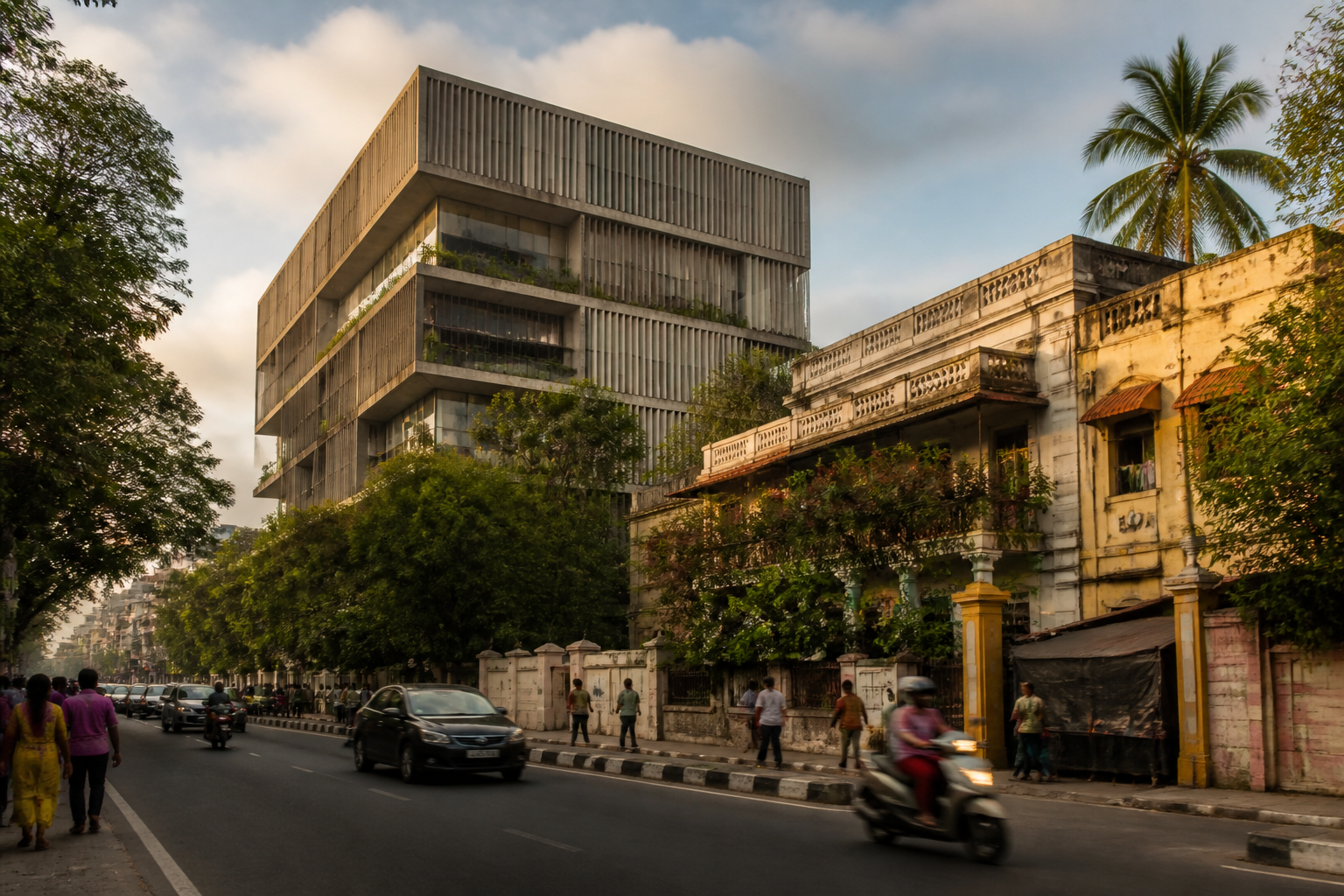
The release of Chennai Contemporary Architecture: A Guide places a question about the city’s built environment in a more useful frame: how should a rapidly changing city record the buildings that have shaped its recent identity? Published by the Chennai Architecture Foundation and The Hindu Group, the book documents 52 buildings and focuses largely on the period after 1995, when economic liberalisation and the emergence of new generations of architects altered Chennai’s architectural landscape.
The book, curated by architects A. Srivathsan and Fiona Evangeline S., was released on Monday by architecture expert P.T. Krishnan. Its launch brought together representatives of The Hindu Group, historian V. Sriram and architect Pramod Balakrishnan. The event’s significance lies less in the ceremony than in the attempt to create an accessible historical record of a city’s present-day architecture.
That framing matters because cities are often documented unevenly. Older buildings may enter architectural histories through established styles, prominent commissions or heritage listings, while more recent buildings can remain scattered across professional publications, project archives and the memories of their designers. By assembling descriptions, drawings and interviews, the book seeks to bring a selection of Chennai’s contemporary buildings into one record.
Its curators have not treated the city’s architecture as a simple contest between an idealised past and an unsatisfactory present. N. Ram, Director of The Hindu Group, said at the launch that the book was not a conventional “then versus now” account. Instead, he described it as a balanced and accessible guide to Chennai’s architectural evolution, particularly after the economic reforms of the 1990s.
That period is used as the book’s principal point of emphasis. Of the 52 buildings featured, 28 were mostly constructed after 1995 and receive detailed descriptions, drawings and interviews with architects. The remaining 24 buildings provide a broader view of the city’s architectural development. The division gives the book two functions at once: it records a group of relatively recent buildings in detail and places them within a wider account of how Chennai’s architecture has developed.
The selection also suggests that contemporary architecture cannot be understood only through visual appearance. The discussions at the launch repeatedly connected buildings to climate, human behaviour, structural elements and local requirements. These are not secondary concerns in a city’s architecture. They are the conditions through which buildings are used, experienced and judged over time.
Krishnan described Chennai’s relative distance from dominant architectural schools as having given its architects a degree of freedom. “There are advantages to being in the wilderness because it offers you total freedom,” he said, arguing that this freedom had been used productively by architects in the city. The observation presents Chennai not simply as a follower of national architectural trends but as a place where local practice could develop with a degree of independence.
The claim is important, but the book’s stated purpose is not to turn that independence into a slogan. Srivathsan said the publication was conceived fundamentally as “an historical record of the present”. That phrase establishes a different standard from a catalogue of celebrated buildings. An historical record must preserve the circumstances, design decisions and professional voices that may otherwise become difficult to recover later.
The book’s emphasis on buildings constructed after 1995 reflects a specific urban transition. The source material does not provide a detailed account of changes in land markets, construction technology, planning rules or building regulation during that period. It does, however, identify economic liberalisation and the arrival of new generations of architects as important influences on Chennai’s architectural landscape. The publication therefore appears to treat architecture as an expression of wider institutional and economic change, rather than as an isolated professional activity.
This is also where the idea of “form follows function” is reopened. Krishnan said that environmental conditions and human behaviour were increasingly shaping buildings, giving the principle a new meaning. He argued that the concept needed to be re-understood in light of this interpretation. The statement moves the discussion away from the idea that function is limited to a building’s assigned use. It suggests that function also includes how occupants behave, how local conditions affect performance and how a structure responds to its surroundings.
For Chennai, the reference to environmental conditions has direct built-environment relevance. The supplied report does not identify particular buildings or quantify their environmental performance, so it cannot establish how successfully the featured projects respond to climate. It does show, however, that the book’s architectural lens includes more than form, material or visual novelty. It records an understanding of buildings as responses to conditions that users and designers encounter in the city.
Historian V. Sriram similarly welcomed the book’s attention to structural elements and to the ways buildings responded to local requirements. His remarks challenged the tendency to dismiss contemporary construction as merely “concrete and glass and cement”. The point is not that every recent building is successful, nor does the source make such a claim. Rather, it is that the materials and structural systems of contemporary buildings should be examined in relation to design intent, construction and use instead of being reduced to a shorthand judgement about modernity.
That approach gives the guide potential value beyond architecture schools and professional offices. Ram said it would be useful to architecture students and professionals as well as to others interested in Chennai and its built environment. The intended audience therefore includes people who use the city without necessarily working in architecture. This broadening is significant because buildings are public facts even when access to architectural criticism remains limited. They shape streets, neighbourhood identities and everyday movement, while the reasoning behind their design is often unavailable to residents.
The book’s 52-building structure also creates a manageable way of reading the city. It does not claim to be a complete inventory of Chennai’s architecture. The source describes 28 buildings in detail and 24 others as providing a broader view. That distinction indicates a curated selection rather than an exhaustive survey. Its value will consequently depend on how clearly the selection criteria are explained and how convincingly the featured projects represent the city’s architectural evolution. Those details are not established in the supplied account.
The institutional arrangement behind the publication is itself notable. The Chennai Architecture Foundation and The Hindu Group are jointly identified as publishers, while architects serve as curators and the launch includes contributions from an architecture expert and a historian. This combination places the book between professional documentation, public cultural record and accessible city history. It also shows that architectural knowledge is being presented through a collaborative structure rather than being left only to individual practices or formal academic histories.
The publication’s timing, as described at the launch, is tied to a period in which Chennai’s architecture has been changing since the 1990s. Yet the book’s broader implication is not limited to one generation of buildings. A city that does not record its recent architecture risks losing the reasons why buildings were designed, the constraints under which they were built and the relationship between professional ambition and local conditions. Once those details disappear, later assessments tend to rely on appearance alone.
The guide therefore raises a structural question for Chennai: who maintains the memory of the contemporary built environment? Government records may document approvals and ownership, while architects retain drawings and project histories. Residents experience the buildings, but their perspectives are not always preserved in formal architectural accounts. A publication that combines drawings, descriptions and architect interviews addresses part of this gap, although the source does not indicate whether residents, users or public authorities were interviewed for the book.
The evidence available about the publication supports a clear conclusion but not a larger judgement about the quality of Chennai’s contemporary architecture as a whole. The book records 52 buildings, gives particular attention to the post-1995 period and presents architecture through environmental, structural and behavioural considerations. Its editors and speakers position it as a record of an evolving city rather than as a simple celebration of new construction.
Its longer-term importance will depend on how the record is used: by students studying the city, professionals examining earlier work and residents seeking to understand the buildings around them. For now, the publication establishes a valuable documentary intervention. It treats Chennai’s recent architecture as part of the city’s history while leaving open the larger task of evaluating how those buildings perform, endure and serve the people who use them.
