


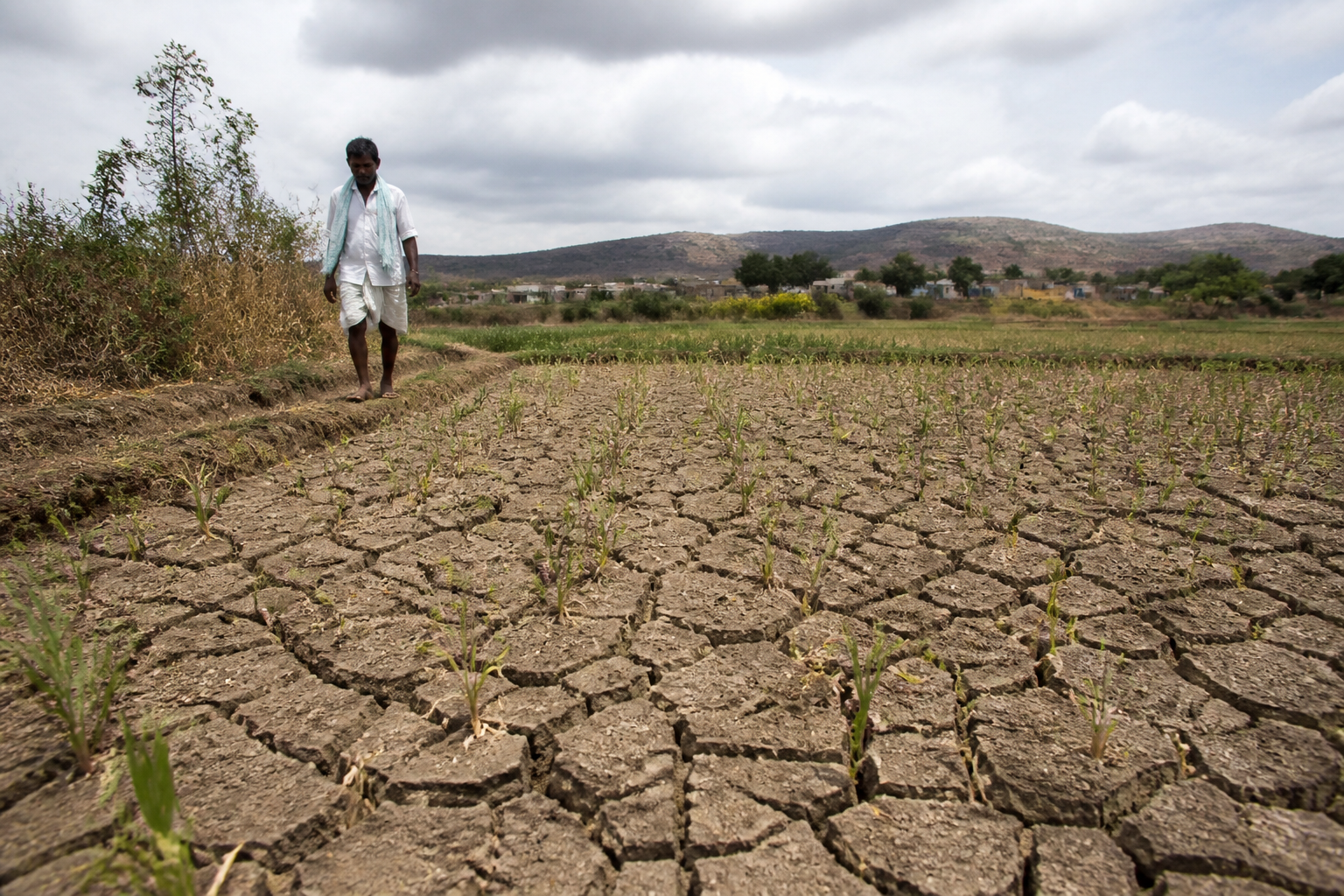
Telangana’s examination of a drought declaration for around 230 mandals is more than a seasonal rainfall update. It is a test of how a state converts uneven local weather data into an administrative decision with consequences for relief, crop planning and access to Central assistance. The reported assessment comes as 312 of the state’s 621 mandals fall in the deficient rainfall category, while one mandal has recorded a deficit of 69 per cent.
The government is examining conditions at the local level before preparing a list of mandals that could be declared drought-affected, according to the report by Deccan Chronicle. An official announcement was expected either during the week of publication or the following week. The possible declaration would cover roughly one-third of Telangana’s mandals, although the final number remains subject to the government’s assessment.
That distinction matters because the statewide average does not describe the experience of every mandal. Data from the Telangana Development and Planning Society showed an average rainfall deficit of 16 per cent, but the distribution was sharply uneven. Seventeen districts were classified as deficient, with rainfall between 20 per cent and 59 per cent below normal, while 16 districts were in the normal category.
At the mandal level, 312 units were listed as deficient. Their deficits ranged from 20 per cent to 59 per cent below normal. Eighteen mandals were close to the large-deficient category, with cumulative deficits between 50 per cent and 59 per cent. Another 57 mandals recorded deficits between 40 per cent and 49 per cent, 106 had deficits between 30 per cent and 39 per cent, and 125 were between 20 per cent and 29 per cent below normal.
Waddepalle mandal in Jogulamba Gadwal district represented the most severe figure in the data cited by the report. It had received 136.5 millimetres against a normal 435 millimetres during the monsoon season so far, a deficit of 69 per cent. That placed it in the large-deficient category, defined in the report as rainfall between 60 per cent and 99 per cent below normal.
The numbers show why drought administration cannot rely only on a state-level average. A moderate average deficit can coexist with severe local stress when rainfall is concentrated unevenly across districts and mandals. For residents and local economies, the relevant question is not simply whether Telangana as a whole received less rain, but whether a particular mandal received enough rainfall at the right time to sustain crops, replenish local water sources and support the next stage of the agricultural cycle.
The rainfall table cited by Deccan Chronicle records no mandal in the large-excess category and 39 mandals in the excess category. There were 268 mandals in the normal category, 312 in the deficient category and one in the large-deficient category. At the district level, no district was listed as having large excess or excess rainfall. This distribution points to a broad weakening of monsoon performance rather than a single isolated pocket of drought.
The report attributes the season’s conditions to an El Niño-affected southwest monsoon and notes that the monsoon was nearing its withdrawal phase. That timing narrows the space for rainfall recovery. Once the season approaches its end, a government assessment shifts from monitoring rainfall to determining what administrative response is justified and how quickly it must be activated.
Telangana’s decision would also carry institutional and fiscal implications. The state last declared a drought in November 2015, when 231 mandals were classified as drought-affected. The comparison is notable because the number under examination now is close to the earlier declaration, although the present assessment cannot be treated as final until the government issues its decision.
The 2015 episode also shows that the timing of a declaration can become part of the relief question. The report says Opposition parties at the time accused the then government of delaying the declaration and argued that this had affected the state’s access to crucial Central aid. Those allegations are part of the political history reported in the source; the current process is still at the examination stage.
The neighbouring states of Karnataka and Maharashtra have already declared drought in 177 and 265 taluks respectively, according to the report. Union Agriculture Minister Shivraj Singh Chauhan also announced that Central teams would visit the two states to assess drought conditions. These developments create a regional administrative context for Telangana, but they do not determine whether Telangana meets the conditions for its own declaration.
The institutional challenge is therefore twofold. First, the state has to identify which mandals face conditions severe enough to qualify for a drought declaration. Second, it has to translate that classification into a response that reaches the affected localities. The source establishes that the government is examining local conditions, but it does not set out the final criteria being applied, the relief package under consideration or the financial assistance that could follow.
That missing information is important because the drought label is not itself the end of the process. It is an administrative gateway. The practical significance for households depends on what follows: the speed of official notification, the coordination between state departments, the assessment of crop and water stress, and the terms under which assistance becomes available. None of those next steps had been finalised in the material supplied for this report.
The data also exposes the limits of treating drought as a uniform condition. Hyderabad, Medchal-Malkajgiri and Ranga Reddy appear in the source’s district classification, alongside districts with large rural and agricultural areas such as Jogulamba Gadwal, Mahbubnagar, Nalgonda, Narayanpet, Suryapet and Wanaparthy. The same rainfall deficit can produce different consequences depending on land use, crop patterns, local water availability and the dependence of households on rain-fed activity. The supplied report does not provide those local impact figures, but the district spread shows that the issue is not confined to one part of the state.
For urban Telangana, the drought question is also connected to the wider water system, even though the reported assessment is organised around mandals and rainfall categories. Hyderabad and surrounding districts are included among the deficient districts listed in the report. The source does not quantify urban reservoir levels, municipal supply conditions or groundwater changes, so no direct conclusion can be drawn about city water availability. But the inclusion of urban districts underlines that rainfall stress can cross the rural-urban boundary within a single state administration.
This is why the quality of local assessment matters. A statewide average can be useful for understanding the broad monsoon pattern, but mandal-level data is more relevant for identifying where the state’s response may need to be concentrated. In the figures reported here, the difference between normal, deficient and large-deficient categories is not a technical detail. It is the framework through which the administration maps uneven exposure.
The possible declaration also raises a question about the relationship between weather information and governance capacity. Telangana has a publicly cited rainfall monitoring system through the Telangana Development and Planning Society, and the report presents a detailed breakdown by district and mandal. The next institutional step is to decide how those measurements should be converted into an official classification. That conversion is where data, administrative rules and fiscal consequences meet.
The source does not establish whether the proposed list of around 230 mandals is final, nor whether every mandal under consideration has the same level of crop or water stress. It also does not establish the expected value or timing of Central assistance. Those uncertainties should remain visible as the government moves from examination to notification.
What the evidence confirms is a broad and uneven rainfall deficit across Telangana, with 312 mandals already in the deficient category and one in the large-deficient category. What remains unresolved is the government’s final drought list and the measures that would follow. The next significant milestone is the state’s official decision on whether, and how extensively, to declare drought-affected mandals.
