


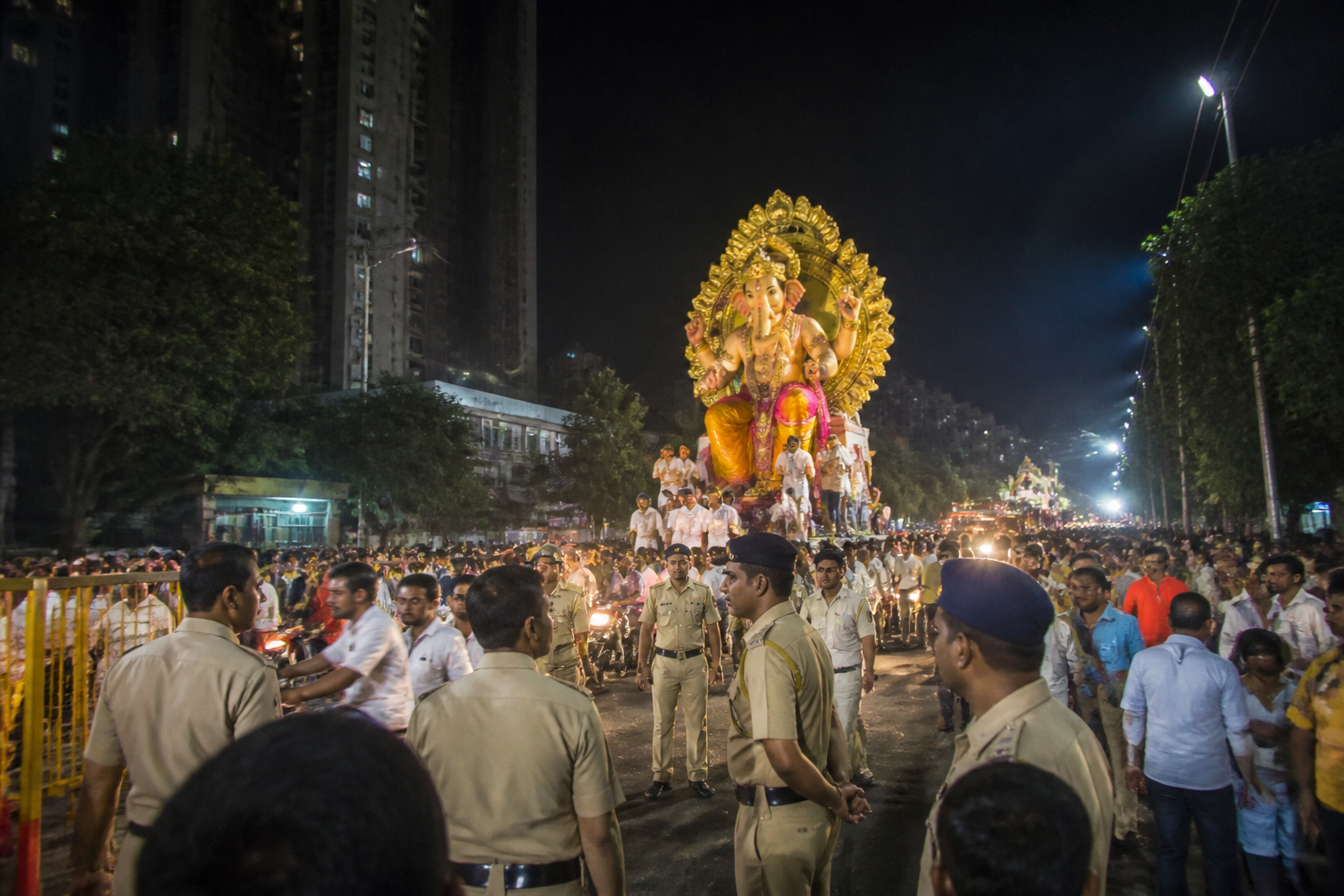
A Rs 1,000 fine imposed on the president of a Pimpri-Chinchwad Ganesh mandal for using high-intensity laser lights during an immersion procession has brought a recurring urban safety problem into focus: a rule may exist, police may intervene and a case may reach court, yet the deterrent effect can remain limited.
The incident took place during the Ganesh immersion procession in Pimple Gurav on September 4, 2025. According to the Sangvi police, officers found harmful laser beam lights being used by Bhairavnath Mitra Mandal and told its president, Gopi Lokhande, to stop. Police said the lights continued during the procession from 8.30 pm to 11.45 pm. An FIR was lodged the following day, and a chargesheet was later filed in court.
Lokhande pleaded guilty before the court. On November 19, 2025, Judicial Magistrate First Class S N Gavali in Pimpri convicted him under the provisions cited in the report and imposed a punishment of two days’ imprisonment or a fine of Rs 1,000. The court said it had taken a lenient view because the accused had voluntarily pleaded guilty and expressed regret. Police said he completed the punishment by paying the fine.
The case matters beyond the individual mandal because it shows how a public-event safety rule moves through the urban enforcement system. The restriction was not merely an advisory issued after the procession. Police said the mandal president had already been informed that laser beam lights were prohibited under provisions of the Bharatiya Nagarik Suraksha Sanhita. The reported sequence therefore involved a known restriction, a police intervention, continued use of the lights, a criminal case, a guilty plea and a low financial penalty.
That sequence raises a practical governance question: what happens when the cost of violating a safety order is small compared with the visibility and spectacle associated with a large procession? The supplied report does not establish how mandals assess such penalties or whether the fine changed practices afterwards. It does, however, document the gap between identifying a prohibited activity and creating a consequence strong enough to prevent it from continuing during the same event.
## A recurring safety concern in public space
Ganesh processions temporarily transform roads, neighbourhood streets and public spaces into high-density gathering areas. They involve moving crowds, amplified sound, temporary lighting, traffic diversions and extended operating hours. In such settings, the safety impact of a laser beam is not confined to the person operating the equipment. It can affect participants, bystanders, drivers and, in some locations, aircraft operations.
The report says citizens have raised concerns over sound pollution and high-intensity laser lights for several years. It also records complaints of vision problems linked to laser exposure. In October 2023, 23-year-old Aniket Shigvan said he had lost about 70 per cent of his vision after exposure to high-frequency laser lights during a Ganesh mandal procession. Shigvan sought a ban and spoke at a press conference with Pune-based ophthalmologist and retina specialist Dr Anil Dudhabhate.
Dudhabhate said that directly looking at a 5 MW laser for 10 seconds could cause retinal haemorrhage. The report attributes that warning to the doctor and cites Shigvan’s experience as an example of the potential harm. The material supplied does not independently establish the cause or medical outcome of Shigvan’s vision loss, but it shows that the issue had entered public discussion well before the Pimpri-Chinchwad case.
The danger also has an aviation dimension. Police periodically issue orders prohibiting high-intensity light beams within a 15-kilometre radius of Pune International Airport at Lohegaon, because such beams may create risks during aircraft landing and take-off. That turns what might otherwise be treated as a local event-management issue into a coordination problem involving police, procession organisers, public safety authorities and airport operations.
## The enforcement chain is the real story
The Pimpri-Chinchwad case provides a clear view of the enforcement chain, but it also shows where the chain can become weak. The first step was the prohibition of high-powered laser beams during the immersion procession. The second was communication of that restriction to the mandal president. The third was police detection during the event. The fourth was registration of an FIR and filing of a chargesheet. The final step described in the report was conviction following a guilty plea and payment of the fine.
Each stage has a different institutional function. A police order establishes the immediate restriction. Police personnel are responsible for monitoring compliance and recording violations. The court determines the consequence after the case is presented. The amount and form of punishment are therefore not decided by the police alone. The reported fine reflects the court’s stated decision to take a lenient view after the guilty plea.
This distinction is important in assessing accountability. The report identifies the incident as the first case in the Pimpri-Chinchwad Police Commissionerate in which a court punished a Ganesh mandal president for illegal use of high-intensity beam lights. That may indicate that enforcement was previously uncommon, or that such cases rarely reached the stage of punishment. The supplied material does not provide enough evidence to distinguish between those possibilities.
It does show that enforcement is often event-specific. The restriction is applied during a particular procession, within a particular jurisdiction and through personnel deployed for that occasion. The report does not mention a wider compliance system involving equipment registration, pre-event inspections, penalties for organisers, seizure of prohibited devices or published records of violations. Those measures may or may not exist; they cannot be assumed from the available evidence. Their absence from the report nevertheless underlines how little is publicly visible about the routine administration of the ban.
## From public order to urban risk management
The central policy challenge is that large religious processions are both cultural events and temporary urban operations. They require road management, crowd control, noise regulation, emergency access and coordination with nearby infrastructure. Lighting is part of the event environment, but high-intensity beams create a distinct risk because they can affect vision and aviation activity beyond the immediate procession route.
A ban under the Bharatiya Nagarik Suraksha Sanhita, as cited by police in the report, provides the legal basis for action. But a legal restriction is only one part of risk management. Its effectiveness depends on whether organisers understand the rule before the event, whether officers can identify prohibited equipment quickly, whether violations are documented and whether the eventual consequence is sufficiently clear to influence behaviour.
The Pimpri-Chinchwad episode also illustrates the difference between enforcement visibility and enforcement certainty. Police detected the lights and told the organiser to stop, according to the report. The lights allegedly continued for several hours. A case was then registered and prosecuted. Yet the final penalty was Rs 1,000. The court’s order records the reason for leniency, and the report does not suggest that the court ignored the guilty plea or acted outside the process described. The institutional question is instead whether a low and predictable penalty can support the preventive purpose of a safety order.
That question is particularly relevant when public authorities regulate activities that take place in crowded, temporary settings. A procession can last only a few hours, while a legal case may continue for months. If the immediate event has already ended, later punishment may have limited value for those who were exposed during it. Prevention therefore depends heavily on what happens before and during the procession, not only on the eventual court outcome.
## What the evidence confirms—and what it does not
The available evidence confirms that police had prohibited high-intensity laser beam lights during the immersion procession, that the restriction had been communicated to the mandal president, that police reported continued use during the event, and that the court later convicted the accused after a guilty plea. It also confirms that police officials described the case as the first of its kind in their Pimpri-Chinchwad jurisdiction.
The evidence establishes a documented public-safety concern involving vision and possible aviation risk. It does not provide a city-wide count of laser-related injuries, a complete record of prosecutions, the number of mandals inspected, or comparative data on compliance before and after the case. It also does not establish whether the Rs 1,000 fine was typical for similar offences or whether any appeal, administrative review or subsequent enforcement action followed.
Those limits matter because one prosecution cannot by itself demonstrate that the ban is broadly ineffective. Nor can it show that every procession using such lights creates the same level of danger. What it does provide is a specific example of the administrative pathway from prohibition to enforcement, together with a record of the modest final penalty.
The larger urban issue is therefore not simply whether laser lights should be used at processions. The reported case shows that public-space safety depends on the interaction of event organisers, police orders, frontline monitoring, courts and other authorities whose operations may be affected by temporary events. The system is strongest when those roles are clear before the crowd gathers and weakest when enforcement begins only after a violation has already continued for hours.
For Pune and Pimpri-Chinchwad, the next useful measure of the policy will be whether future immersion processions produce fewer violations, more consistent enforcement records or additional court cases. The available report records one conviction and the official concerns behind the ban. It does not yet establish whether that conviction has changed the way high-intensity lighting is managed across the city’s public processions.
